How To Choose A Fume Extractor Filter: Choose The Right One
Choose a fume extractor filter by identifying the contaminants your process creates, then selecting media designed to capture those specific particles or gases. A particle filter such as a HEPA filter does not remove most gases, while activated carbon does not reliably capture every type of vapor. Many applications need a combination of filter stages.
Start with the process and materials involved, not just the extractor’s brand or the filter’s label. The right choice also depends on the extractor’s airflow, the filter’s compatibility with the unit, and whether the filtered air will be returned to the room or exhausted outside.
Identify What the Process Releases
“Fume” can refer to airborne particles, gases, vapors, or a mixture. For example, heating a material may release fine particles along with chemical vapors. The material, temperature, additives, coatings, and work method can all affect what enters the air.
Check the material’s safety data sheet (SDS) and process guidance for the substances that may be released. If the emissions are unclear or potentially hazardous, consult a qualified safety professional rather than choosing a filter based on odor or appearance.
Common contaminant categories include:
- Particles: Dust, smoke, and fine aerosols that can be captured by appropriately rated particulate media.
- Gases and vapors: Chemical substances in gas form that may require activated carbon or another specifically selected gas-phase medium.
- Mixed contaminants: Processes that produce both particles and vapors, often requiring multiple filter stages.
An extractor filter is only part of exposure control. The hood or nozzle must capture emissions close to their source, and the equipment must provide suitable airflow for the application.
This Guide May Help You More: Do I Need Helping Hands for Soldering
Match the Filter Type to the Contaminant
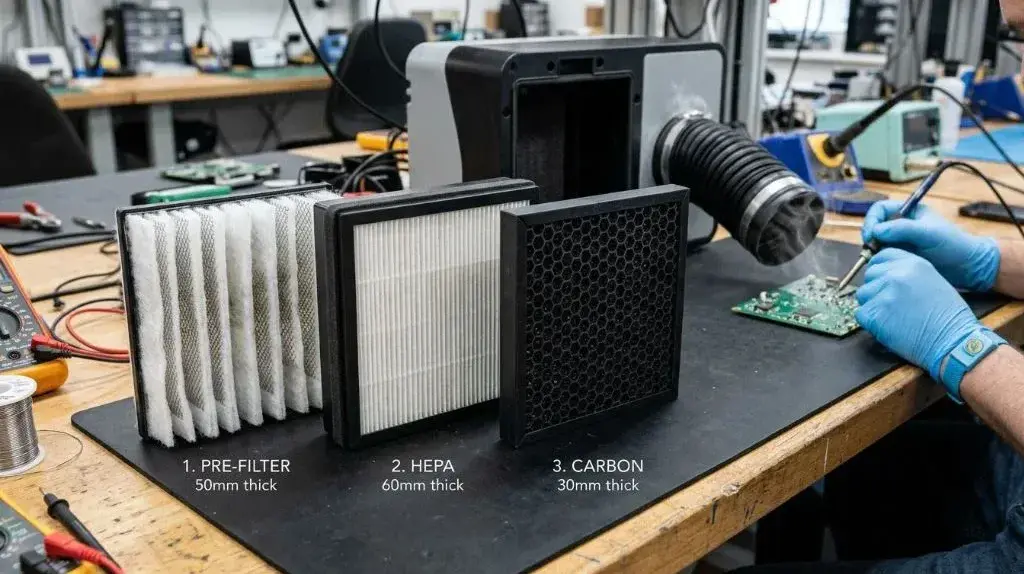
Most fume extractors use one or more filter stages. A staged setup may use a prefilter to catch larger debris, a fine-particle filter for smaller airborne material, and a gas-phase filter for certain vapors. The exact arrangement varies by extractor.
| Filter type | Designed to capture | Main limitation |
|---|---|---|
| Prefilter | Larger dust and debris | Does not provide fine-particle or gas removal on its own |
| Fine-particle or HEPA filter | Airborne particles, subject to its rating and proper installation | Does not remove most gases or vapors |
| Activated carbon or other gas-phase media | Certain gases and vapors, depending on the media and contaminant | Capacity and effectiveness vary; it does not replace particle filtration |
Particle filters
Particle filters capture airborne material as air passes through the filter media. A HEPA filter is a high-efficiency particulate filter, but its rating does not mean it removes gases. A particle filter also needs an intact seal: air that bypasses the media can carry contaminants through the unit untreated.
For a process that produces smoke or fine particulate, check the filter’s stated particle performance and confirm that the extractor is designed to use it. Do not assume that any filter described as “fine” or “high efficiency” is equivalent to a HEPA filter.
Gas-phase filters
Activated carbon is commonly used to adsorb certain gases and vapors. Adsorption means contaminants collect on the surface of the filter media. Some applications use treated or specialized media because ordinary carbon may not be suitable for every substance.
Gas-filter performance depends on the contaminant, media type and amount, airflow, humidity, and operating conditions. A filter that reduces one odor may be ineffective against a different gas. Odor reduction is not proof that the air is safe.
Combination filters
When a process creates both particles and vapors, the extractor may need both particle and gas-phase filtration. Use the filter configuration specified for the unit and application. A particle filter cannot make up for an unsuitable gas filter, and adding carbon does not ensure that fine particles are controlled.
Check Compatibility With the Extractor
A filter must fit the extractor and work within its airflow design. Before selecting a replacement or an upgraded filter, verify:
- The extractor model and approved filter type
- Filter dimensions, mounting method, and orientation
- Whether the filter set includes all required stages
- The unit’s recommended airflow or operating range
- Any application-specific limits from the manufacturer
A filter that physically fits may still be unsuitable. Dense or additional media can increase resistance to airflow, reducing the amount of air the extractor can pull through the hood. Follow the manufacturer’s configuration rather than adding extra filters without approval.
Check that the filter seats correctly and that seals are intact. Gaps around the filter can allow air to bypass the media, undermining filtration even if the filter itself is appropriate.
Consider Airflow and Source Capture
Filter selection and capture performance go together. An appropriate filter cannot remove emissions that escape past the hood or nozzle. Position the capture point close to the source, and use the extractor at the airflow setting recommended for the setup.
After installing a filter, check that the extractor still draws effectively at the work area. A loaded or overly restrictive filter can reduce airflow. If capture seems weak, inspect the filter condition, ducting, connections, and hood position according to the equipment instructions.
Do not judge an extractor only by the airflow rating printed in product materials. The delivered airflow can depend on the filter, ducting, hose length, bends, and other system resistance.
Estimate Filter Life and Plan Replacement
Filter life varies with the process, contaminant load, operating time, humidity, airflow, and filter design. A fixed replacement interval may not apply to every setup. Follow the extractor and filter manufacturer’s maintenance guidance, and use any specified inspection or replacement indicators.
Pay attention to more than one sign:
- A pressure or airflow indicator shows that a filter may be obstructed or loaded with particles.
- Visible dust buildup or a noticeable drop in capture can signal a problem.
- A timer may track service intervals, but it does not necessarily measure remaining gas-filter capacity.
- Odor breakthrough may indicate that gas-phase media is no longer controlling an odor, but the absence of odor does not prove that the media is still effective.
Particle-filter loading and gas-filter exhaustion are different issues. A pressure reading may help identify airflow restriction, but it may not show whether a gas-phase filter has reached its capacity. Use the monitoring method specified for the filter and contaminant.
Replace filters with the correct type and rating for the application. Handle and dispose of used media according to the contaminant involved and local requirements; contaminated filters may need special handling.
Avoid Common Filter-Selection Mistakes
A few assumptions can lead to inadequate filtration:
- Choosing by odor alone: Some hazardous substances have little or no useful warning odor, while some noticeable smells may not indicate the full exposure risk.
- Assuming HEPA means gas removal: HEPA filtration targets particles, not most gases and vapors.
- Assuming carbon removes every chemical: Carbon type and capacity matter, and some substances require different media or other controls.
- Ignoring filter loading: A clogged filter can reduce airflow and weaken source capture.
- Using an unapproved filter combination: Extra or incompatible media can alter airflow or fail to seal properly.
- Treating recirculation as a substitute for ventilation: Returning filtered air to a room is appropriate only when the filtration system and application have been assessed for that use.
A Practical Selection Sequence
Use this sequence to narrow down the right filter:
- List the materials and process conditions. Include coatings, fluxes, solvents, additives, and other substances that may affect emissions.
- Identify the expected contaminants. Determine whether the process releases particles, gases or vapors, or both. Consult the SDS and relevant process guidance.
- Choose media intended for those contaminants. Confirm the particle-filter rating or the gas-phase media specification rather than relying on broad labels.
- Confirm extractor compatibility. Check the model, filter stages, fit, seals, and airflow requirements.
- Plan monitoring and replacement. Find out how to recognize particle loading and how the manufacturer advises tracking gas-filter service life.
- Assess the complete control setup. Confirm that the hood captures emissions at the source and that any recirculation or exhaust arrangement is suitable for the application.
If the emissions are hazardous, poorly characterized, or produced in a process with strict exposure limits, get professional guidance before relying on a portable extractor filter as the primary control.
FAQs About How To Choose A Fume Extractor Filter
Can a HEPA filter remove fumes?
A HEPA filter can capture airborne particles when properly selected and installed, but it does not remove most gases or vapors. If a process produces both, the extractor may need separate gas-phase media as well as particle filtration.
Does activated carbon remove all odors and vapors?
No. Activated carbon can capture certain gases and vapors, but its effectiveness depends on the contaminant and the media. Some substances require treated or specialized media, and odor reduction alone does not confirm that a filter is suitable or that the air is safe.
How do I know when a fume extractor filter needs replacement?
Follow the manufacturer’s instructions and use the monitoring method designed for the filter. A pressure or airflow indicator can help identify particle loading, but it may not show when gas-phase media is exhausted. Do not rely on smell alone.
Can I add a higher-rated filter to improve an extractor?
Not without confirming compatibility. A filter with greater resistance can reduce airflow, and an unapproved filter may not fit or seal correctly. Use the filter configuration recommended for the extractor and application.
Is filtered air safe to return to the room?
That depends on the contaminants, filter system, operating condition, and applicable workplace requirements. Recirculation should not be assumed safe just because the air passes through a filter. Seek qualified guidance when the substances or exposure risks are uncertain.
Final Takeaway
Choose a fume extractor filter based on the contaminants the process actually produces: particle media for particles, suitable gas-phase media for specified vapors, and a compatible combination when both are present. Then verify fit, seals, airflow, and replacement guidance. If the emissions or risks are uncertain, identify them before relying on filtration.

Scott Yarnell is a tool expert focused on practical guides, product research, and real-world tool performance to help readers make informed decisions.