ESD Soldering Mat: What It Is and If You Need One
An ESD soldering mat is a work surface designed to reduce the risk of electrostatic discharge damaging sensitive electronic components during soldering or repair. Some models also resist heat, but not every ESD mat is made to withstand contact with a hot soldering iron.
You may need one if you regularly handle static-sensitive parts, such as circuit boards, microcontrollers, or computer components. The right choice depends on both the components you work on and the mat’s stated electrical and heat-resistance properties.
What an ESD Soldering Mat Does
ESD stands for electrostatic discharge: the sudden movement of static electricity from one object to another. A small discharge may be too weak to feel but can still damage or weaken sensitive electronic components.
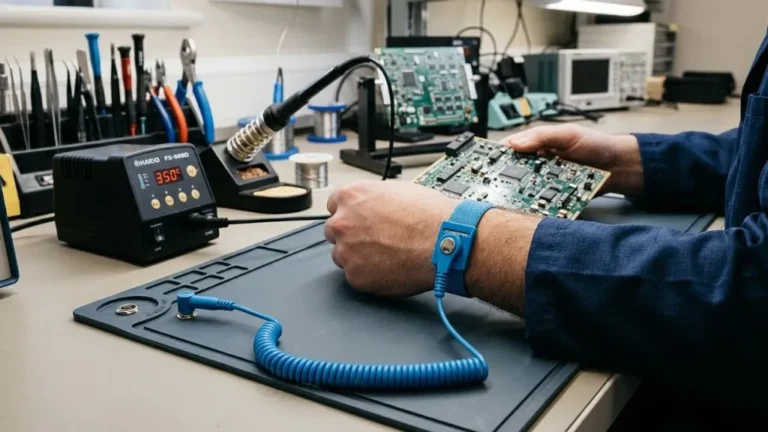
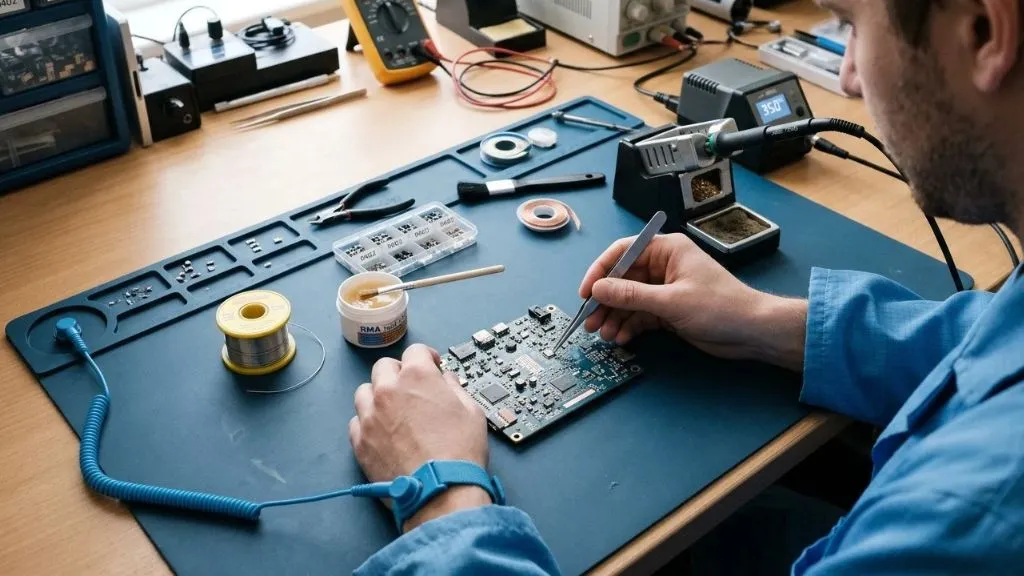
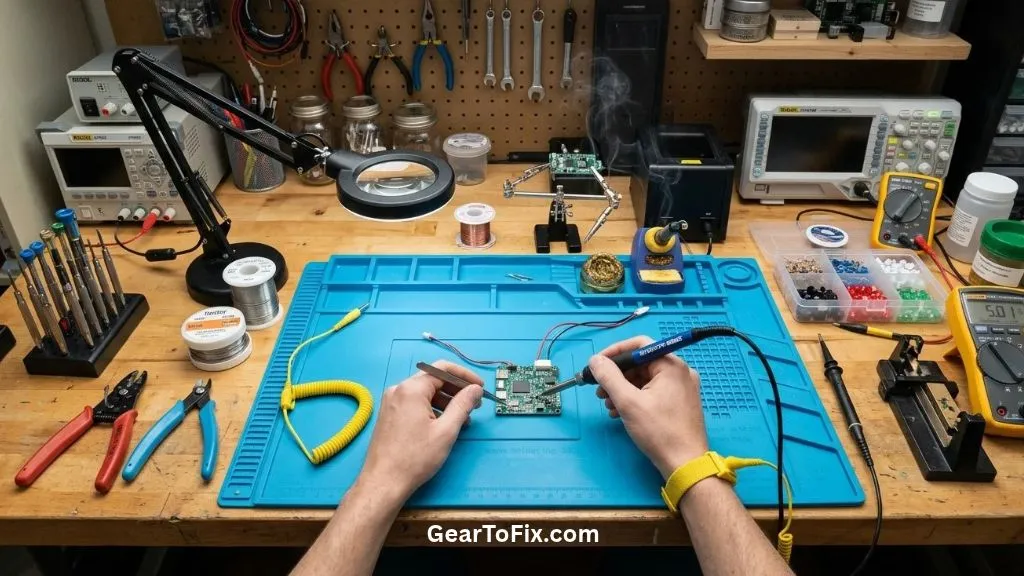
An ESD mat provides a controlled surface that helps dissipate static charge rather than letting it build up and discharge unpredictably. It is usually connected to a grounding point through a mat cord. In a complete ESD setup, other items—such as a wrist strap—may connect to the same designated grounding system.
The mat is not a shield that blocks all electricity, and it does not make a workspace automatically safe for working on powered equipment. It is one part of a system for controlling static around sensitive electronics.
ESD Mat vs. Heat-Resistant Soldering Mat
The terms describe different properties:
- ESD or antistatic mat: Designed to help control static charge.
- Heat-resistant soldering mat: Designed to tolerate heat from soldering work within the limits stated by its manufacturer.
- ESD soldering mat: Intended to provide both static control and a suitable surface for soldering, but its heat resistance still depends on the specific product.
Some silicone soldering mats can tolerate brief contact with hot tools, while some ESD work surfaces are not intended for direct contact with a soldering iron. Check the product specifications rather than assuming that “ESD” means “heatproof,” or that a heat-resistant silicone mat controls static.
A mat’s compartments and texture are also separate features. They may help keep screws and parts organized, but they do not establish that the surface is ESD-safe.
Do You Need an ESD Soldering Mat?
You are more likely to benefit from one if you work on electronics containing static-sensitive components, particularly when you handle circuit boards or parts outside their protective packaging. It can provide a defined work surface and help reduce one source of ESD risk.
An ESD mat may be less necessary for occasional soldering on simple, relatively robust wiring or connectors. Even then, it can help protect the bench from solder and heat if it is designed for those conditions. For ESD-sensitive work, a suitable mat is useful, but it does not replace careful handling or other grounding measures.
| Your work | Is an ESD soldering mat useful? |
|---|---|
| Repairing circuit boards or handling exposed electronic components | Often useful as part of an ESD-control setup |
| Soldering simple wires or robust connectors occasionally | May be optional, depending on the work surface and parts |
| Soldering on a powered circuit | A mat does not make this safe; disconnect power when appropriate and follow safe procedures |
| Protecting a bench from heat and solder | Only if the mat is specifically rated for the heat involved |
What to Check Before Using One
Confirm both ESD and heat properties
Look for clear information showing that the mat is intended for ESD work and that it can tolerate the heat conditions expected during soldering. A manufacturer’s stated rating and care instructions are more useful than a general label such as “anti-static” or “silicone.”
Do not rest a hot iron on the mat unless the product instructions allow it. Use an appropriate iron stand, and avoid prolonged or concentrated heat that could damage the surface.
Check the grounding method
An ESD mat generally needs to be connected as directed by its manufacturer to a designated grounding point. If you also use a wrist strap, follow the instructions for connecting it to the same ESD grounding system.
Do not improvise a connection to a mains outlet or assume that any nearby metal object is a suitable ground. If you are unsure how the grounding point should be installed or verified, consult the mat’s instructions or a qualified person.
Consider the parts and workspace
Choose a mat large enough for the work area you need. If you handle components that must remain static-protected when not in use, use suitable protective packaging or containers; the mat alone does not protect parts stored elsewhere.
Keep the surface clean using only cleaning methods recommended by the manufacturer. Some cleaners or solvents may damage the mat or affect its performance.
What an ESD Mat Cannot Do
An ESD mat reduces one potential source of damage; it does not guarantee that a component will never be harmed by static. Handling practices, grounding, clothing, humidity, and other nearby materials can also affect static control.
It also does not:
- Protect you from electric shock when working on energized equipment
- Make every tool, component, or nearby surface ESD-safe
- Automatically ground a wrist strap or other equipment
- Guarantee protection if it is damaged, incorrectly connected, or used outside its instructions
- Provide heat protection unless the product is designed and rated for it
For sensitive electronics, treat the mat as one part of a broader ESD-control routine: follow handling guidance, use compatible grounding equipment, and keep vulnerable components in appropriate protective packaging when they are not being worked on.
Common Mistakes to Avoid
- Assuming every soldering mat is ESD-safe: A heat-resistant mat may not control static.
- Assuming every ESD mat is heat-resistant: Check the manufacturer’s instructions before placing hot tools on it.
- Using the mat without its specified grounding connection: A mat’s intended performance depends on being installed as directed.
- Treating the mat as electrical shock protection: It is for static control, not a safety barrier for live circuits.
- Ignoring the rest of the setup: A grounded mat cannot compensate for careless handling or unsuitable component storage.
FQAs Of ESD Soldering Mat
Is an ESD mat the same as an anti-static mat?
The terms are sometimes used loosely, so check the product’s specifications. A properly designated ESD work surface is intended to control static charge in a planned way. A product described only as “anti-static” may not provide enough information to confirm how it should be used or grounded.
Does an ESD mat need to be grounded?
Many ESD mats are designed to connect to a designated grounding point, but the correct method depends on the product and the ESD setup. Follow the manufacturer’s instructions rather than attaching the cord to an improvised ground.
Can I put a hot soldering iron on an ESD mat?
Only if the mat’s instructions say it can tolerate that use. Even a heat-resistant mat may be damaged by prolonged or concentrated heat, so use an iron stand and avoid direct contact unless the manufacturer permits it.
Does an ESD mat protect components on its own?
No. It helps control static at the work surface, but it does not eliminate every source of ESD risk. Grounding, handling, storage, and the surrounding workspace also matter.
Can I use a silicone soldering mat for ESD work?
Not necessarily. Silicone may provide heat resistance, but that does not automatically mean the mat controls static. Confirm that the specific product is intended for ESD use and follow its setup instructions.
Final Verdict
An ESD soldering mat is useful when you handle static-sensitive electronics because it helps control charge at the work surface. You do not necessarily need one for every basic soldering task, but if you choose one, verify that it is both suitable for ESD work and rated for the heat it may encounter. A mat is one part of static-control practice—not a substitute for proper grounding, safe handling, or electrical precautions.

Scott Yarnell is a tool expert focused on practical guides, product research, and real-world tool performance to help readers make informed decisions.