How Does a Solder Fume Extractor Work: A Simple Guide
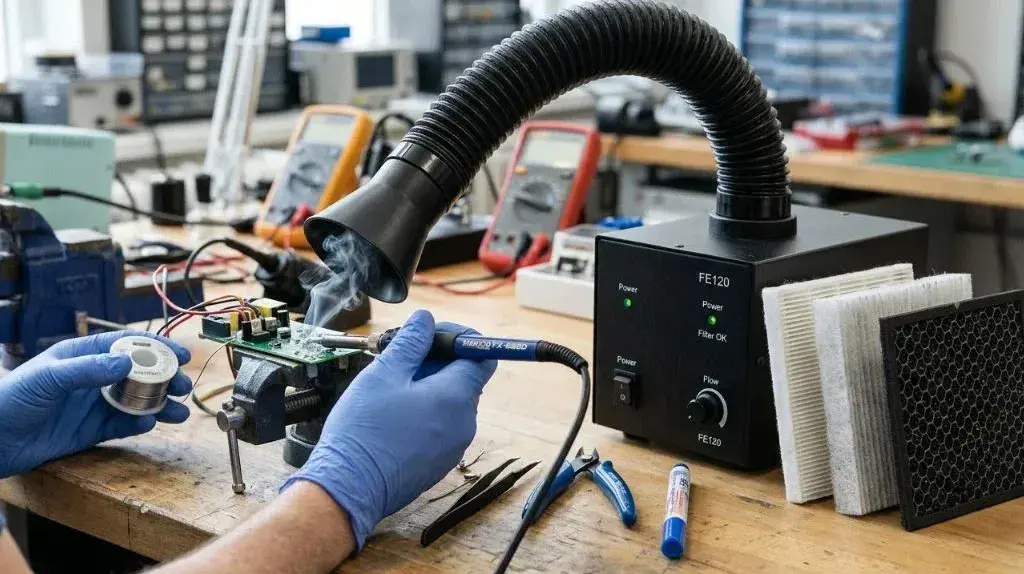
A solder fume extractor uses a fan to pull smoke and airborne particles away from the soldering area, then passes the air through filters. Depending on the unit, those filters may capture particles, adsorb some gases and odors, or do both before the air is returned to the room or vented elsewhere.
Most soldering fumes come from flux heated during soldering, not from solder simply turning into vapor. An extractor works best when its intake is close to the soldering point, so it captures fumes before they spread into the breathing zone.
How a solder fume extractor captures fumes
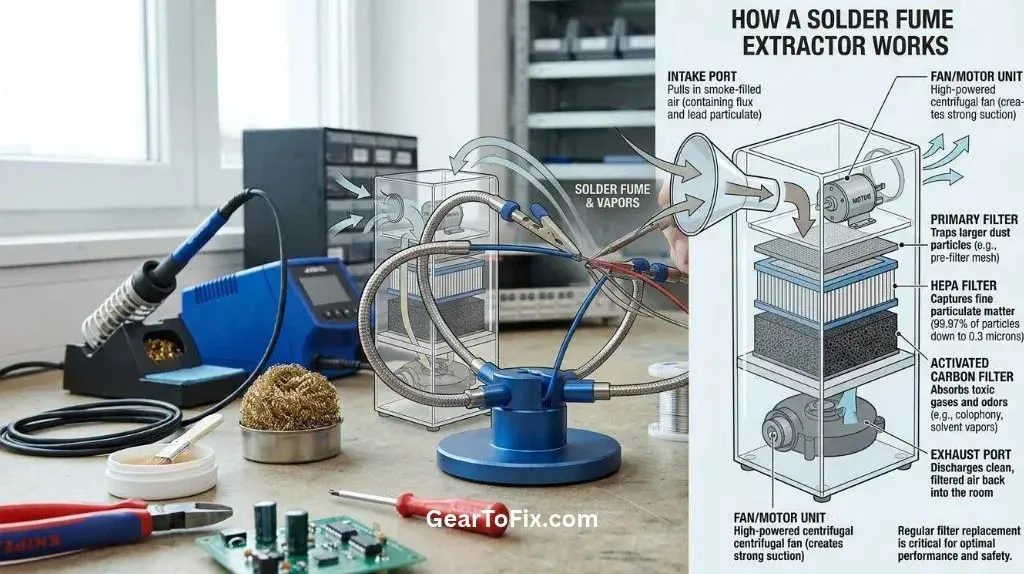
A typical unit moves air through three basic stages:
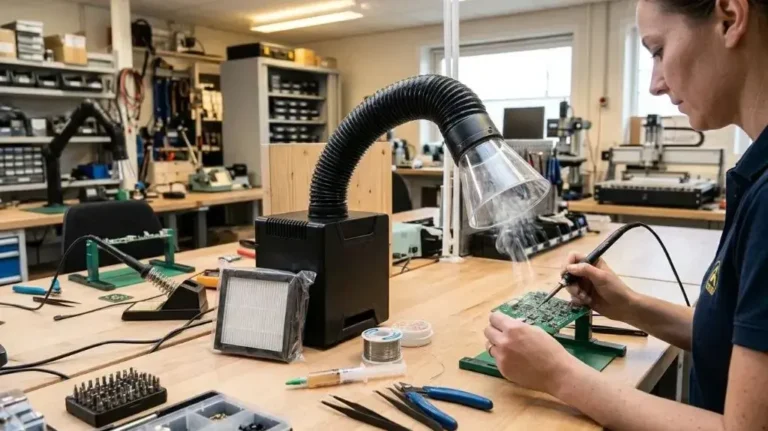
- The intake collects contaminated air. A fan creates airflow toward a hood, nozzle, or intake grille positioned near the work.
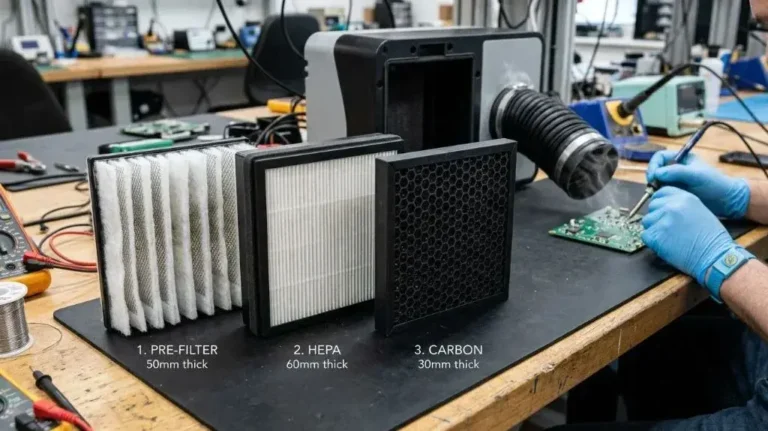
- Filters remove contaminants. A prefilter may catch larger particles, while finer filtration captures smaller airborne particles. Some units also use activated carbon to reduce certain gases and odors.
- The air is returned or exhausted. A recirculating extractor sends filtered air back into the room. An externally vented system sends it through ducting to another location.
The exact filter arrangement varies by model. A compact desktop unit may have a simple filter pack, while a larger system may use separate filter stages and a flexible extraction arm.
What a solder fume extractor filters out
Soldering smoke is a mixture, and its makeup depends on the flux, soldering materials, temperature, and process. It can include airborne particles and gases released as flux heats up.
Different filters handle different contaminants:
- Particle filters trap airborne droplets and particles. A finer filter can capture smaller particles, but its effectiveness depends on the filter design and how well it is fitted.
- Activated carbon adsorbs some gases and odor-causing compounds. Adsorption means that substances attach to the carbon’s surface.
- Prefilters catch larger debris and help protect finer filters from loading too quickly.
No single filter should be assumed to remove every substance in soldering fumes. Particle filtration does not automatically remove gases, and carbon does not capture every gas or remain effective indefinitely. Check the extractor’s documentation to see what its filter is designed to handle.
Are solder fumes the same as lead vapor?
Not generally. At typical soldering temperatures, the visible smoke is mainly associated with heated flux. Lead in solder is not usually the main source of the visible fumes under ordinary soldering conditions. However, lead-containing materials can still create exposure risks through contaminated dust, residues, or hand-to-mouth transfer. Good ventilation and handwashing remain important when working with leaded solder.
Why the intake needs to be close to the soldering point
An extractor does not clean the air equally well throughout a room. It needs to capture the plume near its source. Once fumes disperse, the unit has to pull in a much larger volume of room air to collect them.
Position the intake so fumes travel into it without blocking your view or interfering with the work. If the intake is too far away, or airflow is weak, smoke may pass your face before reaching the filter. A visible stream of smoke being drawn toward the intake can help you judge placement, but it does not prove that every contaminant is being captured.
What affects extractor performance?
A unit’s practical performance depends on more than its filter. Consider these factors:
- Airflow: The fan must move enough air to draw fumes into the intake. A clogged filter can reduce airflow.
- Working distance: Capture generally improves when the intake is positioned near the source, within the limits specified by the manufacturer.
- Hood or nozzle design: The shape and size of the intake affect how air is drawn in.
- Filter condition: Loaded, damaged, or poorly seated filters may reduce performance.
- Air movement in the room: Fans, open windows, and strong ventilation currents can push fumes away from the intake.
- The work itself: Larger or longer soldering tasks may produce more fumes than brief, occasional work.
A higher fan setting may increase airflow, but it can also be noisier or disturb lightweight parts. Use a setting that captures the fumes without making the work difficult.
Recirculating and externally vented extractors
Some extractors filter air and return it to the room. Others connect to ducting and discharge air outside or into a suitable extraction system.
| Type | How it handles air | Main consideration |
|---|---|---|
| Recirculating | Filters air, then returns it to the workspace | Depends on suitable, maintained filters and does not remove contaminants from the building |
| Externally vented | Moves captured air through ducting to another location | Requires appropriate ducting and a safe, practical discharge point |
A recirculating unit’s performance depends on the filters being appropriate for the fumes and replaced as directed. Venting outdoors can remove captured air from the room, but the setup must be suitable for the location and must not direct exhaust toward people or air intakes.
How to use one effectively
- Place the intake near the solder joint. Keep it close enough to capture rising fumes while leaving room to work.
- Aim the airflow through the intake. Avoid positioning it so the plume passes across your face first.
- Turn the unit on before soldering. This establishes airflow at the work area.
- Check that fumes move toward the intake. If they drift away, adjust the hood or work position.
- Maintain the filters. Inspect and replace them according to the manufacturer’s instructions.
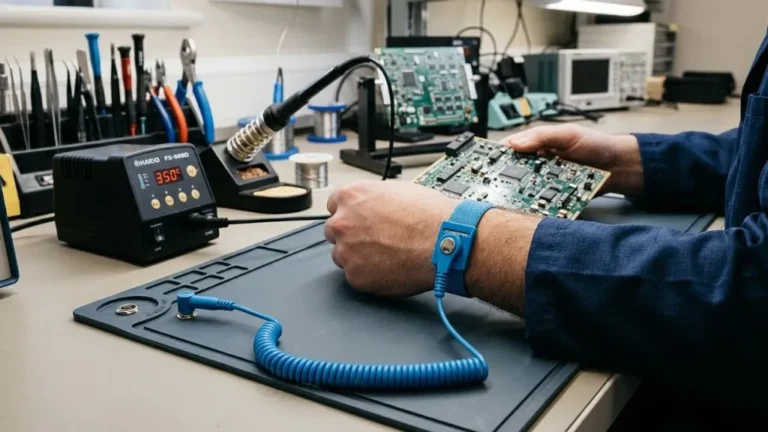
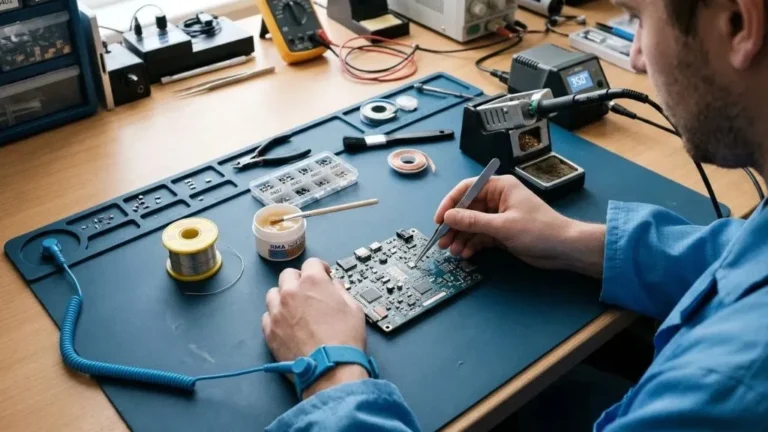
- Keep using good workshop practices. An extractor is one part of exposure control, not a reason to deliberately breathe fumes or ignore other precautions.
Limitations and common mistakes
A solder fume extractor can reduce exposure to airborne contaminants, but it is not a guarantee that the air is completely clean. Its protection depends on capture, airflow, filter suitability, and maintenance.
Common mistakes include:
- Placing the intake too far away: Fumes may disperse before reaching it.
- Assuming every filter handles every contaminant: Particle filters and gas-adsorbing media perform different jobs.
- Ignoring a loaded filter: Reduced airflow can weaken capture even if the fan is running.
- Treating odor removal as proof of safety: Less smell does not necessarily mean all harmful contaminants have been removed.
- Relying on extraction instead of hygiene: Wash hands after handling solder and clean contaminated work surfaces appropriately.
If fumes are not being drawn in, check the intake position, airflow setting, filter condition, and room drafts. Follow the unit’s instructions for filter changes; do not wash or reuse a filter unless its manufacturer specifically allows it.
FAQs About How Does a Solder Fume Extractor Work
Does a solder fume extractor remove all solder fumes?
No. It can capture airborne contaminants when properly positioned and maintained, but no general-purpose unit should be assumed to remove every particle and gas. Check the filter specifications and use suitable ventilation for the work.
Does a solder fume extractor need a HEPA filter?
Not every extractor uses one. A HEPA-type filter is designed for fine particles, while gases and odors require different filter media, such as activated carbon. The appropriate filter depends on the unit and the contaminants it is intended to capture.
How close should the extractor be to the soldering iron?
Keep the intake near the soldering point, following the manufacturer’s guidance, while leaving enough space to work safely. If the fumes drift past your face before being captured, reposition the intake.
How often should extractor filters be replaced?
There is no universal replacement interval. It depends on the filter type, use, and amount of contamination. Follow the manufacturer’s instructions and check for reduced airflow or other replacement indicators.
Is a solder fume extractor the same as a room fan?
No. A room fan moves air but may spread fumes around rather than capture them. A fume extractor is designed to draw contaminated air toward an intake and pass it through filters or ducting.
Conclusion
A solder fume extractor works by drawing fumes into a nearby intake, filtering or venting the air, and reducing how much smoke spreads through the work area. Keep the intake close to the solder joint, use filters suited to the contaminants, and maintain them as directed. It is a useful control, but it does not replace proper ventilation and careful handling of soldering materials.

Scott Yarnell is a tool expert focused on practical guides, product research, and real-world tool performance to help readers make informed decisions.