What Is Aluminum Solder Wire: Uses, Tips & Guide
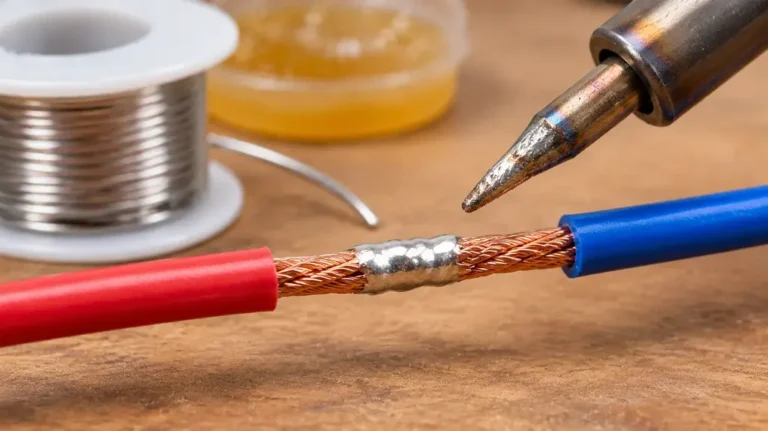
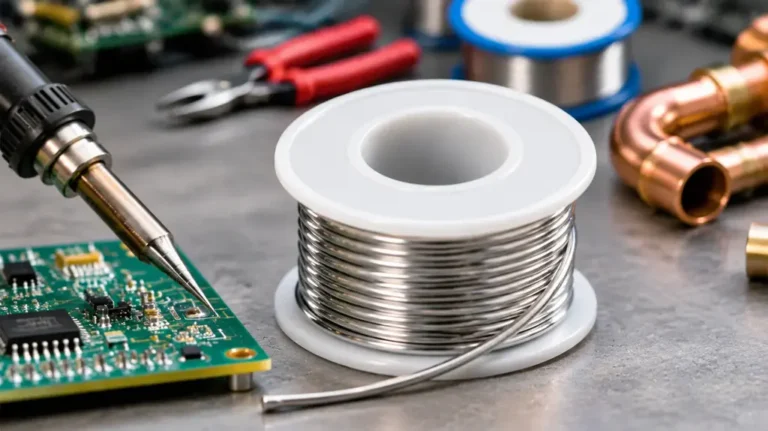
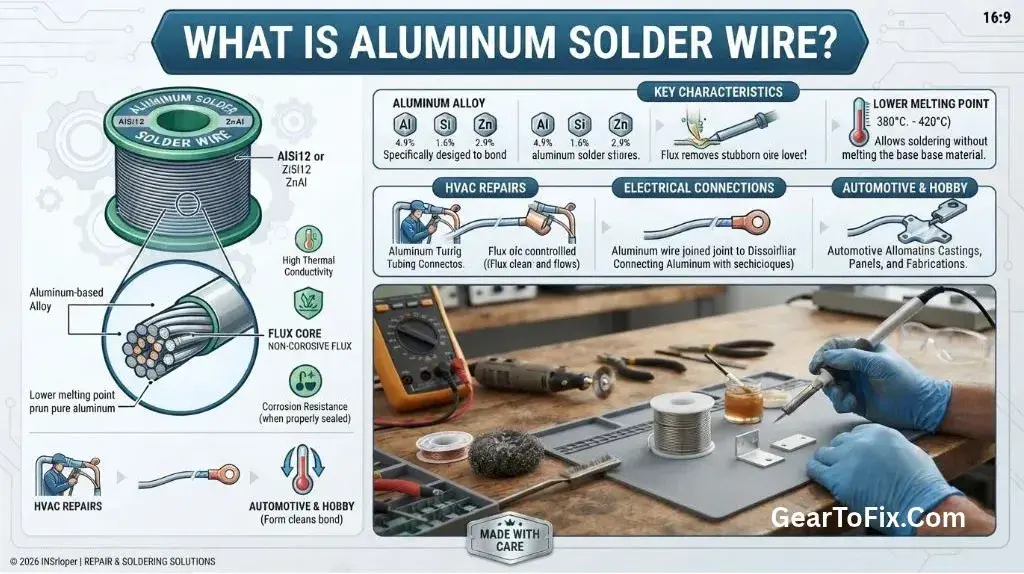
Aluminum solder wire is a filler-metal wire designed to join aluminum surfaces using heat below the melting point of the base metal. It is used for certain repairs and low-stress connections where conventional solder does not bond well to aluminum.
The name can be confusing because “aluminum solder wire” does not always mean the wire itself is made mostly of aluminum. Depending on the product, it may contain aluminum, zinc, tin, or other metals selected to improve bonding with aluminum surfaces. Its performance also depends heavily on the accompanying flux, surface preparation, joint design, and heat source.
This guide explains how aluminum solder wire works, where it is useful, how it differs from ordinary solder, and what limitations to understand before using it.
How Aluminum Solder Wire Works
Aluminum solder wire melts and flows into a prepared joint while the aluminum parts remain solid. After the filler metal cools, it forms a bond between the surfaces.
The process sounds simple, but aluminum is difficult to solder because it quickly forms a thin oxide layer when exposed to air. Aluminum oxide is much harder to melt than the aluminum beneath it, and it can prevent solder from wetting and bonding to the surface.
Wetting describes how well molten solder spreads across a surface. If the solder beads up instead of spreading, the surface has not been properly prepared, the temperature is unsuitable, or the flux is not working effectively.
A typical aluminum soldering process requires:
- Cleaning away oil, dirt, paint, and corrosion
- Removing or disrupting the oxide layer
- Applying a flux intended for aluminum, when required
- Heating the joint evenly
- Feeding the solder wire into the heated joint
- Allowing the joint to cool without disturbing it
- Removing corrosive flux residue when the product instructions require it
The solder should melt because of heat transferred through the workpiece, not simply because the flame or iron is directly melting the wire away from the joint.
What Is Aluminum Solder Wire Made Of?
There is no single universal composition for aluminum solder wire. Different products use different filler-metal formulations for specific applications.
Some aluminum soldering wires use aluminum-containing alloys. Others use alloys based largely on zinc or tin, sometimes with additional metals intended to change melting behavior, strength, flow, or compatibility with aluminum.
The product label or technical data sheet should identify:
- Alloy composition
- Recommended base materials
- Melting or working range
- Whether flux is included
- Required flux type, if the wire is not self-fluxing
- Suitable joint thickness and applications
- Corrosion or cleaning requirements
- Any restrictions on electrical, structural, or pressure-containing use
A wire labeled for aluminum is not automatically suitable for every aluminum repair. Aluminum alloys differ in their composition and surface characteristics, and a filler that works for a small repair may not be appropriate for a highly stressed or sealed assembly.
Aluminum Solder Wire Versus Aluminum Wire
Aluminum wire may simply be a conductor, tie wire, welding wire, or material used for fabrication. Aluminum solder wire is specifically formulated to melt and bond during a soldering operation.
These products are not interchangeable. A length of ordinary aluminum wire will not necessarily behave like solder, and solder wire should not be selected as a substitute for structural aluminum welding wire.
Read More: What Is Copper Solder Wire
How Aluminum Solder Wire Differs From Ordinary Solder
Traditional electronics solder is commonly designed for copper, brass, tinned surfaces, and circuit-board components. It may not bond reliably to bare aluminum because of the oxide layer.
Aluminum solder wire is different in several practical ways:
| Feature | Aluminum solder wire | Conventional electronics solder |
|---|---|---|
| Intended surfaces | Aluminum and selected compatible metals | Copper, brass, tinned surfaces, and electronic components |
| Surface challenge | Must overcome aluminum oxide | Usually works with standard cleaning and flux methods |
| Flux requirement | Often requires specialized aluminum flux | May contain rosin or another electronics flux |
| Typical use | Repairs, low-stress joints, and selected metal connections | Wiring, circuit boards, and small electrical joints |
| Main limitation | Compatibility and joint strength vary widely | Not generally suitable for bare aluminum |
A general-purpose soldering iron and rosin-core solder may fail on aluminum even when the iron is hot enough. The problem is often not only temperature. The oxide layer and unsuitable flux can prevent the solder from contacting the clean aluminum surface.
Aluminum Soldering Wire Versus Aluminum Brazing Rod
Aluminum soldering and aluminum brazing are related but different processes.
The distinction is based mainly on the temperature used relative to the base metal. Soldering uses a lower-temperature filler, while brazing uses a filler that melts at a higher temperature but still below the melting point of the base metal.
Aluminum brazing rods are commonly selected when a stronger or more heat-resistant joint is needed. Aluminum solder wire may be more convenient for small repairs, thin material, or applications where lower heat input is desirable.
Neither process is automatically the right choice. The decision depends on:
- Required joint strength
- Operating temperature
- Joint size and design
- Aluminum alloy
- Access to the repair
- Exposure to vibration, pressure, moisture, or chemicals
- Whether the connection is structural or cosmetic
A soldered repair should not automatically be treated as a replacement for a welded or brazed joint.
Where Aluminum Solder Wire Is Used
Aluminum solder wire can be useful for selected repairs and connections, especially when the joint does not carry significant structural loads.
Possible applications include:
- Small holes or surface defects in suitable aluminum parts
- Low-stress repairs on thin aluminum components
- Joining aluminum to compatible metals in some applications
- Repairing selected tubing, housings, brackets, or sheet-metal items
- Sealing or reinforcing a nonstructural area when the filler is compatible
- Hobby, model, and maintenance work
- Repairs where welding equipment is unavailable or excessive for the task
The exact application depends on the product formulation. A solder wire intended for a hobby repair may not be suitable for an automotive, plumbing, refrigeration, electrical, or pressure-containing component.
Before using it, consider whether the joint will experience:
- Continuous vibration
- Bending or flexing
- High temperatures
- Internal pressure
- Repeated thermal expansion and contraction
- Saltwater or chemical exposure
- Significant mechanical loading
These conditions can exceed the capabilities of a low-temperature soldered joint.
What Flux Does During Aluminum Soldering
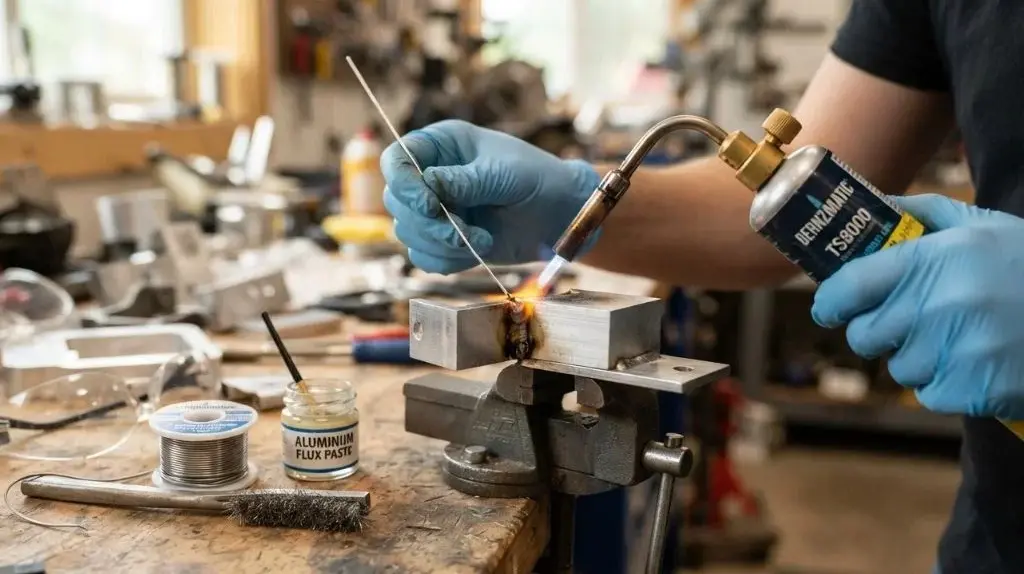
Flux helps prepare the aluminum surface by disrupting or dissolving oxide contamination during heating. It also helps molten solder spread across the metal.
Flux is especially important because aluminum oxide can reform quickly after the surface is exposed. Some aluminum solder wires contain a flux core, while others require a separate liquid, paste, or powder flux.
Do not assume that ordinary rosin flux or acid-free electronics flux will work on aluminum. Flux chemistry is product-specific, and the wrong flux can result in poor wetting or leave residues that cause corrosion.
When using a separate flux:
- Confirm that it is intended for aluminum and the selected solder alloy.
- Apply only the amount recommended by the manufacturer.
- Heat the joint evenly.
- Feed solder into the prepared area.
- Clean residue according to the product instructions.
Some aluminum soldering fluxes are corrosive. Residue left inside a joint, on a circuit, or against dissimilar metals may cause problems later.
How to Use Aluminum Solder Wire
The exact procedure varies by alloy, flux, thickness, and heat source, but the following sequence applies to many small aluminum soldering tasks.
1. Confirm That Soldering Is Suitable
Check the component’s function before applying heat. Do not use an unfamiliar solder wire for a structural, pressurized, safety-critical, or high-temperature repair without confirming that the filler is appropriate.
If the part is cracked, heavily loaded, or exposed to substantial vibration, welding, brazing, mechanical fastening, or replacement may be more suitable.
2. Clean the Aluminum
Remove grease, oil, paint, dirt, and loose corrosion. A clean surface gives the flux and solder a better chance of contacting the aluminum.
Use a suitable degreaser and allow the part to dry. Avoid trapping cleaning chemicals inside a sealed or hollow component.
3. Remove the Oxide Layer
Lightly abrade the joint area with a clean stainless-steel brush, abrasive pad, or other method recommended for the material. The goal is to expose fresh aluminum without deeply gouging the surface.
Oxide can reform quickly, so surface preparation should take place close to the heating and soldering operation.
4. Apply the Correct Flux
Use the flux specified for the aluminum solder wire. If the wire has a flux core, a separate flux may not be necessary, but the product instructions still control.
Avoid mixing unrelated fluxes. Their chemical behavior may be incompatible with the filler or the base metal.
5. Heat the Joint Evenly
Apply heat to the aluminum near the joint rather than concentrating heat only on the solder wire. Aluminum conducts heat quickly, so a larger area may warm up than expected.
The required heat source depends on the size and thickness of the part. A small soldering iron may work for thin material or small connections, while larger aluminum parts may require a more powerful controlled heat source.
Avoid overheating the part. Excessive heat can damage nearby components, burn flux, distort thin material, or bring the base metal closer to its melting range.
6. Feed the Wire Into the Joint
Touch the aluminum solder wire to the heated joint. If the surface is properly prepared and the temperature is suitable, the solder should begin to melt and spread.
If the wire melts but forms round beads, stop and diagnose the problem rather than adding more filler. Common causes include:
- Oxide remains on the surface
- The joint is not hot enough
- The wrong flux is being used
- The metal is contaminated
- The solder wire is incompatible with the alloy
- Heat is being applied unevenly
7. Allow the Joint to Cool
Keep the parts still while the filler solidifies. Moving the joint during cooling can create a weak or cracked connection.
Do not quench a hot soldered joint unless the product instructions specifically allow it. Sudden cooling can create unnecessary thermal stress.
8. Clean and Inspect the Repair
Remove flux residue as directed. Inspect the joint for gaps, loose edges, trapped residue, poor wetting, or signs that the solder only attached to surface contamination.
A smooth appearance alone does not prove that the joint has adequate strength. If the repair has a critical function, it may require a more appropriate joining method or a qualified inspection.
Common Problems When Aluminum Solder Does Not Bond
| What you observe | Possible cause | Practical response |
|---|---|---|
| Solder beads up | Oxide, grease, or unsuitable flux | Clean again, abrade the surface, and verify the flux |
| Wire melts away from the joint | Heat is focused on the wire instead of the workpiece | Heat the aluminum near the joint and feed the wire into the heated area |
| Solder spreads in some areas only | Uneven heating or inconsistent surface preparation | Improve heat distribution and prepare the entire joint |
| Joint appears dull or cracked | Movement during cooling, contamination, or poor bonding | Remove weak material and repeat the preparation process |
| Nearby aluminum begins to soften | Excessive heat | Reduce heat input and protect thin or sensitive sections |
| Joint corrodes later | Flux residue, galvanic effects, or moisture exposure | Clean thoroughly and assess whether the filler is compatible with the environment |
These symptoms do not always have a single cause. Product instructions and the condition of the base metal should guide the diagnosis.
Common Mistakes to Avoid
Using Standard Rosin-Core Solder
Rosin-core solder made for electronics is not a universal solution for aluminum. It may melt easily but fail to wet the aluminum surface.
Use a filler and flux system intended for the material and application.
Skipping Surface Preparation
Solder cannot reliably bond through oil, paint, heavy oxidation, or dirt. Adding more solder over a contaminated area usually produces a larger weak joint rather than a stronger one.
Heating Only the Filler
If the wire melts before the aluminum reaches the required working condition, it may form a blob on top of the metal instead of bonding to it.
The workpiece should provide enough heat to allow the filler to flow across the prepared surface.
Applying Excessive Heat
Aluminum transfers heat efficiently, which can encourage users to keep increasing the heat. Too much heat may damage the component without improving the bond.
Use the lowest practical heat that allows the filler to flow correctly.
Treating Solder as a Structural Repair
A soldered joint may be unsuitable for load-bearing, pressure-containing, high-temperature, or heavily vibrating parts. Confirm the required joint strength before choosing the process.
Leaving Flux Residue Behind
Some flux residues attract moisture or promote corrosion. Cleaning requirements vary, so follow the instructions supplied with the flux and solder wire.
Safety Considerations
Aluminum soldering involves hot metal, molten filler, flux fumes, and potentially flammable materials.
Use appropriate precautions:
- Wear safety glasses and heat-resistant gloves suitable for the task.
- Work in a well-ventilated area.
- Keep combustible materials away from the heat source.
- Secure the workpiece so it cannot shift unexpectedly.
- Avoid touching the part until its temperature has been verified safe.
- Follow the flux manufacturer’s guidance for fumes and residue.
- Do not use an open flame near fuel, vapors, batteries, or other flammable materials.
- Protect nearby plastic, wiring, seals, and painted surfaces from heat.
- Wash hands after handling flux and solder materials.
Do not solder a container or line that may contain flammable liquid, gas, or pressurized contents unless it has been properly made safe by a qualified person.
Is Aluminum Solder Wire Electrically Conductive?
Most metallic solder is electrically conductive, but conductivity varies by alloy and is generally different from the conductivity of the aluminum base material.
A soldered connection may work for a low-current electrical application only when the filler, joint design, mechanical stability, corrosion resistance, and electrical requirements are suitable. A visible metal bond should not automatically be treated as a dependable electrical connection.
For wiring and electronic assemblies, consider whether the joint needs:
- Low electrical resistance
- Long-term stability
- Strain relief
- Compatibility with insulation and circuit materials
- Resistance to vibration and thermal cycling
- A specific industry or equipment requirement
For critical electrical connections, use the joining method specified for the equipment rather than selecting aluminum solder wire solely because it melts at a convenient temperature.
How to Choose Aluminum Solder Wire
Select the wire based on the actual repair rather than the label alone. Check the product documentation for:
- Base-metal compatibility
- Filler composition
- Flux requirements
- Working temperature or range
- Recommended heat source
- Suitable material thickness
- Joint-strength limitations
- Corrosion and cleaning guidance
- Restrictions for electrical, pressure, or structural applications
A wire that is easy to use on thin sheet may not perform well on a thick heat sink. A product suitable for a cosmetic repair may also be inappropriate for a part exposed to vibration or elevated temperatures.
When the application is uncertain, compare aluminum soldering with brazing, welding, mechanical fastening, or replacement. The easiest process is not always the most reliable one.
FAQs About What Is Aluminum Solder Wire
Can regular solder be used on aluminum?
Regular solder may melt on or near aluminum but often will not form a dependable bond because of the aluminum oxide layer. Aluminum-specific filler and flux are usually needed.
Is aluminum solder wire the same as welding wire?
No. Aluminum solder wire is a lower-temperature filler used in soldering. Welding wire is consumed during a welding process that typically fuses the base metal with much higher heat input. They are not interchangeable.
Does aluminum solder wire always need flux?
No. Some products contain a flux core or are formulated to work with limited external flux, while others require a separate aluminum flux. The product instructions should determine the process.
Can aluminum solder wire repair a crack?
It can repair some small, low-stress cracks if the filler is compatible and the joint can be properly cleaned and heated. It is not automatically suitable for structural, pressurized, high-temperature, or heavily vibrating components.
Why does aluminum solder form beads instead of flowing?
Beading usually indicates a surface, heat, or compatibility problem. Possible causes include aluminum oxide, contamination, incorrect flux, insufficient heat in the workpiece, or an unsuitable filler alloy.
Is aluminum solder wire stronger than aluminum?
No general strength comparison applies to every product. The strength of a soldered joint depends on the filler alloy, joint design, surface preparation, bonding quality, and service conditions. It should not be assumed to match the strength of the original aluminum or a welded joint.
Final Takeaway
Aluminum solder wire is a specialized filler used to join aluminum at temperatures below the melting point of the base metal. Its success depends less on simply melting the wire and more on controlling oxide, contamination, flux, heat transfer, and joint design.
Use it for suitable low-stress repairs and connections, but verify compatibility before relying on it for electrical, structural, pressurized, high-temperature, or vibration-prone applications. When the repair carries significant risk or load, aluminum brazing, welding, mechanical fastening, or component replacement may be the more appropriate choice.

Scott Yarnell is a tool expert focused on practical guides, product research, and real-world tool performance to help readers make informed decisions.