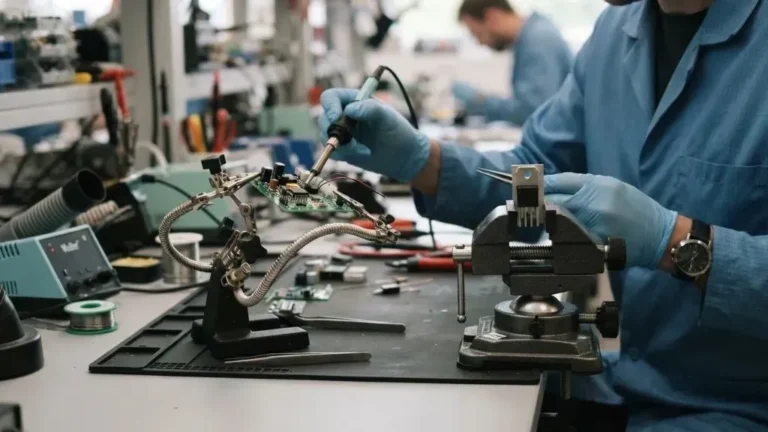
Helping Hands Vs PCB Holder For Soldering: Which Is Better?
Helping hands and PCB holders both keep work steady while you solder, but they hold different things in different ways. Helping hands use small clips on adjustable arms, making them useful for wires and individual components. A PCB holder grips a circuit board itself, usually along its edges, so you can work across the board without repeatedly repositioning it.
The right choice depends on whether your main challenge is keeping small parts in place or securing a circuit board. Here’s how the two compare, where they overlap, and when one tool may not be enough.
The main difference is what each tool supports
Helping hands hold small parts; a PCB holder holds the circuit board. That distinction matters because a wire or component needs a different kind of support from a board you need to inspect and solder across.
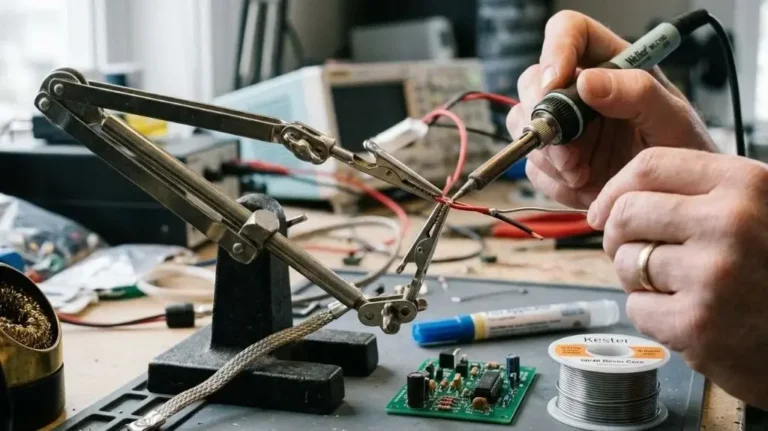
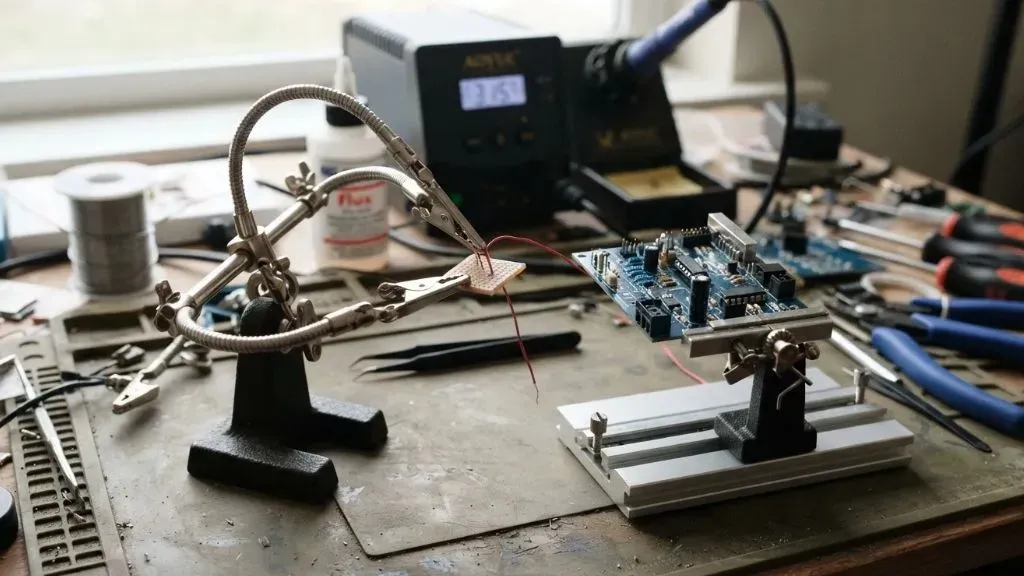
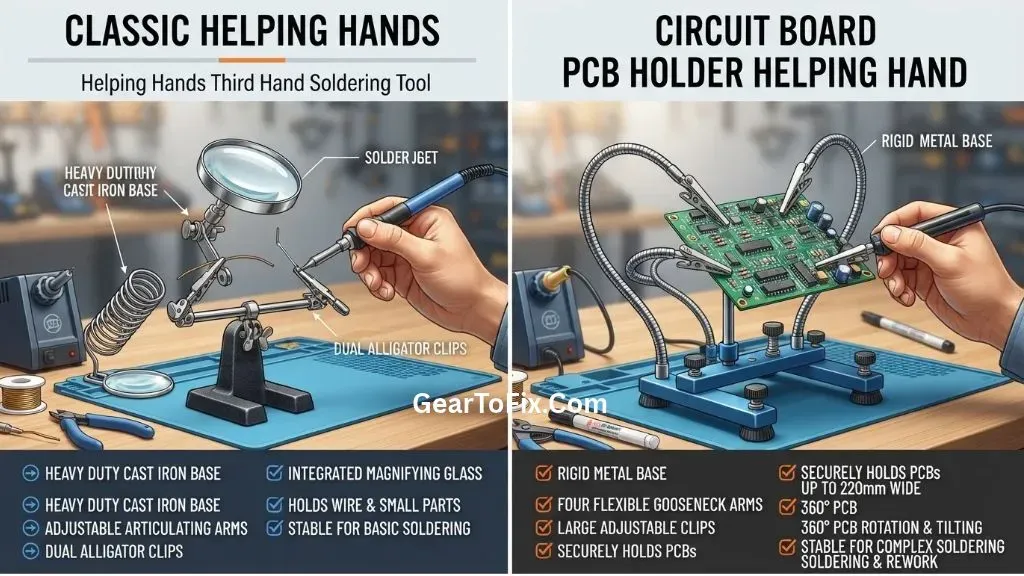
Helping hands typically have one or more articulated arms ending in clips. You position the clips around a wire, connector, or small component, then adjust the arms to keep the work in place. Some models include a magnifier or light.
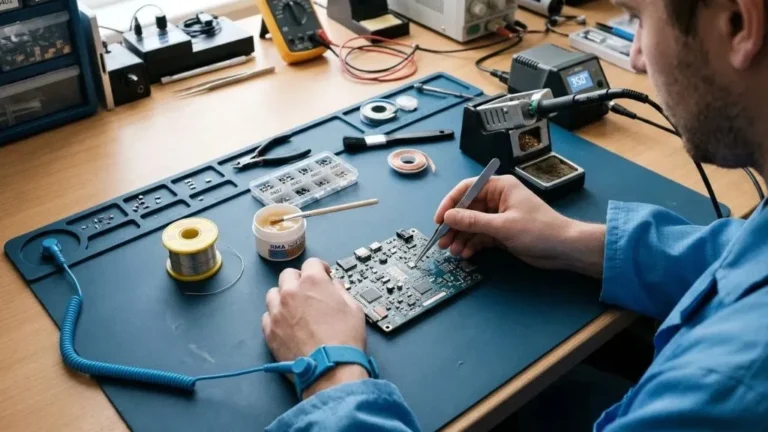
A PCB holder usually clamps the board at its edges or in a frame. Many designs let you rotate or tilt the board, which is helpful when working on different areas or reaching solder joints on the underside. The exact adjustment range depends on the model.
How they behave on the bench
Both tools free up your hands, but they stabilize work differently.
| Feature | Helping hands | PCB holder |
|---|---|---|
| Main job | Hold wires or small parts | Secure a circuit board |
| Contact points | Small clips on adjustable arms | Clamps, jaws, rails, or a frame |
| Best for | Joining or positioning loose parts | Soldering across a board |
| Repositioning | Adjust the arms and clips | Release or rotate the board, depending on design |
| Common limitation | Clips can obstruct the work or grip too tightly | May not suit unusual board shapes or sizes |
In practice, helping hands are useful when two parts need to stay aligned while you solder them together. A PCB holder is more convenient when the board itself keeps shifting, or when you need access to several areas without holding it by hand.
Neither tool improves solder flow or temperature control. Their benefit is mechanical: they help keep the work still so you can guide the iron and solder more consistently.
When helping hands make more sense
Choose helping hands when the parts you need to stabilize are smaller than the board or cannot support themselves. They work well for holding wire ends together, positioning a connector lead, or keeping a small component steady while you tack it in place.
They can also help with tasks that involve parts not attached to a PCB, such as splicing wires or soldering a lead onto a small terminal. Adjustable arms let you approach the joint from different angles.
Their main limitation is the clips. A clip may block the iron or solder wire from reaching the joint, especially on a crowded assembly. Clips can also slip on smooth insulation or mark delicate parts if clamped too firmly. Adjusting several arms takes time, and the arms may move if the base is light or the clips are pulling in different directions.
For many jobs, the best setup is to place the clip on a sturdy section of wire or component lead—not directly on the joint you need to solder.
When a PCB holder is the better fit
A PCB holder makes more sense when the circuit board is the part that needs to stay still. It can support the board while you solder through-hole components, repair a joint, or work on a small prototype.
A holder that rotates or tilts can reduce the need to pick up and turn the board by hand. This is particularly useful if you need to work on both sides. The clamp should hold the board securely without covering the area you need to reach.
PCB holders also have limits. A board with an unusual outline, fragile edge, or components close to the edge may not fit every clamp. Some holders need repositioning to reach different areas. A board can still flex if it is thin or if the clamps are too far apart, so check that it is supported without being squeezed excessively.
A PCB holder does not usually keep loose wires or parts aligned. If you are attaching a wire to a board, the holder can stabilize the PCB, but a helping-hand clip may still be useful to support the wire.
Can one replace the other?
Sometimes, but not reliably. A helping-hand clip can hold a small PCB if the board is light and has a safe place to grip. That may work for a quick repair, but it can leave the board awkwardly positioned or block access to the solder side.
A PCB holder can stabilize a board while you solder, but it generally cannot hold two loose wires together or position an unsupported component lead. Its job is to secure the board, not every item being soldered to it.
If your work involves both a PCB and loose wires or components, the tools can complement each other: use the PCB holder for the board and a helping-hand clip for the loose part. For a simple task, one may be sufficient; for frequent mixed work, using both can make setup easier.
What to check before choosing
Think about the work you do most often, not just the tool that looks more versatile.
- Mostly wires, connectors, or loose components: Helping hands are likely the more useful starting point. Look for arms that stay in position and clips suitable for the size and fragility of your parts.
- Mostly circuit boards: A PCB holder is usually more practical. Check its board-size range, how it grips the edges, and whether it can be tilted or rotated if you need access to both sides.
- Small or delicate boards: Favor gentle, secure clamping and good support. Avoid forcing a board into a clamp that is too narrow or gripping it at a fragile edge.
- Crowded work: Consider whether clips or clamp jaws will obstruct your iron and solder wire. A holder that is stable but blocks the joint may slow the work down.
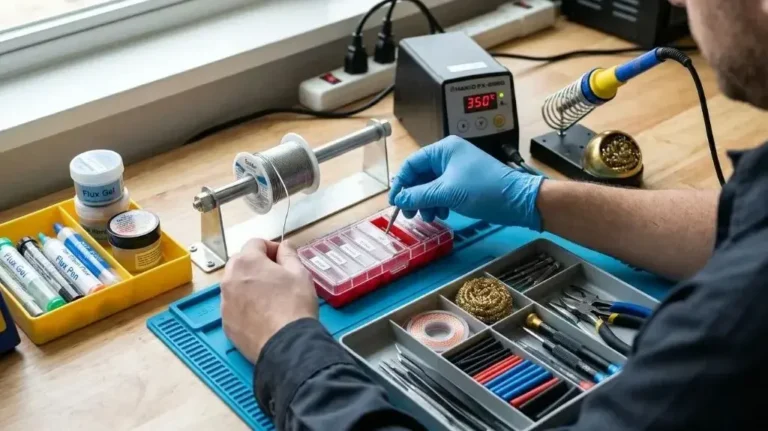
- Limited bench space: Check the base and how the tool will sit beside your soldering iron stand. A poorly placed or easily tipped fixture can be more frustrating than holding the work another way.
Whichever tool you use, keep plastic clips and other heat-sensitive parts away from the iron tip. Secure the work before heating the joint, and avoid pulling hard on the board or component while the solder is molten.
FAQs About Helping Hands Vs PCB Holder For Soldering
Are helping hands and PCB holders the same thing?
No. Helping hands use clips on adjustable arms to hold small parts. PCB holders grip a circuit board. Some fixtures combine features, so check how the particular tool supports the work.
Can helping hands hold a circuit board?
They can hold some small, lightweight boards, but the clips may obstruct access or put pressure on a fragile area. A PCB holder is generally better suited to securing a board during soldering.
Do I need a PCB holder to solder a circuit board?
No. You can hold a board another way if it remains stable and you can work safely. A holder is useful when the board shifts, needs frequent repositioning, or has to be accessed from both sides.
Are helping hands useful for soldering wires to a PCB?
Yes, especially when a wire needs to stay aligned with a pad or terminal. The PCB still needs support, so a PCB holder may be useful as well if the board moves during the task.
Which is better for a beginner?
Neither is universally better. Helping hands are useful if loose parts are the main problem; a PCB holder is more helpful if circuit boards keep moving. Choose based on the work you expect to do most often.
Final Verdict
Helping hands stabilize loose wires and small components; PCB holders stabilize circuit boards. Choose helping hands for positioning parts, and a PCB holder for working steadily across a board. They can overlap on small jobs, but neither fully replaces the other when your soldering tasks involve both a PCB and loose components.

Scott Yarnell is a tool expert focused on practical guides, product research, and real-world tool performance to help readers make informed decisions.