Soldering Mat vs Anti-Static ESD Mat: Key Differences
A soldering mat protects your work surface from heat, solder, and flux; an anti-static ESD mat helps control static electricity around sensitive electronics. They may look similar, but they solve different problems and one does not automatically replace the other. Here’s how to choose the right mat for your bench and when using both makes sense.
Heat protection and static control are different jobs
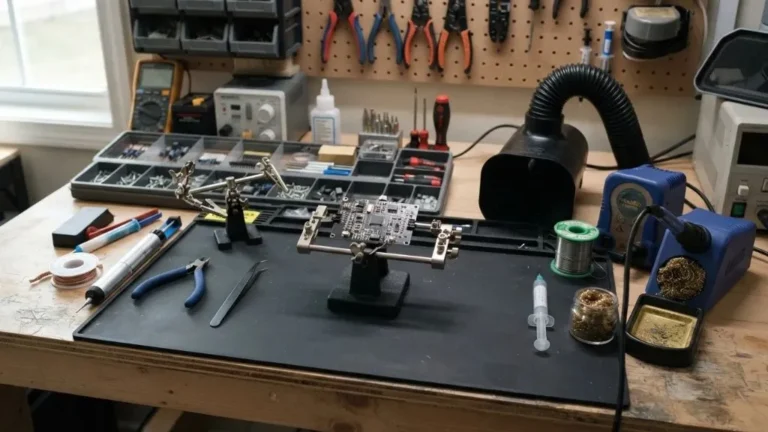
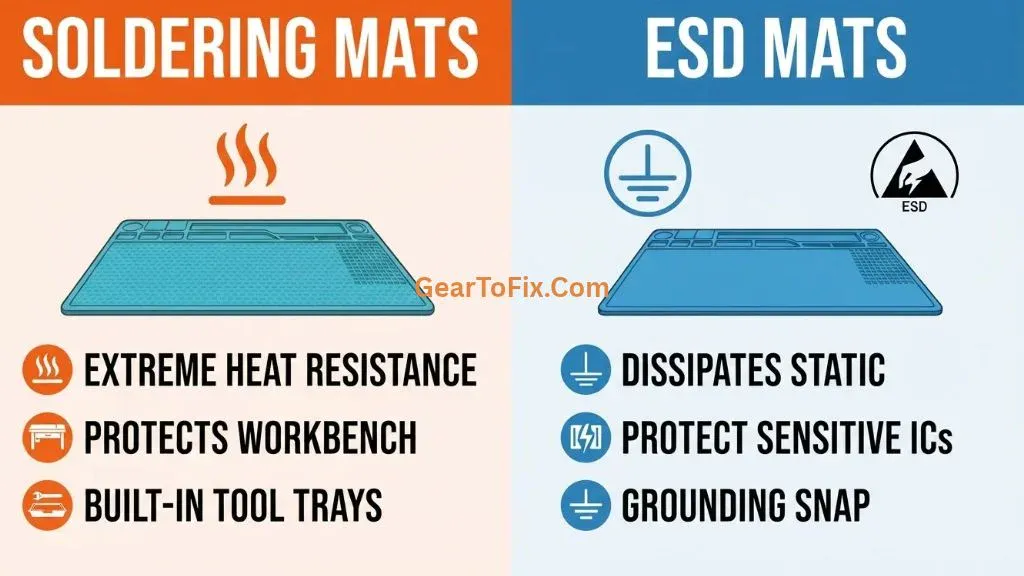
A soldering mat is designed primarily to tolerate the heat and mess of soldering. Many are made from silicone and include sections for holding screws or small parts. Their main job is to protect the bench and keep components organized.
An anti-static ESD mat is designed to reduce the risk of electrostatic discharge damaging sensitive components. It provides a controlled path for static charge to dissipate, usually through a grounding connection. Its main job is static control, not necessarily protection from a hot soldering iron.
That distinction matters because a mat can be good at one job without being suitable for the other. A heat-resistant silicone mat is not automatically ESD-safe. An ESD mat is not automatically safe for direct contact with a hot iron or molten solder.
What to compare before choosing
The practical differences are clearest when each mat is considered for its intended purpose.
| Feature | Soldering mat | Anti-static ESD mat |
|---|---|---|
| Primary purpose | Protects the bench from heat, solder, and flux | Controls static charge around sensitive electronics |
| Typical material | Often silicone or another heat-resistant material | Usually a static-dissipative surface with a grounding connection |
| Hot-tool suitability | Depends on the mat’s heat rating; not a place to rest a live iron | Depends on the product; do not assume it can withstand soldering heat |
| Organization | May include trays, grooves, or compartments | Often provides a broad work surface |
| Grounding | Usually not grounded for ESD control | Designed to connect to a grounding system |
In use, a soldering mat helps manage the physical mess and heat of a repair. An ESD mat helps manage an electrical risk that may not be visible. For sensitive electronics work, protecting the bench and controlling static may both be important.
When a soldering mat makes more sense
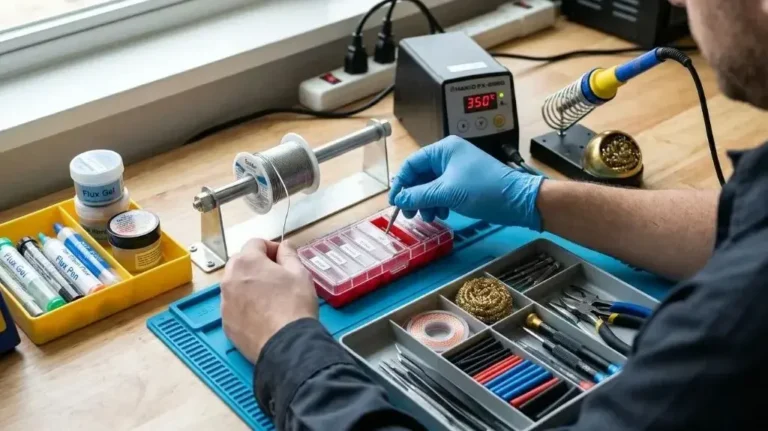
Choose a soldering mat when your main concern is protecting the bench during soldering or rework. It is useful for jobs involving flux, solder splashes, small screws, and components that need to stay organized.
A silicone mat can also be easier to clean than a bare wooden or plastic surface. Some models have compartments that help keep parts from rolling away during disassembly. Those features are convenient, but they do not make a mat ESD-safe unless the manufacturer specifically states that it meets relevant ESD requirements.
Check the mat’s heat-resistance information before use. Even a heat-resistant surface can be damaged by prolonged contact with a hot iron, and molten solder or aggressive chemicals may affect some materials. Keep the iron in a proper stand rather than laying it on the mat.
When an ESD mat is the better choice
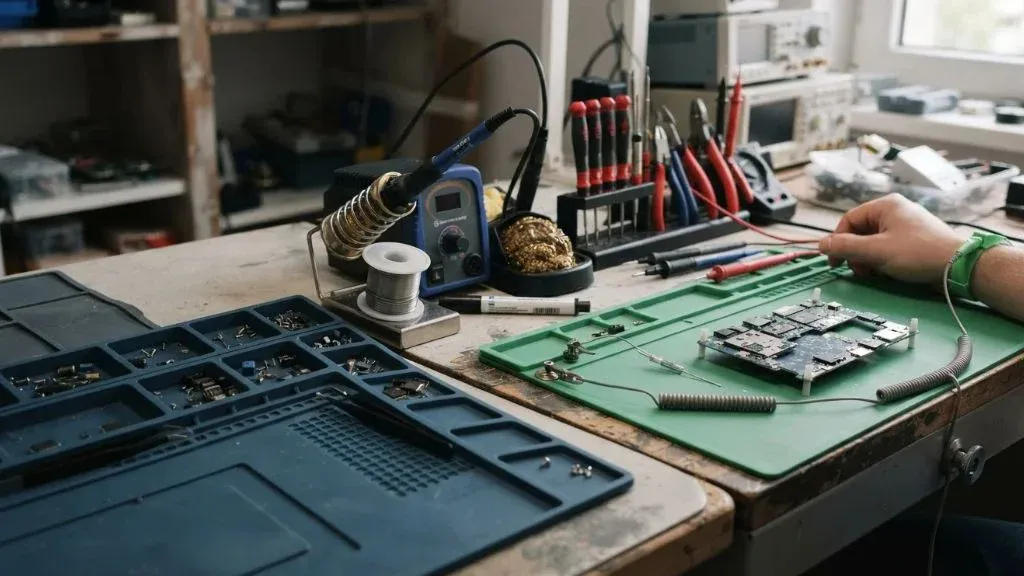
choose an ESD mat when working with components that can be damaged by static discharge, such as many integrated circuits, memory modules, and unprotected circuit boards. The mat helps dissipate charge from items placed on its surface when it is used as part of a properly grounded ESD setup.
A mat alone does not make a workstation fully ESD-safe. Grounding, suitable wrist straps, and correct handling practices may also be needed. Follow the mat manufacturer’s setup instructions and use an appropriate ESD grounding point. Do not improvise a connection to mains wiring.
“Anti-static” can also be used loosely in product descriptions. If static control matters, look for clear information about the mat’s ESD properties and grounding method rather than relying on the label alone.
Can one mat do both jobs?
Sometimes, but only if the product is explicitly rated for both heat exposure and ESD use. A mat’s appearance or material is not enough to confirm either property.
A common practical arrangement is to use a grounded ESD work surface for static-sensitive assembly and place a suitable soldering mat where heat and soldering debris are most likely. Make sure an insulating layer does not interrupt the ESD connection for the components or work area that need protection. Check the manufacturers’ instructions for both mats.
If the two requirements conflict—such as a heat-resistant mat that is electrically insulating—use separate, appropriately specified surfaces rather than assuming one will cover both needs.
Avoid these common assumptions
- “Silicone means ESD-safe.” It does not. Confirm the product’s ESD specifications.
- “Anti-static means heat-resistant.” It does not. Check the mat’s heat rating and intended use.
- “A grounded mat protects everything nearby.” ESD control depends on a properly configured work area and correct handling, not just one grounded surface.
- “The mat is a safe place for a hot iron.” Use a soldering iron stand unless the manufacturer explicitly provides another safe arrangement.
FAQs About Soldering Mat vs Anti-Static ESD Mat
Can I solder directly on an ESD mat?
Only if the mat’s manufacturer says it is suitable for soldering heat and solder exposure. Many ESD mats are intended for static control, not direct contact with a hot tool or molten solder.
Is a silicone soldering mat ESD-safe?
Not necessarily. Silicone is commonly used for heat-resistant soldering mats, but the material alone does not establish ESD performance. Look for specific ESD information from the manufacturer.
Do I need both a soldering mat and an ESD mat?
You may need both if you solder heat-sensitive or static-sensitive electronics. Use products with appropriate ratings, and set them up so the soldering mat does not interfere with the ESD-controlled work area.
Does an ESD mat need to be grounded?
An ESD mat is generally used with a suitable grounding connection so charge can dissipate in a controlled way. Follow the manufacturer’s instructions and use a proper ESD grounding system.
Can an ESD mat replace a soldering iron stand?
No. A mat is not a substitute for a stable iron stand. Keep the hot iron in its stand, even when working over a heat-resistant soldering mat.
Conclusion
A soldering mat is the practical choice for protecting a bench from soldering heat and mess. An anti-static ESD mat is the right choice for controlling static around sensitive electronics. Neither should be assumed to replace the other: choose a product rated for both tasks if you want one surface to do both, or use separate mats for their specific purposes.

Scott Yarnell is a tool expert focused on practical guides, product research, and real-world tool performance to help readers make informed decisions.