How To Choose A Solder Spool Holder: Find The Right Fit
The right solder spool holder keeps wire within easy reach, lets the spool turn smoothly, and prevents it from tipping or rolling across your workbench. Start by checking whether the holder fits your spool’s center hole, width, and outside diameter. Then consider how you feed solder, how much bench space you have, and whether you need a portable or fixed setup.
A simple spindle may be enough for occasional bench work. For frequent soldering, a stable holder with a controlled feed path can make it easier to pull out wire without tangles or excess spool movement.
Check that the holder fits your solder spool
Solder spools vary in size and shape, so don’t rely on a holder being described as “standard.” Compare the holder’s dimensions with the spool you plan to use.
Check these measurements:
- Center-hole diameter: The spindle or axle must fit through the spool’s core. It should support the spool without binding.
- Spool width: The holder needs enough clearance for the reel to turn, but not so much side-to-side movement that it slips off or feeds unevenly.
- Outside diameter: A large spool needs room to rotate without hitting the base, guide, or nearby tools.
- Spool weight: A heavy or nearly full spool may need a sturdier base or stronger mounting than a small reel.
If you use multiple spool sizes, look for an adjustable spindle or a holder designed to accommodate more than one reel width. Confirm that the adjustment range suits your actual spools rather than assuming it will.
Choose a holder style that suits your bench
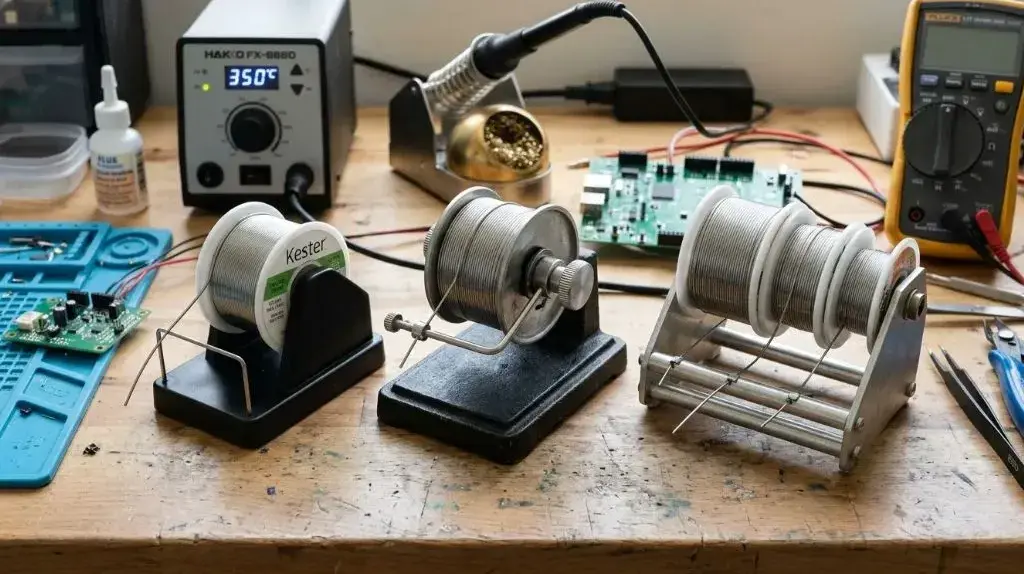
Solder spool holders generally fall into a few practical categories. The best style depends on where you work and how often you move the holder.
| Holder style | Works well for | Main consideration |
|---|---|---|
| Freestanding holder | Flexible bench setups and occasional use | Needs a stable base that resists tipping |
| Bench-mounted holder | A permanent soldering station | Requires a suitable mounting surface and location |
| Simple spindle or axle | Basic wire storage and hand feeding | Offers fewer controls for guiding the wire |
| Holder with a guide or feed arm | Repeated soldering where a consistent wire path helps | The guide must align with your working position |
A freestanding model is easy to reposition, but a lightweight one may slide or tip when you pull solder. A mounted holder stays put, though it takes up a fixed spot and may not suit a shared or compact workbench.
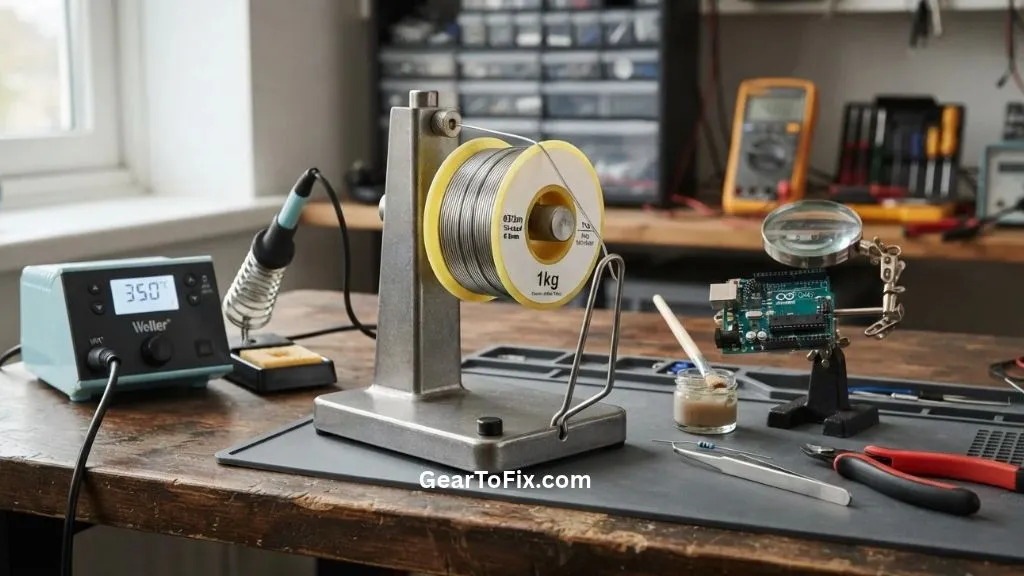
A guide arm can keep the wire accessible and reduce the need to reach around the spool. It should direct solder toward your work area without forcing a sharp bend or making the reel difficult to turn.
Look for smooth, controlled spool rotation
The spool should turn as you pull wire, but it shouldn’t keep spinning freely after you stop. Excessive movement can create loose loops, tangles, or wire that falls off the reel. Too much resistance makes feeding awkward and may cause the holder to shift.
Look for a spindle that supports the reel securely and allows it to rotate without rubbing heavily against the frame. Side supports or washers can help keep the spool aligned, provided they don’t pinch it. If the holder includes a brake or tension feature, it should be adjustable enough to control overspin without making the wire hard to pull.
A good feed path matters, too. The solder should come off the spool cleanly and reach the work without snagging on the holder, nearby equipment, or the edge of the bench.
Consider how you solder
Your work habits help determine which features are worth having.
- Occasional repairs: A compact, basic holder may be sufficient if it fits your spool and stays stable.
- Frequent bench soldering: A fixed position, smooth rotation, and convenient wire guide can make repeated feeding more comfortable.
- Small or delicate work: Place the holder so the wire reaches the joint without crossing your hand or obstructing your view.
- Shared or crowded workbench: A compact freestanding design may be easier to move, while a mounted holder can keep the spool from taking up loose bench space.
- Several solder types or sizes: Consider whether you need one holder per spool or an adjustable design that can be changed without awkward reassembly.
For hand feeding, the holder mainly needs to keep the spool stable and let it turn freely. If you use a separate wire feeder, check that the holder’s outlet position and feed direction work with that setup.
Check stability, construction, and setup
A holder should remain in place when you pull solder with one hand. A broad or weighted base can help, but the overall design matters: a high spool on a narrow base may still feel unstable. If you choose a clamp- or screw-mounted model, make sure your bench can accommodate its mounting method.
Pay attention to the parts that contact the spool and wire. Smooth edges help prevent snagging, and a spindle that is easy to access makes spool changes less frustrating. A design with fewer awkward joints may also be simpler to clean and inspect.
Before using a new holder, load the spool and pull out a short length of solder. Check that:
- The spool turns without catching.
- The holder stays put as wire is pulled.
- The reel does not wobble excessively or slide off the spindle.
- The wire follows a clear path to your work.
- The spool does not continue unwinding excessively when you release the wire.
If any part rubs, binds, or feels unstable, reposition the spool or choose a better-fitting holder.
Avoid these common selection mistakes
- Assuming every spool has the same core size: A spindle that is too large may not fit, while one that is too small may let the reel wobble.
- Choosing based on appearance alone: A compact holder is not useful if it tips or makes the wire difficult to feed.
- Ignoring the spool’s full size: Check clearance for the reel’s outside diameter and width, not just the center hole.
- Buying more adjustment than you need: Adjustable features are useful only if they match the spools you use and are easy to set.
- Overlooking placement: Even a well-designed holder can be inconvenient if it blocks your view, crowds the iron stand, or pulls wire across your workspace.
FAQs About How to Choose a Solder Spool Holder
Does a solder spool holder need to match the solder brand?
Usually, the relevant fit is determined by the spool’s dimensions, not its brand. Check the center-hole diameter, width, and outside diameter against the holder’s stated capacity.
Should the solder spool spin freely?
It should rotate smoothly when you pull wire, but it should not keep unwinding excessively after you stop. A little resistance can help control the feed, as long as it does not make the spool bind.
Can I use one holder for different spool sizes?
Some holders have adjustable spindles or supports; others fit only a narrower range of reels. Compare the holder’s adjustment range with each spool’s dimensions before relying on it for multiple sizes.
Is a mounted holder better than a freestanding one?
Neither is always better. A mounted holder can stay firmly in place at a permanent station. A freestanding holder is easier to move and may suit a flexible workspace, provided it is stable enough for the spool you use.
Where should I place a solder spool holder?
Place it within comfortable reach, with a clear path from the spool to the work. Keep the wire from crossing your hand, obstructing your view, or interfering with the soldering iron and other equipment.
Final Takeaway
Choose a solder spool holder by matching it to your spool’s core, width, diameter, and weight, then consider stability, rotation, and wire access. The best holder is the one that keeps the reel secure and feeds solder smoothly in the space where you actually work.

Scott Yarnell is a tool expert focused on practical guides, product research, and real-world tool performance to help readers make informed decisions.