Do I Need A Fume Extractor For Soldering: Is It Essential?
A fume extractor is recommended for soldering, especially if you solder often, work indoors, or use rosin-based flux. It captures fumes near their source and can reduce how much you breathe in. For an occasional job, good room ventilation may help, but it is still best to keep your face out of the plume and avoid working in a small, stagnant space.
The fumes come mainly from heated flux, not from lead evaporating out of solder under normal soldering conditions. That does not make the fumes harmless: flux smoke can irritate your eyes and airways, and repeated exposure is worth minimizing.
What soldering fumes contain
Soldering fumes are produced when flux heats up and breaks down. Flux helps solder flow and form a reliable joint, but the smoke it creates can contain irritating particles and chemical compounds. The exact mixture depends on the flux and soldering materials.
With typical hand soldering, lead in solder does not readily become airborne as vapor at the temperatures used to melt solder. The more immediate airborne concern is usually flux smoke. Lead can still pose a separate exposure risk through contaminated hands, surfaces, or solder residue, so wash your hands after soldering and keep food and drinks away from the work area.
When a fume extractor is especially useful
Consider using an extractor if you:
- Solder regularly or for long sessions.
- Work in a small room, basement, or other area with limited ventilation.
- Use rosin-based flux or notice visible smoke.
- Find that soldering fumes irritate your eyes, nose, throat, or breathing.
- Share the workspace with other people.
An extractor is also useful when opening a window or improving room ventilation is impractical. If you have asthma, another respiratory condition, or particular sensitivity to fumes, reducing exposure and seeking appropriate medical guidance may be especially important.
How a fume extractor helps
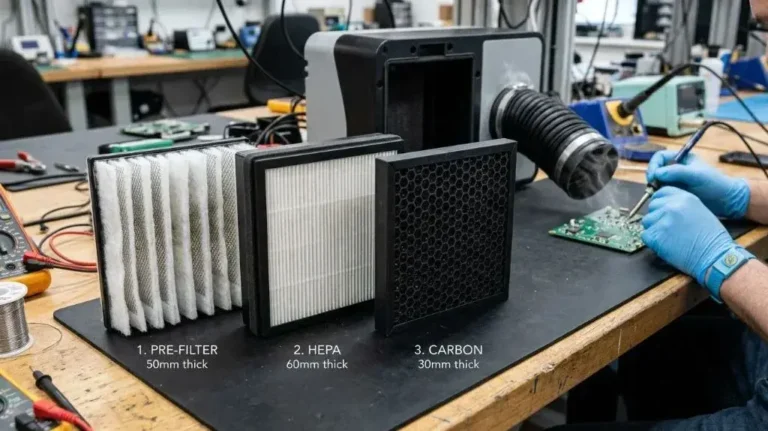
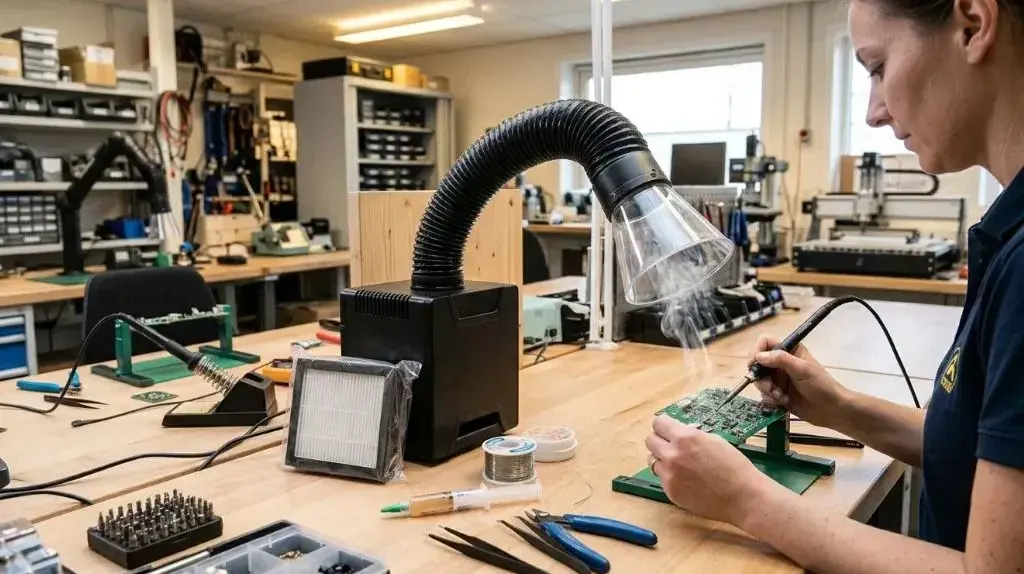
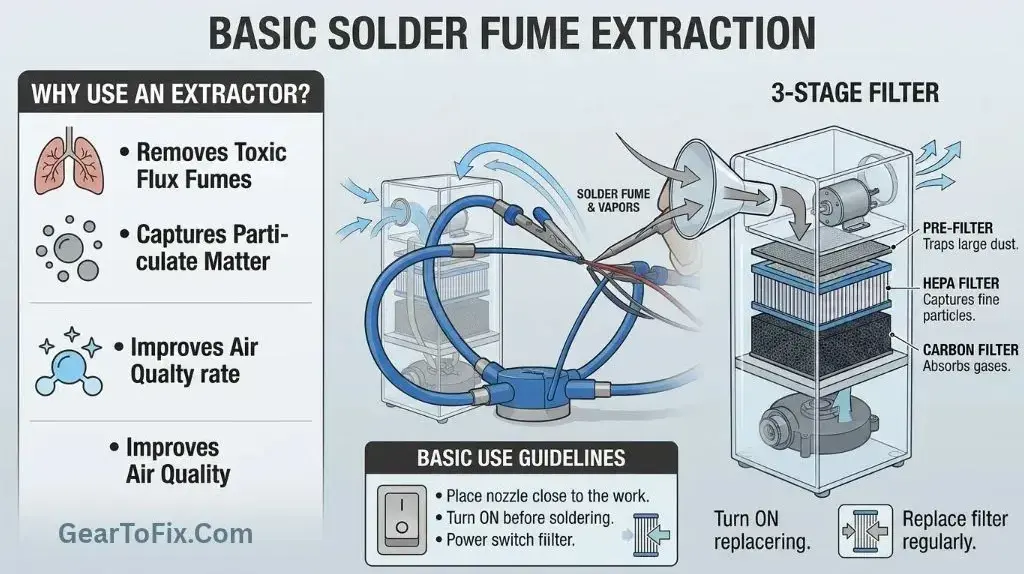
A soldering fume extractor draws air away from the work area, ideally capturing the plume before it reaches your face. Depending on its design, it may filter the air and return it to the room or send it through ducting to the outside.
Its effectiveness depends on more than whether the fan is running. The intake needs to be close enough to capture the rising smoke, and the airflow must be strong enough for the setup without disrupting the work. A filter also needs to be suitable for the fumes and maintained according to its manufacturer’s instructions.
Recirculating units and exhaust systems
A recirculating extractor pulls fumes through filters and returns air to the workspace. These units are convenient, but their effectiveness depends on the filter type, condition, fit, and proper use. Particle filters can capture airborne particles; activated carbon may help adsorb some gases and vapors, but it does not remove every possible contaminant.
An exhaust system carries captured air outdoors. It can avoid returning filtered air to the room, but it must be set up to discharge safely and in accordance with local requirements. Do not vent fumes into another occupied area.
Neither setup should be treated as a guarantee that the air is completely clean. Follow the equipment instructions, replace filters as directed, and maintain general ventilation.
How to position an extractor
Place the intake near the soldering point so it catches the smoke as it rises, while keeping enough clearance to work comfortably. A unit positioned too far away may let the plume pass your face before it reaches the intake. If the airflow makes it harder to control the soldering iron or cools the joint too quickly, adjust the position or airflow.
Keep your head out of the path between the work and the extractor. The goal is to draw fumes away from your breathing zone, not to pull them past your face first.
Is a desk fan enough?
A desk fan can move fumes away from your face, but it does not necessarily capture or filter them. It may simply spread the smoke through the room, and a strong cross-breeze can interfere with delicate work. If you use room airflow as a temporary measure, direct it so fumes move away from you and toward a suitable source of ventilation—not toward other people.
A fume extractor is designed to capture fumes near the work. For frequent soldering, it is generally a more controlled option than relying on a fan alone.
Ways to reduce exposure
Use an extractor alongside sensible work habits:
- Work in a well-ventilated area.
- Keep the extractor intake close to the soldering point.
- Avoid leaning over the joint or breathing the plume.
- Use only as much flux as the task requires.
- Keep the work area clean and wash your hands when finished.
- Follow the extractor’s guidance for filter inspection and replacement.
If fumes remain noticeable around your face, improve the capture position or ventilation rather than assuming the equipment is working effectively just because it is switched on.
FAQs Of Do I Need a Fume Extractor for Soldering
Do I need a fume extractor for occasional soldering?
It is still a good precaution, but the need depends on the workspace, materials, and duration. For a brief task in a well-ventilated area, careful positioning and keeping your face away from the smoke can reduce exposure. In a confined space or during repeated work, use source capture if possible.
Are soldering fumes dangerous?
They can irritate the eyes and respiratory system, and the level of exposure depends on factors such as flux type, ventilation, and how often you solder. Avoid breathing the fumes and reduce exposure with suitable ventilation or extraction. Do not assume that a lack of visible smoke means there is no exposure.
Do soldering fumes contain lead?
The visible fumes from typical hand soldering mainly come from heated flux. Lead in solder does not normally evaporate in significant amounts at ordinary soldering temperatures. Lead residue can still contaminate hands and surfaces, so use good hygiene and keep the work area clean.
Can I use a regular air purifier instead?
A room air purifier may reduce some airborne particles, depending on its design and filter, but it may not capture fumes at the source or address all gases and vapors. A properly positioned soldering extractor is intended to capture the plume near the joint.
How close should the extractor be?
Close enough to capture the smoke before it reaches your breathing zone, without obstructing your hands or disturbing the work. The best position varies with the extractor’s airflow and intake design, so follow the manufacturer’s guidance and adjust based on whether the plume is being captured.
Final Takeaway
A fume extractor is a sensible choice for regular soldering and for work in poorly ventilated spaces. Occasional soldering does not always require a dedicated unit, but you should still keep fumes out of your breathing zone and provide adequate ventilation. For the best results, capture the plume close to the joint and maintain the filters or exhaust system as directed.

Scott Yarnell is a tool expert focused on practical guides, product research, and real-world tool performance to help readers make informed decisions.