Temperature Controlled Vs Fixed Soldering Iron: Best Choice
Choosing between a temperature controlled vs fixed temperature soldering iron mainly comes down to how much control, consistency, and flexibility your work requires.
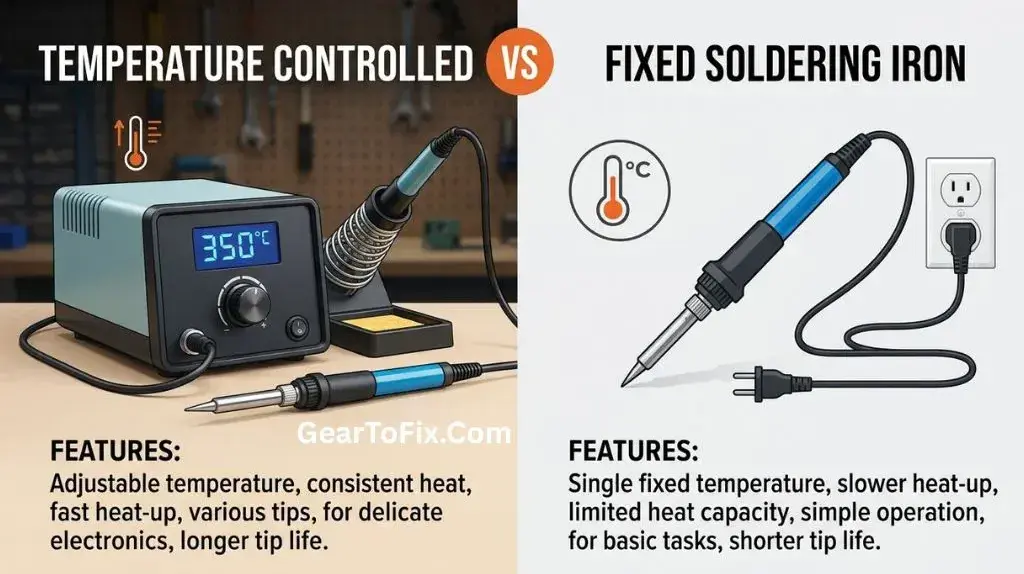
A fixed temperature iron heats to one designed operating temperature, while a temperature controlled iron allows you to set or adjust the working temperature. That difference affects more than convenience. It can influence tip life, heat recovery, component safety, solder flow, and the types of projects the iron can handle comfortably.
A fixed temperature model can be perfectly suitable for occasional repairs and basic electrical work. A temperature controlled iron becomes more useful when you work with different solder types, delicate components, large joints, or projects that require repeatable results.
The Basic Difference Between the Two Iron Types
A fixed temperature soldering iron is designed to operate around one preset temperature. Once plugged in, it heats until it reaches that range and then cycles on and off or regulates itself through a simple internal control system.
A temperature controlled soldering iron lets the user select a target temperature. Depending on the design, it may use a dial, buttons, or a digital display. More advanced models monitor the tip or heater temperature and adjust power continuously to stay near the selected setting.
The important distinction is this:
- Fixed temperature: one general-purpose heat level
- Temperature controlled: adjustable heat selected for the solder, joint, and component
Neither design is automatically better for every task. The right choice depends on how often you solder, what materials you work with, and how much control you need.
Comparison at a Glance
The following table summarizes the differences that matter most during actual use.
| Feature | Fixed Temperature Iron | Temperature Controlled Iron |
|---|---|---|
| Working temperature | Preset or limited to one level | Adjustable to suit the task |
| Precision | Adequate for general work, but less flexible | Better control and repeatability |
| Heat recovery | Varies by design; may struggle with larger joints | Often stronger and more consistent |
| Ease of use | Very simple; plug in and wait | Requires selecting an appropriate setting |
| Portability | Often compact and convenient | May be larger, especially with a station |
| Best suited for | Basic repairs, hobby work, occasional soldering | Electronics assembly, repair, and repeated use |
| Risk of overheating | Greater when working with delicate parts | Lower when the temperature is set correctly |
The table does not tell the whole story. A well-designed fixed temperature iron can outperform a poorly made temperature controlled model. Build quality, heater design, tip compatibility, and actual heat delivery still matter.
How Temperature Control Changes Soldering
Temperature control matters because different soldering tasks do not require the same amount of heat.
Lead-free solder generally needs a higher working temperature than traditional tin-lead solder. Small circuit-board pads and delicate components may need less heat exposure than large wires, connectors, or metal terminals. A large joint may also draw heat away from the tip quickly, requiring better heat recovery.
With a fixed temperature iron, you have to work around its preset heat level. If it runs too hot for a small component, the joint may heat quickly but the surrounding area receives more thermal stress. If it runs too cool for a large joint, solder may flow slowly or fail to wet the surfaces properly.
A temperature controlled iron lets you choose a more appropriate setting. This does not eliminate the need for good technique, but it gives you a wider margin for working cleanly.
Temperature Control Is Not the Same as Temperature Accuracy
An adjustable temperature setting does not automatically mean the iron is highly accurate.
Some inexpensive temperature controlled irons display a target temperature that may differ from the actual tip temperature. The reading can be affected by the tip design, heater position, airflow, soldering technique, and the amount of heat being drawn from the tip.
The useful question is not only whether the iron has a display. It is also:
- Does it regulate temperature effectively?
- Does it recover quickly after touching a large joint?
- Are compatible replacement tips available?
- Does the temperature remain reasonably stable during normal use?
A fixed temperature iron may have a simple design, but if its preset temperature is well matched to a particular task, it can still produce good joints.
Heat-Up Time and Heat Recovery
Heat-up time is how long the iron takes to reach a usable temperature. Heat recovery describes how quickly it returns to that temperature after losing heat to a joint.
These are related but different characteristics.
A fixed temperature iron may heat up quickly because it has a simple control system and a relatively narrow operating range. That does not necessarily mean it will recover quickly when soldering larger connections. Some compact models lose considerable heat when the tip contacts a heavy wire or metal connector.
Many temperature controlled irons are built with stronger heaters and more responsive regulation. They can detect a temperature drop and deliver more power to the heater. This is especially useful when soldering:
- Ground wires
- Large terminals
- Shielding
- Connectors
- Heavy-gauge cable
- Large copper areas on circuit boards
Heat recovery does not mean the tip never cools. It means the iron responds more effectively when heat is drawn away.
For occasional small joints, the difference may be barely noticeable. During repeated soldering, poor recovery can make the work feel slow and inconsistent.
What Happens When the Iron Is Too Hot or Too Cool?
Temperature affects solder flow, component stress, and tip condition.
If the iron is too hot
An excessively hot tip can:
- Burn or rapidly consume flux
- Oxidize the tip surface
- Damage insulation
- Lift circuit-board pads
- Overheat semiconductors and small components
- Make solder spread too quickly
- Increase the chance of poor-looking joints
High heat is not a substitute for good heat transfer. Holding a very hot iron on a joint for too long can be more damaging than using a suitable temperature with a properly sized tip.
If the iron is too cool
A temperature that is too low can cause:
- Solder to melt slowly
- Poor wetting on the joint
- Dull or uneven solder surfaces
- Extended contact time
- Weak mechanical connections
- More rework and repeated heating
A cool iron often encourages the user to hold the tip on the joint longer. That can also damage components, especially when the problem is a dirty tip, insufficient flux, or an undersized tip rather than a genuinely low temperature.
Temperature control helps you correct these problems, but it cannot compensate for poor tip selection or contaminated surfaces.
Fixed Temperature Irons: Where They Make Sense
A fixed temperature soldering iron is often practical when your work is simple, occasional, and consistent.
It can be a good fit for:
- Basic wire splicing
- Simple hobby projects
- Occasional connector repair
- Household electrical repairs involving suitable low-voltage work
- Learning fundamental soldering technique
- A backup iron for quick jobs
- Portable repair kits
The main advantage is simplicity. There are no settings to configure, and there is less chance of selecting an unsuitable temperature by mistake. The iron is ready to use after it reaches its operating range.
Fixed temperature models can also be compact and inexpensive to keep in a toolbox. If you only solder a few times a year and usually work on similar wire sizes or terminals, the limited control may not be a serious disadvantage.
Limitations of a Fixed Temperature Iron
The same simplicity becomes restrictive when your work varies.
A fixed temperature iron may be less suitable for:
- Delicate printed circuit boards
- Fine-pitch components
- Lead-free assembly requiring a different heat range
- Large joints that remove heat quickly
- Frequent soldering sessions
- Work involving several wire sizes and component types
- Projects where repeatable temperature matters
A fixed iron also gives you fewer ways to correct a problem. If solder is not flowing well, you may need to improve the tip, add flux, clean the joint, or change your technique rather than simply adjusting the temperature.
Temperature Controlled Irons: Where They Earn Their Cost
A temperature controlled iron is more useful when soldering is frequent or the work varies from one joint to the next.
It is particularly suitable for:
- Electronics repair
- Circuit-board assembly
- Lead-free soldering
- Fine wires and small pads
- Repeated production or repair work
- Projects with both delicate and heavy joints
- Work requiring consistent results
- Users who need different tip temperatures for different materials
The biggest practical benefit is adaptability. You can use a lower setting for sensitive work and increase the temperature when a larger joint needs more heat transfer.
Temperature controlled irons are also usually available with a wider range of tip shapes and replacement options. That matters because tip geometry often has as much effect on soldering performance as the selected temperature.
A Temperature Controlled Iron Still Requires Good Technique
Adjustability can create its own problems for beginners. Setting the iron unnecessarily high may make solder melt quickly, but it can shorten tip life and increase the chance of board or component damage.
A sensible approach is to use the lowest temperature that allows the joint to heat quickly and solder to flow properly. If the joint does not heat efficiently, first check:
- Whether the tip is clean and properly tinned
- Whether the tip is large enough for the joint
- Whether the surfaces are clean
- Whether additional flux is appropriate
- Whether the joint is mechanically stable
- Whether the iron has enough power and heat recovery
Increasing temperature should not be the first response to every soldering problem.
Tip Compatibility and Tip Temperature
The tip is the part that transfers heat into the joint, so its condition and shape matter greatly with both iron types.
A larger chisel or bevel tip can transfer heat more effectively to a large connection. A fine conical tip may provide access in a tight area but can struggle to transfer enough heat to a broad copper surface. Using a very fine tip for every task often leads to longer contact times and frustration.
Temperature controlled irons may offer more tip choices, but compatibility is not universal. Tips can differ in:
- Physical size
- Heater arrangement
- Temperature sensing method
- Mounting system
- Intended operating range
A replacement tip must match the iron or station. A tip that physically fits may not perform correctly if it is designed for a different heating or sensing system.
Fixed temperature irons also need tip care. Their limited temperature range does not make them immune to oxidation, contamination, or mechanical wear.
Portability and Bench Use
Fixed temperature irons are often the more convenient option when portability is important. Many are compact, have fewer parts, and can be stored easily in a small tool case.
This makes them useful for:
- Field repairs
- Occasional maintenance
- Remote work
- Emergency kits
- Small hobby setups
A temperature controlled iron may be a handheld unit with a built-in control, but many are soldering stations with a separate base. Stations take up more bench space and need a stable location, a power connection, and room for the holder.
That extra equipment is not simply wasted bulk. The station may provide better temperature regulation, a safer iron rest, control buttons, and additional features such as standby or automatic shutoff. The trade-off is reduced portability.
Which Iron Is Better for Beginners?
For very occasional work, a fixed temperature iron is easier to start with because there are fewer controls. It can teach basic skills such as tinning a tip, heating the joint, feeding solder, and removing the iron at the right time.
For someone planning to learn electronics seriously, a temperature controlled iron is usually the more flexible long-term choice. It allows the user to work with different solder types and component sizes without replacing the entire tool.
The most important beginner consideration is not the number on the display. It is learning to use:
- A suitable tip
- A stable stand
- Proper ventilation
- Enough flux
- Short, controlled contact time
- The correct amount of solder
An adjustable iron does not automatically make soldering easier if these fundamentals are ignored.
Can a Fixed Temperature Iron Replace a Temperature Controlled Iron?
Sometimes, but not in every situation.
A fixed temperature iron can replace a temperature controlled model for basic wires, simple terminals, and occasional repairs when its operating temperature and tip size are appropriate. Many straightforward joints do not require frequent temperature adjustment.
It is not a full replacement when you need to switch between delicate circuit-board work, lead-free solder, heavy connectors, and different heat-sensitive materials. In those situations, the fixed temperature design limits your options.
The reverse is also true. A temperature controlled iron can handle simple work, but it may be unnecessary if portability, low complexity, or occasional use matters more than flexibility.
Cost and Long-Term Value
The purchase price alone does not determine value.
A fixed temperature iron may be enough if you have a narrow range of tasks and do not need specialized tips or precise control. Spending more on features that will never be used does not automatically improve the result.
A temperature controlled iron may offer better long-term value when it replaces several task-specific tools or supports regular electronics work. Its value also depends on the availability and cost of replacement tips, the durability of the heater, and whether the controls remain reliable over time.
Before choosing, consider the complete setup rather than only the iron:
- Replacement tips
- Soldering stand
- Tip cleaner
- Brass wool or damp sponge
- Flux
- Power requirements
- Storage and transport
- Availability of compatible parts
A low-cost iron that cannot accept readily available replacement tips may be less practical over time than a slightly more capable tool with a reliable tip system.
Care and Safe Use
Both types of iron reach temperatures capable of causing burns, melting insulation, and starting fires if left against combustible materials.
Use a stable stand, keep the cord away from the hot tip, and avoid leaving the iron unattended while powered. Allow the tool to cool before storing it.
For tip care, keep the working surface lightly tinned when the iron is hot. Clean away residue when needed, but avoid aggressive filing or abrasive treatment unless the manufacturer specifically permits it. Excessive abrasion can remove the tip’s protective coating.
With temperature controlled models, use standby or shutoff features when available, but do not treat them as a replacement for a proper stand and attention. With fixed temperature irons, unplugging the tool when the work is finished is especially important because there may be fewer automatic controls.
Common Misunderstandings About Soldering Iron Temperature
Higher temperature does not always mean faster soldering
A higher setting may melt solder quickly, but the joint still depends on surface cleanliness, tip condition, flux, and heat transfer. Too much heat can damage the work and shorten tip life.
Wattage is not the same as temperature
Wattage describes the iron’s ability to supply power, not its fixed operating temperature. A higher-wattage iron may recover heat faster, while a lower-wattage iron may be adequate for small joints. Temperature and power address different aspects of performance.
A digital display does not guarantee accuracy
A display shows the selected or estimated setting. It does not prove that the actual tip temperature matches the number exactly. Regulation quality and calibration still matter.
A fine tip is not always more precise
A fine tip may reach a small pad, but it also holds less heat and may transfer it less effectively. Precision often comes from using the correct tip shape and controlled technique rather than choosing the smallest available tip.
FAQs Of Temperature Controlled Vs Fixed Soldering Iron
Is a temperature controlled soldering iron better than a fixed temperature model?
A temperature controlled iron is generally better for varied, frequent, or delicate work because it offers adjustable heat and often better recovery. A fixed temperature model can be the better practical choice for occasional basic repairs where simplicity and portability matter.
What temperature should a temperature controlled soldering iron use?
The correct setting depends on the solder alloy, joint size, component sensitivity, and tip design. Use the lowest temperature that lets the joint heat quickly and allows the solder to flow properly, following the solder and tool manufacturer’s guidance where available.
Are fixed temperature soldering irons safe for circuit boards?
They can be used on circuit boards if the operating temperature, tip, and technique are suitable. The risk is greater when the iron runs too hot or requires prolonged contact. A temperature controlled iron gives more control, but careful technique is still essential.
Does a temperature controlled iron heat faster?
Not necessarily. Heat-up time depends on the heater and design. Temperature controlled stations often provide strong heat recovery, but a particular fixed temperature iron may heat up faster than a poorly designed adjustable model.
Can I use lead-free solder with a fixed temperature iron?
You may be able to, but it depends on whether the iron reaches and maintains a suitable working temperature. Lead-free solder usually requires more heat and can expose weaknesses in a low-power or poorly recovering iron.
Which type is better for occasional home repairs?
A fixed temperature iron is often sufficient for occasional simple repairs, especially when portability and low complexity are priorities. Choose a temperature controlled model if those repairs include circuit boards, different solder types, or heat-sensitive components.
Final Verdict
A fixed temperature soldering iron is best when you want a simple, portable tool for occasional and predictable jobs. It can handle basic wires, terminals, and hobby repairs without requiring temperature adjustments.
A temperature controlled soldering iron makes more sense for electronics, lead-free soldering, repeated use, mixed-size joints, and work where heat exposure needs to be managed carefully. Its adjustable setting and usually stronger regulation provide greater flexibility and consistency.
Neither option universally replaces the other. Choose the fixed temperature design for straightforward work and simplicity; choose temperature control when project variety, precision, and repeatable heat performance matter.

Scott Yarnell is a tool expert focused on practical guides, product research, and real-world tool performance to help readers make informed decisions.