What Can I Use A Soldering Iron For: Practical Uses
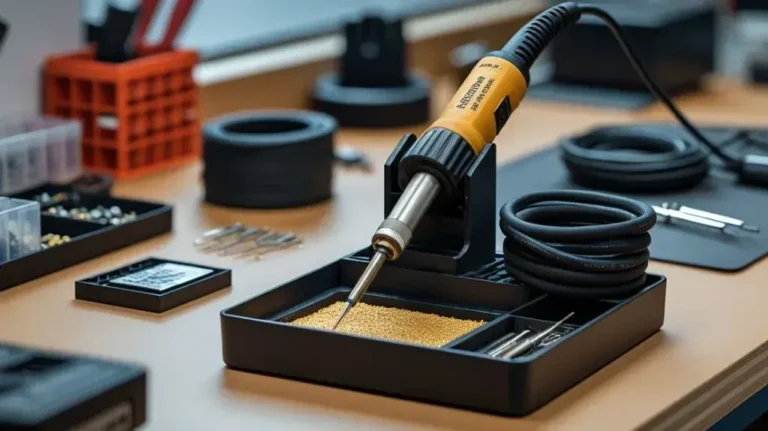
A soldering iron is mainly used to join wires, electronic components, and small metal parts with solder. When the heated tip melts solder, the liquid metal flows between clean surfaces and forms an electrical or mechanical connection as it cools.
You can use a soldering iron for electronics repair, wire splicing, circuit-board assembly, hobby projects, and some small metalwork. It is not suitable for every type of repair, though. The tool is designed for controlled, relatively small joints—not heavy structural connections, large plumbing pipes, or materials that require high heat.
Common Uses for a Soldering Iron
The most suitable applications involve small conductive parts that can be heated briefly without being damaged. The following are some of the most common uses.
Joining Electrical Wires
A soldering iron can join two wires after their insulation has been removed and the conductors have been properly positioned. Solder helps hold the strands together and creates a conductive connection.
A typical wire-soldering job involves:
- Removing only the necessary amount of insulation.
- Sliding heat-shrink tubing onto one wire before making the joint.
- Twisting or positioning the conductors together.
- Heating the wire rather than simply melting solder onto the iron tip.
- Allowing the solder to flow through the joint.
- Letting the connection cool before covering it with insulation.
Solder should not be the only thing holding a wire under mechanical tension. If the wire will be pulled, bent, or vibrated, secure it with a crimp, connector, strain relief, or another suitable method. Solder creates an electrical connection, but it does not automatically make a joint mechanically strong.
Repairing Circuit Boards
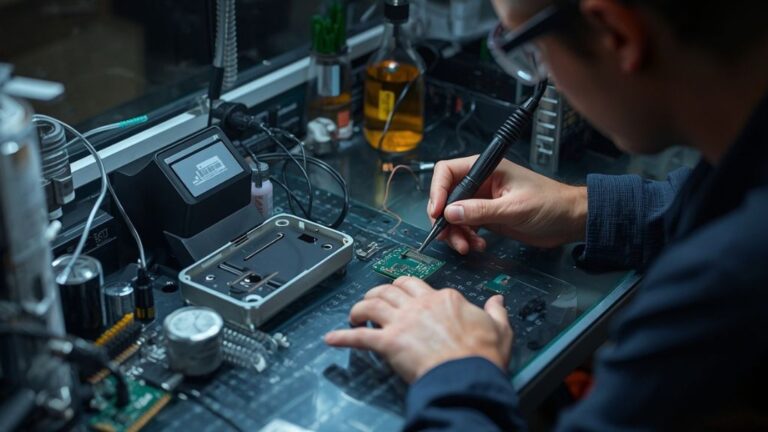
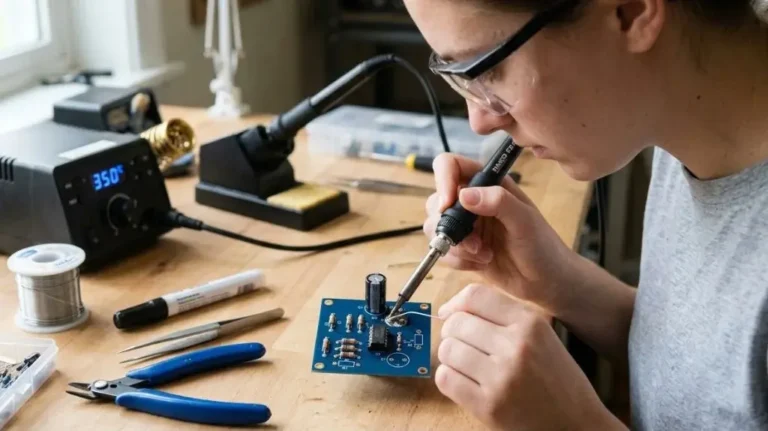
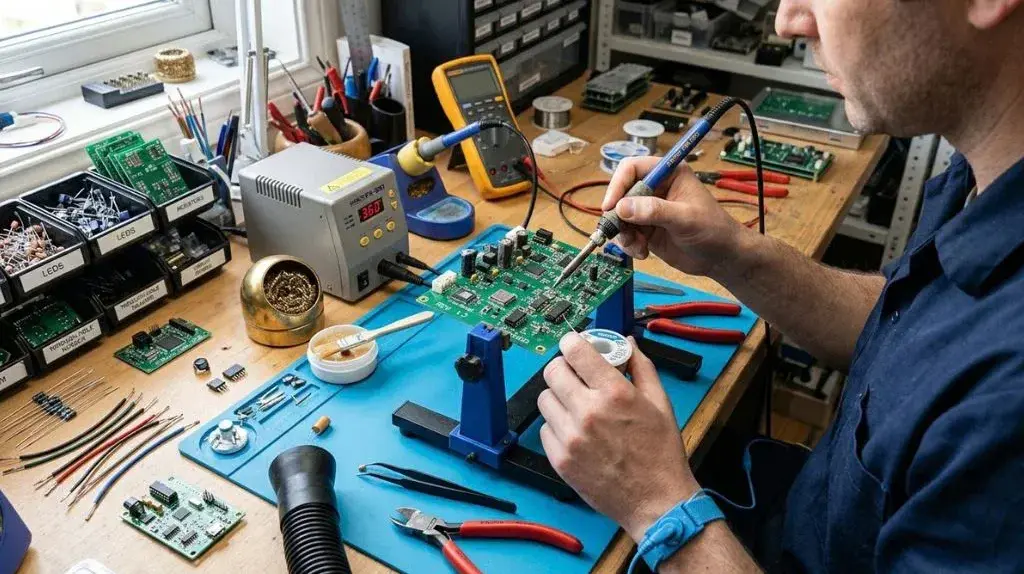
Soldering irons are widely used to attach or replace components on printed circuit boards, often called PCBs. This can include:
- Resistors
- Capacitors
- Switches
- Connectors
- Diodes
- Transistors
- Small wires
- Terminal pins
- Battery contacts
- Through-hole components
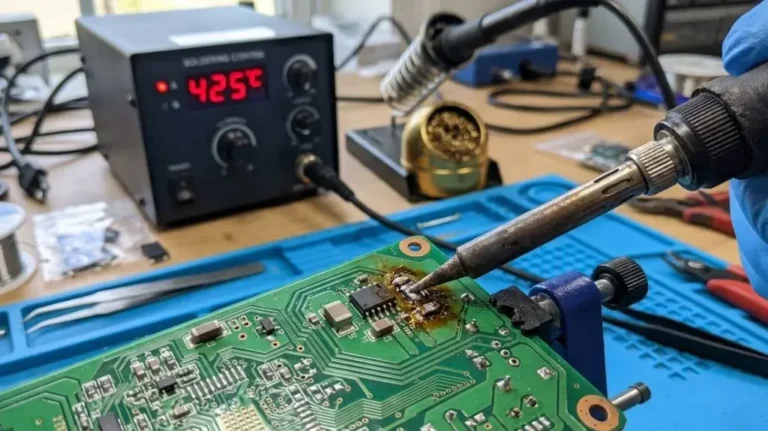
A soldering iron can also help repair a cracked or detached solder joint. The joint may need to be reheated and supplied with a small amount of fresh solder. If the copper pad or circuit trace has lifted from the board, simply adding more solder may not solve the problem.
Circuit boards require careful temperature control and a suitably sized tip. Too much heat can damage a pad, loosen a component, or affect nearby parts. A large tip can also bridge adjacent contacts with excess solder.
Replacing Wires and Connectors
Small connectors can become loose, corroded, or physically damaged. A soldering iron can be used to replace connector pins, attach wires to terminals, or install a new connector on a cable.
This is common in low-voltage projects such as:
- Audio cables
- Speaker wires
- Small lights
- Electronic toys
- Computer accessories
- Remote-control equipment
- Hobby circuits
- Sensor wiring
Before replacing a connector, identify the wire locations carefully. Connecting a power, ground, or signal wire to the wrong terminal can damage the device or create a short circuit.
Building Electronic Projects
A soldering iron is useful for assembling permanent electronic circuits. While solderless breadboards are convenient for testing, soldered connections are more suitable when a project needs to remain assembled.
You can use one to attach components to:
- Perfboard
- stripboard
– Prototype boards - Custom circuit boards
- Terminal blocks
- Small control panels
Soldering is also useful for making short jumper wires, connecting switches, and attaching battery holders. A clean, well-formed joint is generally easier to inspect and more reliable than a loose temporary connection.
Repairing Audio and Speaker Cables
A soldering iron can repair broken or intermittent connections in certain audio cables and speaker leads. It may be used to attach conductors to a plug, terminal, switch, or speaker contact.
The wire arrangement matters because audio cables may include separate signal and ground conductors. Shielded cables can be especially sensitive to incorrect wiring. Before cutting a cable, note the original connections or consult the applicable wiring diagram.
A soldering iron can fix a bad connection, but it cannot repair every cable problem. If the conductor is broken in multiple places, the insulation is badly damaged, or the connector is molded onto the cable, replacing the cable may be more practical.
Making Small Battery and Low-Voltage Connections
A soldering iron can attach wires to battery holders, small terminals, and low-voltage electronic assemblies. It is often useful when a battery compartment has a broken wire or a contact has become detached.
Extra caution is needed with batteries. Do not apply a soldering iron directly to lithium-ion cells or attempt to heat, puncture, open, or modify damaged batteries. Heat can create a serious hazard. Whenever possible, solder wires to a proper battery holder or designated tab rather than directly to a cell.
Creating Custom Wires and Cable Assemblies
If a standard cable is too long, too short, or has the wrong connector, a soldering iron can help create a custom cable. This may involve attaching plugs, terminals, switches, or circuit-board connectors to wire.
Useful custom cable projects include:
- Short extension leads
- Test leads
- LED wiring
- Control cables
- Sensor connections
- Low-voltage power leads
- Small audio cables
Label each conductor before soldering. For cables with multiple wires, color coding alone may not be enough, particularly if the colors are similar or the cable will be serviced later.
Hobby and Craft Projects That Use a Soldering Iron
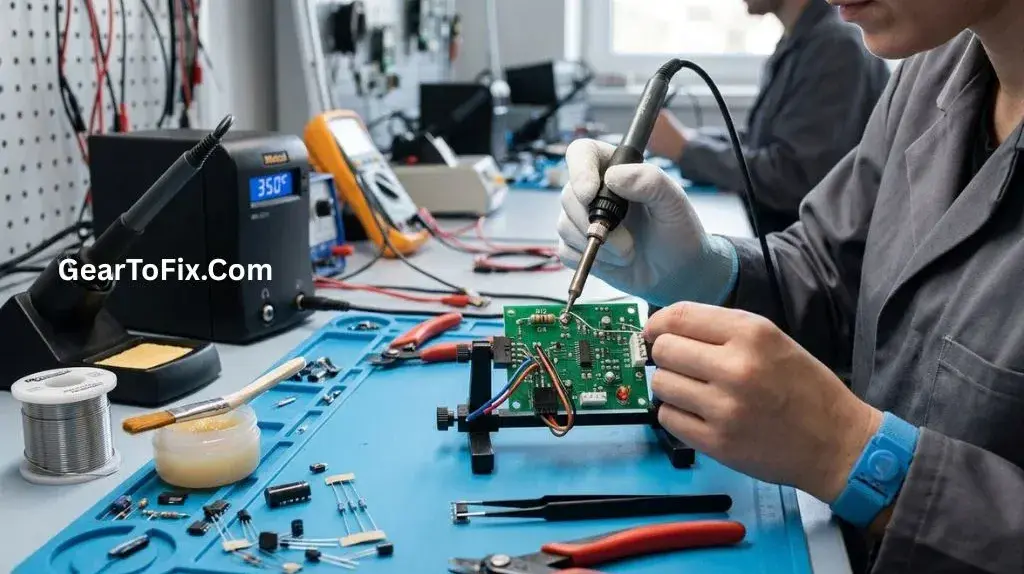
Soldering irons are also used outside conventional electronics. These applications still involve small, controlled joints and materials that can tolerate the required heat.
Model Making and Robotics
A soldering iron is useful for connecting motors, switches, LEDs, sensors, and battery holders in models and small robots. It can make compact connections that take up less space than some plug-in connectors.
For a moving project, provide strain relief for wires. Vibration and repeated movement can eventually break a soldered joint if the wire is allowed to flex directly at the connection.
LED Projects
LED strips, individual LEDs, lighting circuits, and small display projects often require soldered connections. A soldering iron can attach wires to LED pads, join sections of strip lighting, or connect resistors and switches.
LEDs are polarity-sensitive, meaning the positive and negative sides must be connected correctly. Many LED circuits also require current-limiting components. The exact requirements depend on the LED and the power source, so do not assume that an LED can be connected directly to any battery or supply.
Stained Glass and Decorative Metalwork
Some stained-glass and decorative projects use soldering irons to join metal foil or small metal sections. The iron is used with an appropriate flux and solder for the technique.
This work requires more than simply heating the solder. The surfaces must be prepared properly, and the finished project may need cleaning to remove flux residue. Follow the material and flux manufacturer’s handling guidance, especially when working indoors.
A regular electronics soldering iron may not have the size or heat capacity needed for larger decorative work. Tool suitability depends on the joint size, solder type, and construction method.
Jewelry and Small Metal Crafts
A soldering iron may be suitable for limited decorative craft tasks involving low-melting solder or specialized craft materials. It is generally not a replacement for a torch used in traditional jewelry soldering.
Jewelry soldering often requires higher heat, controlled heating of the entire joint, and materials that behave differently from electronics solder. A soldering iron may work for certain small accessories or conductive craft projects, but it is not appropriate for all metals or jewelry repairs.
Sealing the Ends of Synthetic Rope
A heated tool can melt and seal the end of some synthetic ropes to reduce fraying. However, using a soldering iron for this purpose can contaminate or damage the tip, and the fumes may be unpleasant or hazardous depending on the material.
A dedicated hot knife or manufacturer-approved method is often more suitable. Never use heat to seal unknown rope or plastic without understanding how the material reacts.
Can a Soldering Iron Melt or Cut Plastic?
A soldering iron can soften or melt some plastics, but that does not mean it is a good general-purpose plastic cutting tool.
People sometimes use heated tips to:
- Open small holes in plastic
- Modify a plastic enclosure
- Melt a narrow channel
- Repair certain plastic parts
- Embed wire into compatible plastic
- Shape limited areas of thermoplastic material
The result depends heavily on the plastic. Some plastics melt relatively easily, while others burn, produce irritating fumes, or become brittle. A soldering iron can also leave an uneven edge and permanently contaminate its tip.
Do not melt unknown plastics indoors without suitable ventilation and appropriate precautions. For clean openings, a drill, rotary tool, heated knife designed for plastic, or another purpose-built tool may produce a better result.
What a Soldering Iron Is Not Designed For
A soldering iron is useful for small joints, but it has clear limitations.
Large Plumbing Pipes
A typical electronics soldering iron does not provide the heat distribution or capacity needed to solder large copper plumbing joints. Plumbing work also requires different preparation, flux, solder, and safety procedures.
Small electronics solder and plumbing solder are not interchangeable in every application. Plumbing systems may also have requirements related to potable water, pressure, and local regulations.
Structural Metal Repairs
Solder has a relatively low melting point compared with many structural metals, and a soldered joint is not intended to replace welding, brazing, or mechanical fastening where significant strength is required.
Do not use a soldering iron to repair:
- Load-bearing brackets
- Vehicle suspension parts
- Structural frames
- Pressure-containing components
- Safety-critical hardware
- Heavily stressed tools
A soldering iron can join small conductive parts, but the connection should not be treated as a structural weld.
Large Heat Sinks or Heavy Metal Parts
Large metal components draw heat away from the joint. A small soldering iron may not be able to raise the workpiece to the temperature needed for solder to flow properly.
This can result in a weak, dull, or incomplete joint. A higher-capacity soldering tool or a different joining method may be required, depending on the material and application.
Direct Repair of Damaged Lithium Batteries
Do not use a soldering iron directly on lithium-ion cells, swollen batteries, punctured batteries, or batteries showing signs of overheating. Battery repair and cell replacement can involve fire, explosion, and toxic exposure risks.
Use a compatible battery holder, replace the battery with an appropriate approved part, or have the equipment serviced by a qualified professional.
Materials and Components That Work Well With a Soldering Iron
A soldering iron works best when the material, solder, flux, and tool are compatible. Common suitable workpieces include:
- Tinned copper wire
- Electronic component leads
- Copper circuit-board pads
- Brass terminals
- Small connector contacts
- Compatible stained-glass foil
- Certain low-melting craft materials
Clean surfaces usually solder more easily than dirty, oxidized, or coated surfaces. Some metals, such as aluminum and stainless steel, are difficult to solder with ordinary electronics methods because their surface oxides interfere with wetting. A different flux, solder, preparation method, or joining process may be necessary.
Basic Soldering Practices for Better Results
Even a simple soldering job is more reliable when the work is prepared correctly.
Keep the Parts Still
Hold the wire or component in place before heating it. Movement while the solder is cooling can create a weak or cracked joint.
Heat the Joint, Not Just the Solder
Touch the heated tip to the parts being joined, then apply solder to the heated joint. If solder is melted only on the tip and transferred to the work, it may not bond properly to the surfaces.
Use Enough Solder
Too little solder may leave gaps or incomplete coverage. Too much can form bridges between nearby contacts, hide defects, or create unwanted electrical connections.
Choose an Appropriate Tip
A fine tip is useful for small circuit-board work, while a broader tip can transfer heat more effectively to larger wires. The tip should suit the joint without touching nearby components unnecessarily.
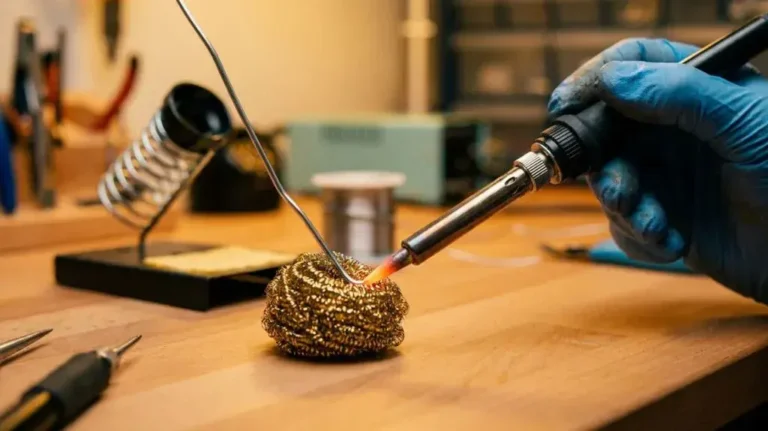
Clean and Tin the Tip
A clean, lightly tinned tip transfers heat more effectively and helps solder flow. Remove excess oxidation or residue according to the soldering station manufacturer’s instructions.
Safety Precautions When Using a Soldering Iron
A soldering iron reaches temperatures high enough to cause serious burns and ignite nearby materials. Work on a stable, heat-resistant surface and place the iron in a proper stand when it is not in use.
Basic precautions include:
- Wear eye protection when cutting or soldering wire.
- Keep the hot tip away from skin, cables, and flammable materials.
- Maintain ventilation, especially when using flux or solder that produces fumes.
- Wash your hands after handling solder and flux.
- Avoid touching the tip, recently soldered parts, or metal stand components.
- Unplug or switch off the iron when the work is finished.
- Keep children and pets away from the work area.
- Inspect cords and plugs before use.
- Do not solder energized circuits unless the equipment is specifically designed for that procedure.
Lead-free and lead-containing solder have different handling considerations. Check the solder label and follow appropriate hygiene and ventilation practices.
Common Mistakes to Avoid
Several mistakes can make a soldered connection weak or damage the workpiece.
Applying Heat for Too Long
Excessive heat can damage circuit boards, insulation, connectors, and sensitive components. Work efficiently and remove heat once the solder has flowed.
Using Solder as a Mechanical Support
A soldered wire may conduct electricity correctly but still fail if it is pulled or repeatedly flexed. Add strain relief or mechanical support where needed.
Ignoring Polarity and Wiring Order
Reversing power and ground connections or mixing up signal wires can damage a device. Confirm the wiring before applying power.
Using the Wrong Flux
Flux helps remove surface oxides and improve solder flow, but not every flux is suitable for electronics. Acid-based plumbing flux can be corrosive when left on electronic assemblies.
Creating Solder Bridges
A solder bridge occurs when solder unintentionally connects two separate contacts. Inspect closely after soldering and remove excess solder before testing the circuit.
FAQs About What Can I Use A Soldering Iron For
Can I use a soldering iron to repair a broken wire?
Yes. A soldering iron can join a broken wire if the conductors are clean and the connection can be insulated and mechanically supported. Use heat-shrink tubing or another suitable insulation method, and do not leave the joint exposed.
Can a soldering iron solder steel?
Sometimes, but ordinary electronics soldering methods are usually not effective on steel. Steel may require specialized solder, flux, surface preparation, and enough heat to maintain the correct joint temperature. For many steel repairs, brazing, welding, or mechanical fastening is more suitable.
Can I use a soldering iron on aluminum?
Aluminum is difficult to solder because its oxide layer forms quickly and prevents normal solder from bonding. Specialized products and preparation methods exist, but a standard electronics soldering iron and ordinary solder may not produce a dependable connection.
Can I use a soldering iron to repair a circuit board?
Yes. Circuit-board repair is one of the most common uses for a soldering iron. Use a suitable tip, controlled heat, compatible solder, and careful technique to avoid lifting pads or damaging nearby components.
Is a soldering iron the same as a soldering gun?
No. A soldering iron is usually a pen-shaped tool with a heated tip, while a soldering gun typically uses a larger transformer-based design and may heat differently. Both can melt solder, but a soldering iron is often more suitable for delicate electronics and small joints.
Can I solder without flux?
Some solder contains flux in its core, so additional flux may not always be necessary. However, oxidized or difficult-to-solder surfaces may require suitable extra flux. Use the correct type for the material and clean residue when the product instructions require it.
Final Takeaway
You can use a soldering iron to join wires, repair circuit boards, attach electronic components, build low-voltage projects, make custom cables, and complete certain hobby or craft applications. It works best on small, clean, compatible parts where controlled heat is sufficient.
It is not a substitute for a welder, brazing torch, plumbing tool, or battery-repair equipment. Choose the solder, flux, tip, and technique for the specific material, and always provide proper insulation and mechanical support after making an electrical connection.

Scott Yarnell is a tool expert focused on practical guides, product research, and real-world tool performance to help readers make informed decisions.