What Wattage Soldering Iron Do I Need: Find The Right Power
For most electronics work, a 30- to 60-watt temperature-controlled soldering iron is a practical choice. Small circuit boards and delicate components often work well with approximately 30–50 watts, while wires, connectors, ground planes, and other heat-demanding joints may need 60–100 watts or more.
The wattage you need depends less on the size of the iron and more on how quickly the tool can transfer heat to the joint. A higher-wattage iron does not automatically run hotter. In a temperature-controlled model, extra wattage mainly helps the tip recover its temperature after touching a joint.
The Best Wattage for Common Soldering Jobs
There is no single wattage that suits every soldering task. Use the following ranges as general starting points rather than strict rules:
| Soldering application | Useful wattage range | What to look for |
|---|---|---|
| Small electronic components | 20–40 watts | Fine tip and adjustable temperature |
| General circuit-board repair | 40–60 watts | Temperature control and replaceable tips |
| Through-hole components and connectors | 50–70 watts | Good heat recovery and medium-size tips |
| Wires, terminals, and cable joints | 60–100 watts | Larger tip and enough thermal capacity |
| Large copper areas or heavy connectors | 80–150 watts or more | High heat recovery and suitable tip design |
| Occasional light-duty work | 20–40 watts | Simple operation and appropriate tip size |
| Battery-powered soldering | Varies by model | Battery capacity, warm-up behavior, and portability |
These ranges overlap because wattage is only one part of soldering performance. A well-designed 40-watt iron may handle a small board better than a poorly controlled 60-watt model. For most general-purpose work, adjustable temperature and effective heat transfer matter more than choosing the highest wattage available.
Why Soldering Iron Wattage Matters
Wattage describes the electrical power the soldering iron can use to produce and maintain heat. It affects how quickly the tool heats up and how well it can recover when the tip loses heat during soldering.
When the hot tip touches a cool component lead, wire, terminal, or circuit-board pad, heat flows away from the tip. A low-powered iron may struggle to replace that lost heat. The tip temperature can drop, causing the solder to melt slowly or not at all.
A higher-wattage iron can usually restore its working temperature more quickly. This is especially useful when:
- The joint is connected to a large metal area.
- The wire or terminal is thick.
- Several joints must be soldered in succession.
- The workpiece absorbs heat quickly.
- You are using lead-free solder, which generally requires more heat than traditional leaded solder.
- The soldering iron has a large tip or is being used for heavier work.
Wattage does not mean the tip will always operate at that temperature. A temperature-controlled 80-watt iron may run at the same selected temperature as a 40-watt model. The difference is that the higher-powered unit may maintain that temperature more effectively under load.
What Wattage Do I Need for Electronics?
For most small electronics projects, choose a 30- to 60-watt temperature-controlled soldering iron.
A 30- to 40-watt model can be suitable for:
- Small circuit boards
- Resistors, capacitors, and diodes
- Fine electronic wires
- Small connectors
- Signal-level wiring
- Occasional hobby repairs
A 50- to 60-watt model offers more flexibility. It can still handle many delicate electronic jobs when used with the correct temperature and tip, but it also provides better heat recovery for larger pads, ground connections, and through-hole components.
The main risk with electronics is not simply having too much wattage. The greater concern is using excessive temperature, holding the tip on the joint too long, or applying mechanical force while the solder is molten. A temperature-controlled iron with a suitable fine or medium tip gives you more control than a low-wattage iron that cannot maintain heat.
Is a 100-Watt Iron Too Powerful for Circuit Boards?
Not necessarily. A 100-watt temperature-controlled soldering station can be used on circuit boards if the temperature, tip size, and contact time are appropriate.
However, a high-powered tool may be unnecessary for small components. It can also make mistakes more costly if the user selects an excessive temperature or uses a tip that is too large for the pad. For routine electronics, a moderate-wattage iron is usually easier to control and more versatile.
The wattage becomes useful when the board contains large ground planes, heavy terminals, shielding, or other areas that rapidly draw heat away from the joint.
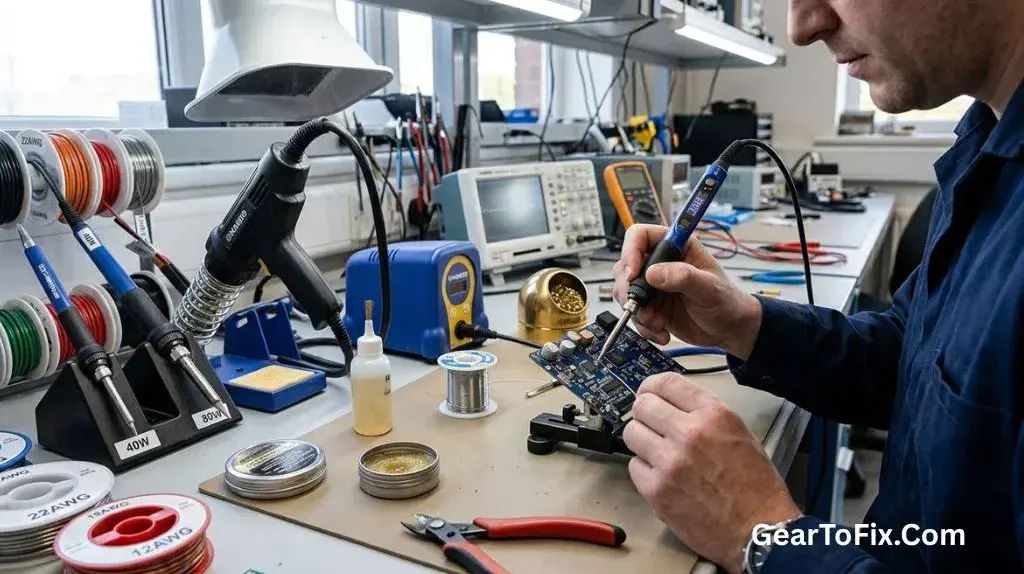
What Wattage Do I Need for Wires?
For small wires, approximately 40–60 watts is often adequate. Larger wires, cable terminals, battery tabs, and heavy connectors may require 60–100 watts or more, depending on the joint design and the amount of metal absorbing heat.
Wire soldering usually benefits from:
- A tip with enough surface area to transfer heat efficiently
- Adequate temperature control
- A clean, properly tinned tip
- Pre-tinned wire ends when appropriate
- A joint that is mechanically stable before heating
A common mistake is trying to solder a large wire with a very fine tip. The problem may appear to be insufficient wattage, but the small tip may simply be unable to transfer enough heat. Changing to a wider tip can improve performance without changing the iron.
For very heavy cables, large terminals, or substantial copper connections, a soldering iron may not be the right tool. A soldering gun, high-powered soldering station, or another joining method may be more appropriate, depending on the application and safety requirements.
What Wattage Is Best for Lead-Free Solder?
Lead-free solder commonly needs more heat and may require better heat recovery than traditional leaded solder. For general lead-free electronics work, a 50- to 70-watt temperature-controlled iron can provide a useful balance of control and performance.
The exact setting depends on the solder composition, flux, component sensitivity, tip condition, and workpiece. Follow the solder manufacturer’s guidance when available rather than assuming one temperature applies to every lead-free product.
A higher wattage does not remove the need for proper technique. If lead-free solder will not flow, check these factors before simply increasing the temperature:
- The tip may be oxidized or poorly tinned.
- The joint may be dirty or contaminated.
- The tip may be too small for the connection.
- The component or wire may be moving.
- The solder may not contain enough suitable flux.
- The iron may be losing heat because the joint is too large for its capacity.
Temperature Control Matters More Than Wattage Alone
A soldering iron’s wattage tells you how much electrical power it can use, but it does not fully describe how the tool performs. Two irons with the same wattage can behave differently because of their heating elements, sensors, control circuits, tip construction, and thermal design.
A temperature-controlled iron measures or regulates the heater so the tip stays near the selected operating temperature. When the tip contacts a cool joint, the system can increase power to recover the lost heat.
This is why a temperature-controlled 60-watt iron is often more useful than a basic 100-watt iron with little or no regulation. The controlled model can provide:
- More consistent solder flow
- Better protection for heat-sensitive components
- Faster recovery during repeated work
- Greater control over different solder types
- Less need to guess how hot the tip is
Some basic soldering irons are described by wattage but do not offer precise temperature adjustment. They may be adequate for occasional simple repairs, but they provide less control when working with modern electronics or heat-sensitive materials.
How Tip Size Affects the Wattage You Need
The tip transfers heat from the iron to the joint. A tip that is too small may not make enough contact with the work, even if the soldering iron has plenty of wattage.
A larger tip can transfer heat more effectively because it provides greater contact with the joint. Use a tip that is large enough for the connection but still allows you to work without touching nearby components.
As a general approach:
- Use a fine tip for small pads and closely spaced leads.
- Use a medium chisel or bevel tip for general circuit-board work.
- Use a larger chisel or bevel tip for wires, terminals, and broad copper areas.
Tip shape also matters. A chisel or bevel tip often transfers heat more effectively than an extremely fine conical tip because more of its surface contacts the joint.
A large tip on a high-wattage iron is not automatically better. It can transfer too much heat to a small pad or make it difficult to avoid nearby components. Match the tip to the joint rather than choosing the largest available option.
How to Tell If Your Soldering Iron Has Enough Wattage
Your soldering iron may not have enough effective heating capacity if the joint remains difficult to heat even when the technique is correct.
Possible signs include:
- Solder takes a long time to melt on a properly heated joint.
- The tip temperature drops sharply when it touches the work.
- Solder forms a bead instead of flowing across the joint.
- Large terminals require prolonged contact.
- The iron works on small pads but struggles with ground planes or thick wires.
- Several consecutive joints become increasingly difficult.
- The solder freezes before it wets the surfaces.
These symptoms do not always mean the wattage is too low. Check the simpler causes first:
- Clean and tin the tip. Oxidation reduces heat transfer.
- Use the correct tip size. A tip that is too small may be the main problem.
- Confirm the temperature setting. The selected temperature may be unsuitable for the solder or joint.
- Add appropriate flux. Clean surfaces and adequate flux help solder flow.
- Secure the work. Movement can prevent a reliable joint.
- Check the soldering iron’s condition. A worn heater, damaged tip, or faulty control system can reduce performance.
If the iron still loses too much heat after these checks, a higher-powered model may be appropriate.
Common Wattage Mistakes
Choosing the Highest Wattage Available
More power is not automatically better. A high-wattage iron can still be useful for delicate work if it is properly controlled, but buying excess power may add cost, size, and complexity without improving your results.
Choose enough capacity for your largest regular task, not the most demanding job you might perform once.
Assuming Low Wattage Protects Components
A low-wattage iron is not automatically safer for electronics. If it cannot heat the joint efficiently, you may hold it against the component for too long. Prolonged heating can damage pads, insulation, or heat-sensitive parts.
Controlled temperature, proper tip selection, and short, efficient contact are more useful than low wattage alone.
Ignoring Heat Recovery
Two irons may have similar wattage but different recovery behavior. Heat recovery describes how quickly the tip returns to its selected temperature after transferring heat to the joint.
This matters when soldering large connections or working continuously. A tool that recovers poorly may seem powerful on paper but perform slowly in actual use.
Using a Fine Tip for Every Job
A very fine tip is useful for small pads but performs poorly on thick wires and large terminals. It may not transfer enough heat, even when the soldering iron itself has adequate wattage.
Keep several compatible tip sizes available if you work on different types of projects.
Holding the Tip on the Joint Too Long
Long contact time can damage circuit-board pads, insulation, or components. If the joint does not heat efficiently, improve the tip condition, flux, tip size, or tool capacity rather than simply holding the iron in place longer.
A Practical Way to Choose Your Wattage
If you are buying one general-purpose soldering iron, consider a temperature-controlled model in the 50- to 60-watt range. This offers useful flexibility for many electronics projects, small wires, connectors, and routine repairs.
Choose a lower range when:
- You only work on very small electronic joints.
- Portability and low power use matter.
- Your projects do not include large wires or heat-absorbing connections.
Choose a higher range when:
- You regularly solder thick wires.
- You work with large terminals or connectors.
- Your circuit boards contain substantial ground planes.
- You use lead-free solder frequently.
- You need fast recovery during continuous work.
Also check whether the iron supports suitable replacement tips, provides stable temperature control, and is designed for the voltage and electrical system where you will use it.
Safety Considerations
Soldering irons can cause burns, ignite nearby materials, and produce irritating fumes. Use the tool on a stable, heat-resistant surface and keep the hot tip away from cables, plastics, paper, and other combustible items.
Use ventilation appropriate for the solder and flux you are working with. Do not touch molten solder or the metal tip, and place the iron in its stand whenever it is not in use. Wash your hands after handling solder, especially when working with solder that contains lead, and follow applicable handling guidance for the materials.
Disconnect or de-energize the equipment being repaired unless the specific procedure requires otherwise and can be performed safely. Never solder a powered circuit simply because the iron has a suitable wattage.
FAQs Of What Wattage Soldering Iron Do I Need
Is a 40-watt soldering iron enough for electronics?
A 40-watt iron can be sufficient for many small electronics jobs, especially when it has temperature control and an appropriate tip. It may struggle with large ground planes, thick wires, or heavy connectors that absorb heat quickly.
Is a 60-watt soldering iron good for beginners?
A temperature-controlled 60-watt iron can be a practical choice for beginners because it provides enough capacity for many common tasks without being limited to tiny joints. The user still needs to select a reasonable temperature and tip size.
Can a 25-watt soldering iron melt solder?
Yes, a 25-watt iron can melt solder if it reaches a suitable operating temperature. Its limitation is usually heat recovery. It may work for small joints but lose heat quickly on larger connections.
Does higher wattage mean a hotter soldering iron?
No. Wattage describes available electrical power, not necessarily the operating temperature. A temperature-controlled iron can use higher wattage to maintain its selected temperature when the joint draws heat away.
What wattage is best for soldering copper wire?
Small copper wires may only need around 40–60 watts, while thicker wires and large terminals can require 60–100 watts or more. Tip size, wire mass, flux, and the connection design also affect the result.
Can I use a 100-watt soldering iron on a circuit board?
Yes, if the iron has suitable temperature control and you use an appropriate tip and technique. For small circuit-board work, 100 watts may be more capacity than necessary, but it is not automatically unsafe or unsuitable.
Final Takeaway
For most people, a 30- to 60-watt temperature-controlled soldering iron is enough for electronics and general repair work. Choose closer to 30–40 watts for small, delicate joints and closer to 50–60 watts for broader everyday use. Thick wires, large terminals, ground planes, and continuous work may justify 60–100 watts or more.
The best choice is not simply the highest-wattage iron. Look for a tool with stable temperature control, suitable tip sizes, and enough heat recovery for the largest joints you regularly solder.

Scott Yarnell is a tool expert focused on practical guides, product research, and real-world tool performance to help readers make informed decisions.