
Soldering Iron vs Heat Gun: Electronics Repair Guide
A Soldering Iron Vs Heat Gun comparison often starts with a simple question: both produce heat, so can one replace the other? In most cases, no. A soldering iron delivers concentrated heat through a metal tip, while a heat gun moves hot air across a wider area.
That difference affects precision, temperature control, component safety, and the type of work each tool can handle. A soldering iron is designed mainly for forming controlled solder joints. A heat gun is better suited to shrinking tubing, softening materials, removing finishes, and heating larger areas. Specialized hot-air rework stations can also remove or install surface-mount components, but a general-purpose heat gun is not the same tool.
The Main Difference: Contact Heat vs. Moving Hot Air
The most important difference is how each tool transfers heat.
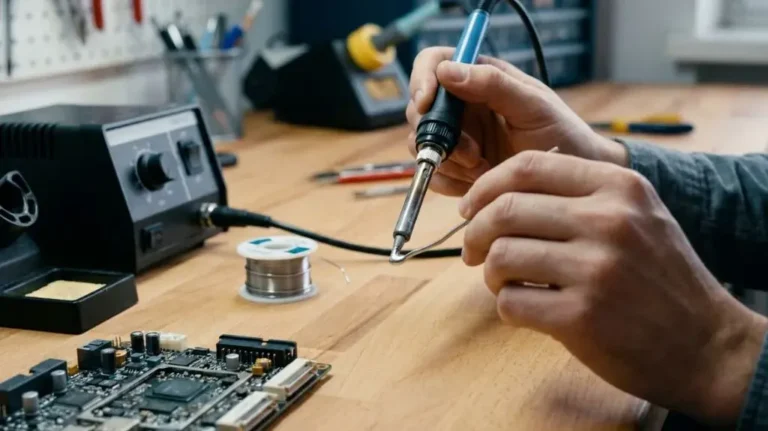
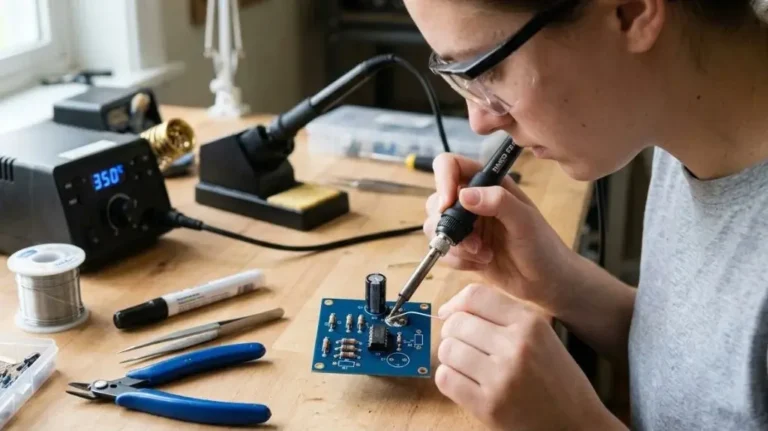
A soldering iron heats a replaceable tip. You place that tip directly against a wire, pad, terminal, or component lead. Because the contact area is small, heat can be directed to a specific joint.
A heat gun uses an electric heating element and a fan to blow hot air through a nozzle. It heats the surrounding air rather than a solid tip. This makes it useful for covering a broader area, but it also makes the heat less precise.
In practical use:
- A soldering iron heats one solder joint with controlled contact.
- A heat gun warms several nearby parts or a larger surface.
- A soldering iron transfers heat mechanically through its tip.
- A heat gun transfers heat through airflow and radiation.
- A soldering iron is usually easier to control around delicate electronics.
- A heat gun can be more useful when contact with the workpiece is undesirable.
The tools may both be described as heating tools, but their working methods are fundamentally different.
Soldering Iron vs Heat Gun at a Glance
The following comparison focuses on general-purpose soldering irons and heat guns. Specialized hot-air rework equipment is considered separately because it offers more control than a typical workshop heat gun.
| Feature | Soldering Iron | Heat Gun |
|---|---|---|
| Heat delivery | Concentrated through a metal tip | Broad stream of hot air |
| Best suited for | Soldering wires, terminals, and through-hole joints | Heat-shrink tubing, softening, stripping, and broad-area heating |
| Precision | High | Low to moderate, depending on nozzle and airflow control |
| Contact with workpiece | Required for most soldering | Usually avoided |
| Control around components | Generally easier | More difficult because hot air spreads |
| Surface-mount rework | Suitable with the right tip and technique | Possible only with suitable temperature and airflow control |
| Risk of moving nearby parts | Low when used carefully | Higher because airflow and heat affect surrounding parts |
The table shows why neither tool is universally better. The correct choice depends on whether the job needs precise contact heating or broad, contact-free heating.
Why a Soldering Iron Is Better for Making Solder Joints
A soldering iron is the practical choice when the goal is to join electrical conductors with solder.
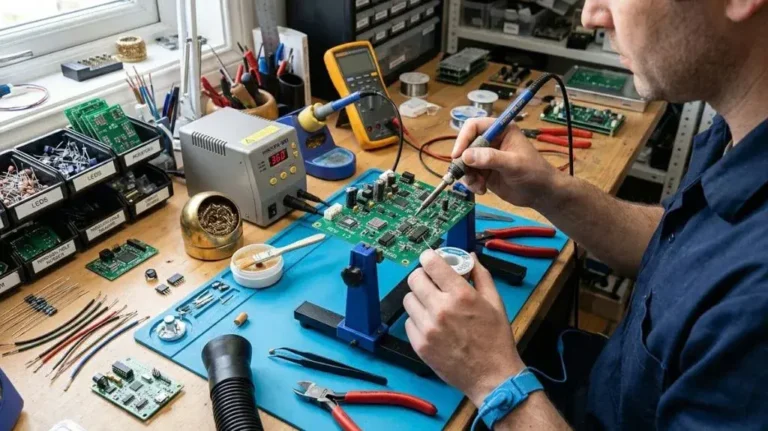
The tip can be positioned directly on the joint, allowing the metal surfaces to reach soldering temperature without heating the entire assembly. This is especially useful for:
- Joining wires
- Soldering components to through-hole circuit boards
- Repairing broken terminals
- Attaching connectors
- Tinning wire ends
- Touching up individual solder joints
- Removing solder with a suitable tip and wick
A soldering iron also gives the user physical feedback. You can see and control where the tip contacts the work. With a temperature-controlled model, the iron can maintain a more suitable working temperature as the joint absorbs heat.

Precision matters more than maximum temperature
A common mistake is to assume that the tool with the highest temperature is automatically better. Soldering depends on controlled heat transfer, not simply on producing extreme heat.
Too little heat can create a weak, dull, or poorly wetted joint. Too much heat can lift circuit-board pads, damage insulation, overheat components, or oxidize the tip quickly.
A soldering iron gives you several ways to control the process:
- Tip shape
- Tip size
- Contact position
- Contact time
- Temperature setting
- Amount of solder and flux
That level of control is difficult to achieve with a general-purpose heat gun.
Where a Heat Gun Makes More Sense
A heat gun is more practical when the job involves heating material over an area rather than forming one precise joint.
Typical uses include:
- Shrinking heat-shrink tubing
- Softening adhesive
- Removing labels or vinyl
- Bending or forming some plastics
- Loosening certain fasteners or fittings
- Stripping paint with the appropriate precautions
- Drying or warming materials
- Removing conformal coatings in controlled situations
For heat-shrink tubing, a heat gun can warm the tubing evenly without touching the wire or connector. A soldering iron can shrink tubing in an emergency, but bringing a hot tip close to insulation is less controlled. It can scorch, puncture, or melt the tubing.
A heat gun is also useful when the workpiece is too large or awkward to heat with a soldering iron tip. The trade-off is that nearby materials receive heat too, whether you want them to or not.
Can You Use a Heat Gun to Solder?
You can use hot air to melt solder, but a general-purpose heat gun is usually a poor substitute for a soldering iron.
A heat gun may soften or melt solder on large metal parts, heavy wires, or some connectors. It can also help with certain disassembly tasks when the surrounding materials can tolerate the heat. But it often lacks the fine temperature and airflow control needed for reliable electronic soldering.
Several problems can occur:
- Nearby components may become hot before the target joint melts.
- Airflow can move loose components or disturb molten solder.
- Plastic housings and insulation may deform.
- Circuit-board pads may delaminate or lift.
- Solder can melt unevenly across the work area.
- The operator may have difficulty seeing and controlling the joint.
A hot-air rework station is different. It is designed for electronics work and normally provides adjustable temperature, airflow, nozzles, and a more controlled heating pattern. Even then, it is mainly useful for surface-mount rework, component removal, and solder paste work—not as a universal replacement for an iron.
Can You Use a Soldering Iron Instead of a Heat Gun?
A soldering iron can handle a few small heating tasks, but it cannot replace a heat gun in general use.
It works reasonably well for:
- Shrinking a small section of heat-shrink tubing
- Softening a tiny spot of adhesive
- Melting a small plastic edge
- Heating a small terminal or connector
The iron’s tip can apply heat exactly where needed, which is useful when the target area is very small. The problem is that the tip can leave marks or make direct contact with surfaces that should not be touched.
A soldering iron is not practical for:
- Heating wide areas
- Shrinking long sections of tubing evenly
- Stripping paint
- Softening large adhesive surfaces
- Forming larger plastic parts
- Warming an object without touching it
If the task needs moving hot air, a soldering iron will be slow, uneven, and awkward.
Temperature and Airflow Control Change the Comparison
Not all heat guns or soldering irons offer the same level of control.
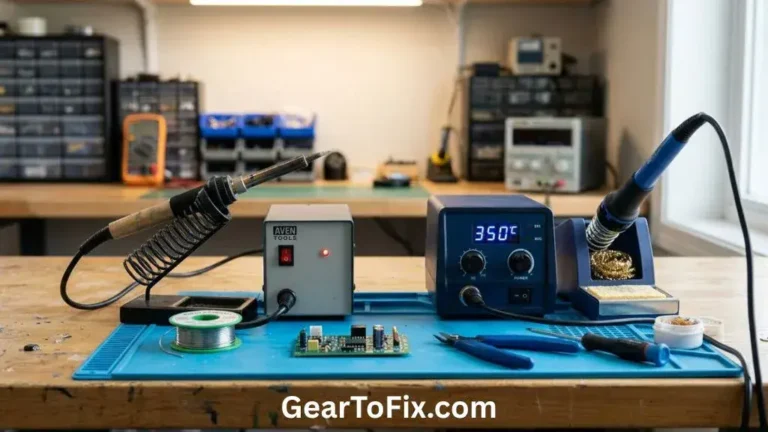
A basic soldering iron may have a fixed operating temperature. A temperature-controlled soldering iron or station allows the user to adjust the working temperature and often recovers heat more effectively when touching a large joint.
Heat guns vary even more. Some basic models have limited temperature settings and a single airflow level. More capable versions may provide:
- Adjustable temperature
- Variable airflow
- Different nozzles
- A stable stand
- A cooler air setting
- Better control at lower heat levels
For electronics, airflow is particularly important. High airflow can blow small components away or spread heat beyond the intended area. A lower airflow setting with a suitable nozzle is generally easier to control.
Temperature readings also need to be interpreted carefully. The displayed setting is not necessarily the exact temperature at the workpiece. Nozzle distance, airflow, surface material, and exposure time all affect the actual heat reaching the target.
Working on Circuit Boards: Which Tool Is Safer?
For ordinary circuit-board soldering, a soldering iron is usually the safer and more predictable choice.
It heats a small region, making it easier to avoid:
- Plastic connectors
- Nearby capacitors
- Wire insulation
- Adhesives
- Battery housings
- Heat-sensitive sensors
- Board coatings
A heat gun can be used for some circuit-board operations, but it demands more control and awareness. Broad hot air can heat the entire board or loosen components that were not meant to move.
When using hot air for electronics, the nozzle should stay moving unless the process specifically requires otherwise. Shielding nearby parts with suitable materials can help, but shielding is not a substitute for correct temperature and airflow settings.
For removing surface-mount components, a proper hot-air rework station is generally more suitable than a household or construction heat gun. The latter may produce too much heat and airflow for delicate boards.
Heat-Shrink Tubing: A Clear Example of Overlap
Heat-shrink tubing is one of the few common jobs where both tools can work.
A heat gun is usually better because it heats the tubing without touching it. This helps produce an even result and reduces the chance of damaging the insulation.
A soldering iron can be useful when:
- The tubing is very small
- The work is in a confined space
- No heat gun is available
- Nearby parts must receive as little surrounding heat as possible
To use an iron for this purpose, keep the tip close without pressing into the tubing. Direct contact can create a hole or a melted spot. For longer tubing, a heat gun normally gives a more consistent finish.
A dedicated hot-air tool may offer better control than a high-powered general-purpose heat gun, especially around small connectors and delicate wiring.
Which Tool Is Easier for Beginners?
For learning basic electrical soldering, a temperature-controlled soldering iron is generally easier to understand and control.
The beginner can focus on a small number of variables:
- Clean and tin the tip.
- Heat the joint, not just the solder.
- Feed solder into the heated joint.
- Remove the solder and iron cleanly.
- Let the joint cool without movement.
A heat gun can seem simple because it does not require direct contact, but broad heat is less forgiving. Beginners may accidentally overheat surrounding materials, shrink tubing unevenly, soften plastic, or move small parts with the airflow.
The easier tool still depends on the task. A beginner shrinking tubing may find a heat gun more natural than trying to use an iron. Someone attaching wires to a connector will normally have a much easier time with a soldering iron.
Common Mistakes When Comparing the Two
Assuming both tools are interchangeable
They overlap only in limited heating tasks. A heat gun is not a precision soldering tool, and a soldering iron is not a general-purpose hot-air source.
Choosing based only on temperature
The highest temperature is not necessarily useful. Heat concentration, control, airflow, and the material being heated matter just as much.
Using a construction heat gun on delicate electronics
A general-purpose heat gun may be designed for paint stripping, heavy plastic work, or large surfaces. Its heat output and airflow can be excessive for small circuit boards.
Holding a heat gun still
Leaving hot air on one spot for too long can damage insulation, plastic, adhesives, and circuit boards. Movement, distance, and the correct nozzle are important.
Using an iron tip directly on heat-shrink tubing
This can work for small repairs, but contact makes it easy to scorch or puncture the tubing.
Ignoring the workpiece’s heat capacity
Large metal terminals and heavy wires draw heat away quickly. In those cases, a soldering iron with inadequate power may struggle, while a high-output model or suitable tip can make the work easier. That does not mean the heat gun is automatically the right answer; uncontrolled surrounding heat can create new problems.
Safety Differences Worth Taking Seriously
Both tools become hot enough to cause burns, ignite materials, and damage components.
With a soldering iron:
- Use a stable stand.
- Keep the tip away from cords and flammable surfaces.
- Do not leave the iron unattended.
- Clean and tin the tip appropriately.
- Avoid breathing directly over flux smoke.
With a heat gun:
- Keep the airflow away from skin, cables, and combustible materials.
- Remember that the nozzle and nearby metal remain hot after switching off.
- Provide ventilation when heating coatings, plastics, or adhesives.
- Secure small parts so airflow cannot move them.
- Avoid heating sealed containers, batteries, or unknown materials.
The material being heated is part of the safety decision. Plastics, coatings, adhesives, and electronic components can release irritating fumes or suffer permanent damage when overheated.
What Features Matter When Choosing Between Them?
If your work is mainly electrical assembly, prioritize a soldering iron with:
- Adjustable temperature
- Suitable tip availability
- Comfortable grip
- Flexible cord
- Stable stand
- Adequate power for your typical joints
- Replaceable tips
For heat-shrink, plastics, adhesives, or broader heating jobs, look for a heat gun with:
- Adjustable temperature
- Adjustable airflow
- Useful nozzle options
- A stable stand
- A manageable size and weight
- Clear controls
- Replacement nozzles or serviceable parts
For electronics hot-air work, choose equipment specifically designed for rework rather than assuming a general-purpose heat gun will provide the necessary control.
Frequently Asked Questions: Soldering Iron Vs Heat Gun
Is a heat gun better than a soldering iron for electronics?
No. A soldering iron is generally better for precise solder joints and ordinary board repairs. A controlled hot-air rework tool is useful for certain surface-mount tasks, but a general-purpose heat gun can easily spread too much heat.
Can a heat gun remove solder?
Yes, a heat gun can melt solder on some large or heat-tolerant assemblies, but it is usually too broad and difficult to control for delicate electronics. Desoldering braid, a solder sucker, or a suitable rework tool is normally more practical.
Can a soldering iron shrink heat-shrink tubing?
Yes, especially on small sections. Keep the tip close without touching the tubing when possible. A heat gun is usually better for even shrinking and longer sections.
Which tool uses less heat on nearby components?
A soldering iron usually affects a smaller area because heat is concentrated at the tip. A heat gun can warm surrounding components and materials, particularly at high airflow or when held too close.
Do I need both a soldering iron and a heat gun?
You may benefit from both if you solder wires or electronics and also use heat-shrink tubing, adhesives, plastics, or other heat-sensitive materials. If your work is limited to solder joints, start with a suitable soldering iron.
Is a hot-air rework station the same as a heat gun?
No. A hot-air rework station is designed for controlled electronics work and normally offers more precise temperature, airflow, and nozzle control. A general-purpose heat gun is intended for broader heating applications.
Final Verdict
A soldering iron is the right tool for precise electrical connections, wire work, terminals, and most conventional soldering. A heat gun is better for heat-shrink tubing, adhesives, plastics, coatings, and larger areas where contact heating is unsuitable.
Neither tool fully replaces the other. A soldering iron is too narrow for broad heating, while a general-purpose heat gun is too uncontrolled for many delicate soldering jobs. If surface-mount rework is the goal, a dedicated hot-air rework station is a more appropriate third option than trying to force either basic tool to do work it was not designed to handle.

Scott Yarnell is a tool expert focused on practical guides, product research, and real-world tool performance to help readers make informed decisions.