Soldering Iron Sponge vs Brass – Cleaning, Moisture, Wear
Keeping your soldering iron tip clean is the single most important factor in achieving clean joints, maintaining heat transfer, and extending the lifespan of your tools. A dirty, oxidized tip resists solder flow, transfers heat poorly, and can ruin delicate components.
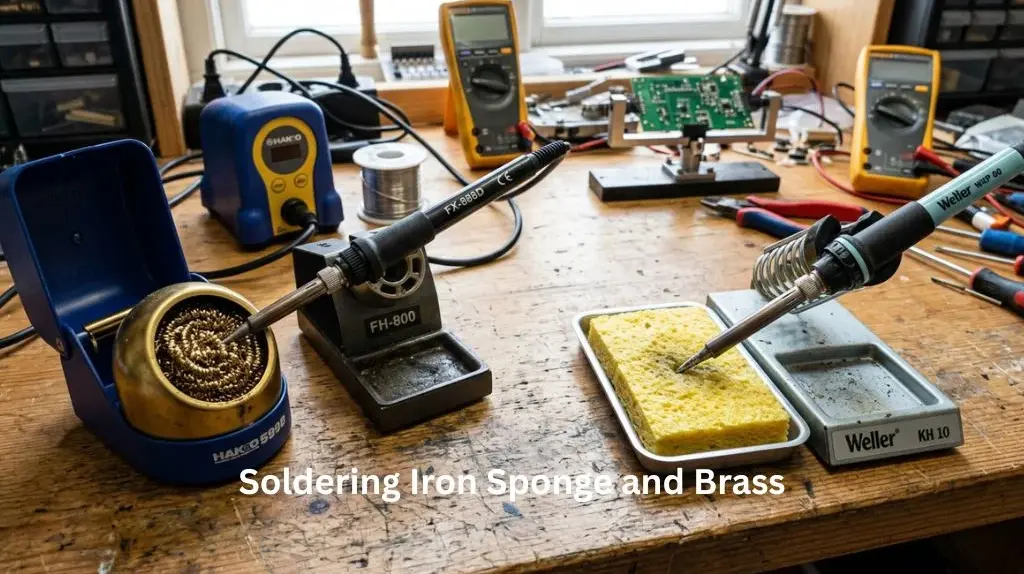
When it comes to tip cleaning, the two standard options are the traditional wet cellulose sponge and the modern brass wire coil.
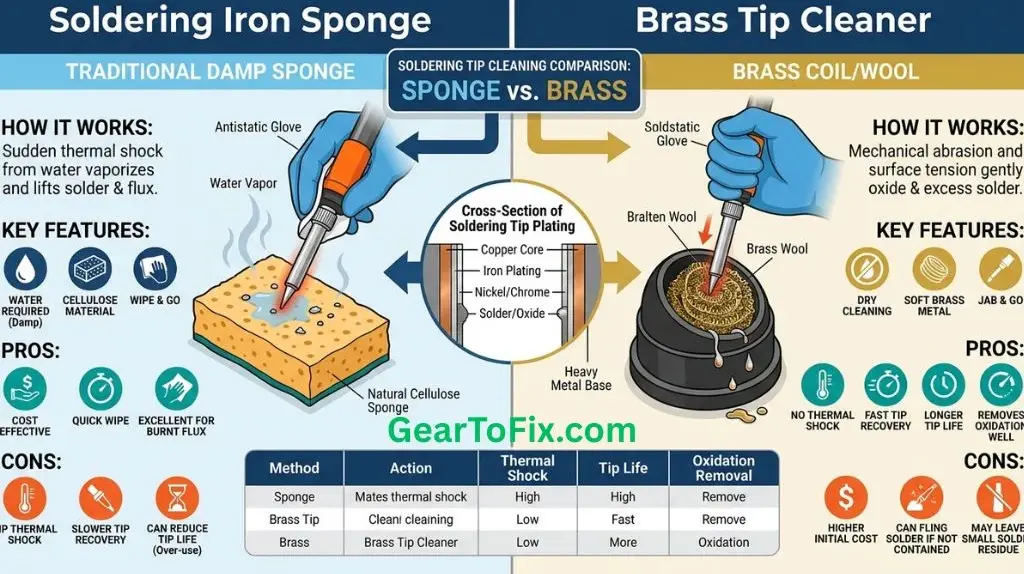
The main difference between a soldering iron sponge and a brass wire cleaner is how they remove debris: a wet cellulose sponge cleans via thermal shock and steam, while a brass wire cleaner uses mechanical abrasion. The wet sponge is highly effective at removing stubborn flux residue but drops the tip’s temperature significantly. The brass wire cleaner removes excess solder and light oxidation without cooling down the tip, making it much better for continuous work and tip longevity.
Here is a practical, workshop-focused look at how these two cleaning accessories compare, how they impact your workflow, and when you should use each.
How They Work: The Science of Cleaning a Hot Tip
To understand why these two tools perform differently, you have to look at how they interact with a hot soldering tip.
The Wet Cellulose Sponge
A soldering sponge is made of natural cellulose designed to hold water without melting. When you swipe a hot, solder-laden tip across a damp sponge, the water instantly vaporizes into steam. This sudden burst of steam, combined with the rapid contraction of the metal (thermal shock), forces the old solder and burnt flux to release from the tip and stick to the sponge.
The Brass Wire Cleaner
Often called “brass wool” or a “golden sponge,” this cleaner consists of coiled brass wire housed in a small container. Brass is a soft metal—softer than the iron plating used on soldering iron tips. When you plunge your hot tip into the brass coils, the metal ribbons scrape away excess solder, dross, and oxide buildup without scratching the underlying iron plating.
Temperature Control and Heat Retention
In electronics work, maintaining a stable tip temperature is critical. This is where the difference between these two cleaners is most obvious.
Brass wire cleaners are vastly superior for heat retention. Because the brass wire is dry, it removes debris without absorbing significant heat from the iron. When you clean your tip with brass, you can immediately return to soldering.
Wet sponges cause a massive, sudden temperature drop. Touching a $350^\circ\text{C}$ ($662^\circ\text{F}$) metal tip to a wet sponge cools the tip instantly. The heater in your soldering iron must then work hard to recover that lost heat. If you are using a low-wattage iron or working on a heat-sinked ground plane, this temperature drop can cause cold solder joints if you do not wait several seconds for the iron to recover.
Impact on Tip Longevity and Wear
Replacing soldering tips can become expensive over time. The cleaner you choose directly impacts how long your tips will last.
A wet sponge accelerates tip wear through thermal fatigue. The rapid cycle of heating and cooling (thermal shock) causes the copper core and the outer iron plating of the tip to expand and contract at different rates. Over time, this microscopic stress causes the iron plating to crack. Once the plating cracks, the copper core quickly dissolves into the solder, ruining the tip.
Brass wire is much gentler on the tip’s physical structure. Because it does not cause thermal shock, it eliminates thermal fatigue. While it is abrasive, the brass alloy is soft enough that it will not wear through the iron plating under normal use.
Furthermore, a wet sponge strips all the solder off the tip, leaving the bare iron plating exposed to oxygen, which causes rapid oxidation. A brass wire cleaner leaves a micro-thin layer of clean solder on the tip, protecting it from oxidation between joints.
Practical Usability and Workshop Convenience
Beyond performance, the day-to-day logistics of your workshop play a role in which tool is more practical.
- Preparation: A wet sponge requires water. If you work in a basement, garage, or field environment, having to wet the sponge before every session is a chore. If the sponge dries out during a long session, it will burn when touched by the iron. Brass wire requires zero preparation; it is always ready to use.
- Debris Control: Plunging an iron into a brass wire holder keeps the scraped solder inside the metal container. Cleaning a tip on a sponge can occasionally cause solder to “flick” or splatter onto your workbench, your circuit board, or your skin.
- Residue Removal: The one area where the wet sponge excels is removing baked-on, sugary flux residues. Some sticky flux formulations do not scrape off easily with dry brass wire but dissolve instantly when hit with the steam of a wet sponge.
Comparison: Sponge vs. Brass Wire
Here is a direct comparison of the key performance factors for both cleaning methods.
| Feature | Wet Cellulose Sponge | Brass Wire Cleaner |
|---|---|---|
| Cleaning Action | Steam & Thermal Shock | Mechanical Scraping |
| Tip Temperature Drop | High ($50^\circ\text{C}$ to $100^\circ\text{C}$) | Extremely Minimal |
| Tip Wear Rate | Higher (due to thermal fatigue) | Lower (gentle mechanical wear) |
| Preparation Required | Needs water before use | Ready to use instantly |
| Risk of Splattering | Low to moderate (solder can flick) | Very low (debris stays in holder) |
| Stubborn Flux Removal | Excellent (steam dissolves residue) | Moderate (may require multiple wipes) |
| Protective Solder Layer | Strips tip completely bare | Leaves a thin protective solder layer |
When to Use Each Cleaner
You do not necessarily have to choose one to the exclusion of the other. Many experienced technicians keep both on their bench.
When the Brass Wire is Better
- Production work: When you need to make joint after joint without waiting for the iron to reheat.
- Lead-free soldering: Lead-free solder requires higher working temperatures, which naturally increases oxidation. Brass keeps the tip hot and protected.
- Delicate electronics: When soldering temperature-sensitive SMD components where temperature fluctuations must be minimized.
- General daily use: For $90%$ of standard soldering tasks, brass is the cleaner, faster, and more tip-friendly option.
When the Wet Sponge is Better
- Heavy flux clean-up: When using highly active, sticky, or corrosive fluxes that leave a thick, caramelized lacquer on the tip.
- End-of-session cleaning: Gently wiping the tip on a damp sponge to remove the last traces of burnt flux before applying fresh solder and turning off the station.
- Low-temperature soldering: When working at lower temperatures where thermal shock is less severe.
Common Mistakes and Misconceptions
Mistake 1: Using the Sponge Dripping Wet
A common beginner mistake is soaking the cellulose sponge until it is swimming in water. A dripping wet sponge cools the tip down too aggressively, floods the heater, and can actually crack the ceramic heating element of some irons. The sponge should only be damp—squeeze out all excess water before starting.
Mistake 2: Substituting Steel Wool for Brass Wire
Never use standard kitchen steel wool, copper scouring pads, or stainless steel sponges to clean a soldering tip. Steel is much harder than the iron plating on your soldering tip. Using steel wool will strip the plating off the tip in a single afternoon, rendering it useless. Always ensure you are using genuine brass wire designed specifically for soldering.
Frequently Asked Questions: Soldering Iron Sponge vs Brass
Does brass scratch or damage soldering iron tips?
No, genuine brass wire will not scratch your soldering tip. Brass is a softer metal than the iron plating used to protect the copper core of soldering tips. It easily scrapes away solder and oxide without gouging the hard iron surface.
Why does my wet sponge burn when I touch it with the iron?
This happens when the sponge is too dry. Cellulose sponges must be damp to work. The water in the sponge absorbs the heat and vaporizes, protecting the wood-fiber cellulose from burning. If the sponge is dry, the heat of the iron will scorch and melt the fibers.
Can I use a regular kitchen sponge instead of a soldering sponge?
No, you should not use standard synthetic kitchen sponges. Most kitchen sponges are made of polyurethane or polyester, which will melt instantly upon contact with a hot soldering iron. This leaves melted plastic stuck to your tip, which is incredibly difficult to remove and ruins heat transfer. Only use natural cellulose sponges.
How often should I replace my brass wire cleaner?
You only need to replace the brass coil when it becomes saturated with old solder and debris, or when the wire begins to flatten and lose its springiness. For hobbyists, a single brass coil can last a year or more. You can occasionally take the coil out of its container and shake out the loose solder dust to extend its life.
Final Verdict
The brass wire cleaner is the modern standard for a reason. By eliminating thermal shock, preserving tip temperature, and requiring no water, it makes soldering faster, cleaner, and cheaper in the long run.
However, the wet cellulose sponge is not obsolete. It remains a valuable secondary tool for dissolving stubborn flux residues that dry brass cannot scrape away.
For the best setup, use a brass wire cleaner as your primary, everyday tool to keep your workflow fast and preserve your tips. Keep a damp cellulose sponge nearby as a secondary cleaner for those times when your tip accumulates heavy, caramelized flux buildup that needs a blast of steam to clear away.

Scott Yarnell is a tool expert focused on practical guides, product research, and real-world tool performance to help readers make informed decisions.