Analog Vs Digital Soldering Station: Which Is Best?
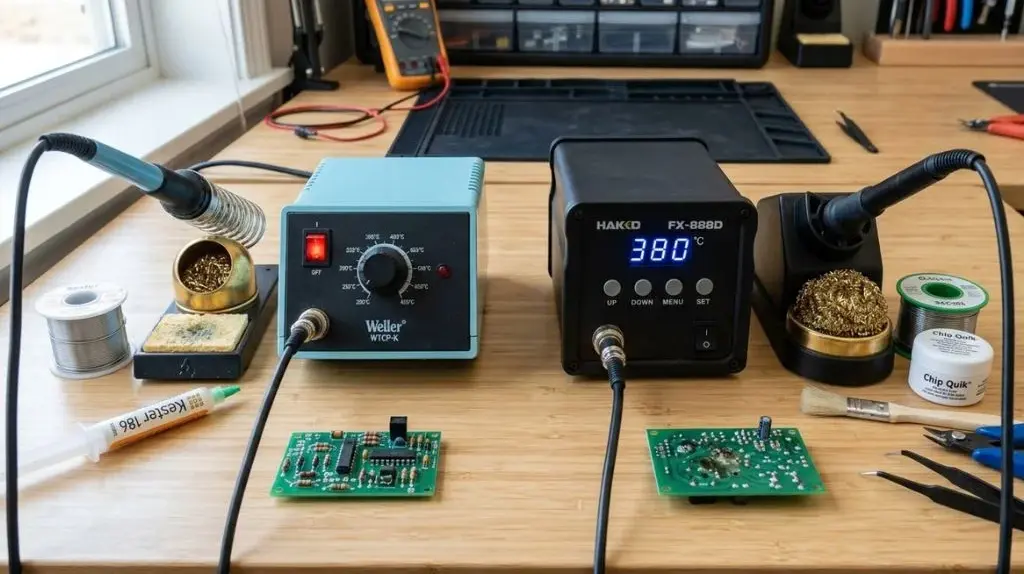
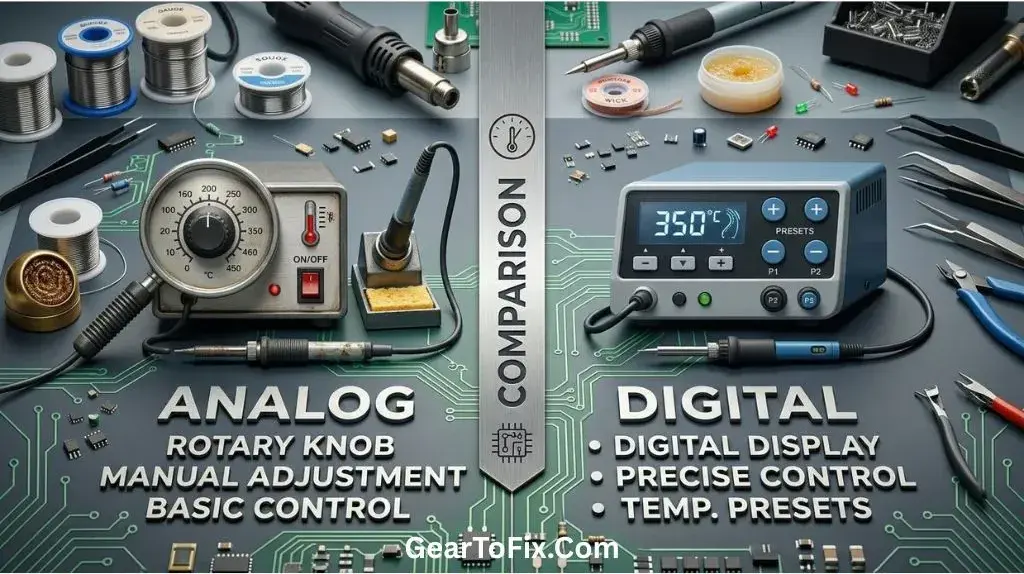
The main difference between an analog and digital soldering station is how you set and monitor temperature. Analog stations usually use a rotary dial and may rely on a simple thermostat or analog control circuit. Digital stations use electronic controls and a display to show the selected temperature.
That difference affects convenience, repeatability, and sometimes accuracy—but a digital display does not automatically mean better soldering performance. The heating element, temperature sensor, tip design, power rating, and heat recovery system often matter just as much.
An analog station may be the more practical choice for straightforward repair work and hobby projects. A digital station becomes more useful when you regularly switch between solder types, component sizes, or temperature settings and want to return to the same setting quickly.
What the Two Station Types Actually Control
Both types are designed to regulate the temperature of a soldering iron connected to a separate control unit. Unlike a basic plug-in soldering iron, a soldering station normally provides a stable stand, temperature control, and a replaceable tip system.
The key distinction is the user interface and control electronics:
- Analog station: Temperature is normally adjusted with a dial. The setting may be marked with numbers or temperature ranges.
- Digital station: Temperature is adjusted with buttons, a dial, or a combination of controls, and shown on a display.
Some analog stations use feedback from a temperature sensor to regulate the tip. They are not necessarily uncontrolled or crude. Likewise, some inexpensive digital stations display a target temperature without measuring the tip temperature with exceptional accuracy.
This is why the label alone should not determine your choice.
Temperature Setting Versus Actual Tip Temperature
A digital station usually makes it easier to select a specific temperature, but the number on the screen is not always the exact temperature at the working point of the tip.
The displayed value may represent:
- The target temperature selected by the user
- The temperature measured by an internal sensor
- An estimated heater or cartridge temperature
- A regulated value that differs slightly from the tip surface temperature
Analog stations have a similar limitation. The markings around the dial provide a reference, but they may not correspond perfectly to the temperature at the tip.
Actual tip temperature can change because of:
- Tip shape and size
- Contact with a large copper pad
- Soldering time
- Air movement
- Oxidation or contamination on the tip
- The station’s sensor location
- The soldering iron’s power and heat recovery
For most hobby and repair work, consistent heat delivery is more important than whether the station uses a dial or a display.
How Analog and Digital Stations Differ During Real Use
The practical difference becomes clearer when you use the station repeatedly rather than simply setting it once.
| Feature | Analog Station | Digital Station |
|---|---|---|
| Temperature adjustment | Rotary dial, usually quick and simple | Buttons, encoder, or keypad with display |
| Repeatability | Good if the dial markings are consistent | Usually easier to return to an exact setting |
| Temperature display | Approximate scale or no exact readout | Numeric display, though accuracy varies |
| Controls and features | Usually fewer and simpler | May include presets, sleep mode, lockout, or calibration |
| Learning curve | Very short | Slightly more interface-related setup |
An analog dial is fast when you already know the approximate setting needed. You turn the control, wait for the station to stabilize, and begin working.
A digital station takes a little more interaction, but it gives you a clearer reference. If you use one temperature for leaded solder and another for lead-free solder, a digital display makes those changes easier to repeat.
Heat-Up Time and Heat Recovery Are Separate Issues
Digital control does not automatically make a station heat faster or recover faster after a large joint pulls heat away.
Heat-up time is how long the iron takes to reach its operating temperature. Heat recovery is how quickly it returns to temperature after touching a joint, connector, ground plane, or other heat-absorbing area.
These depend more on:
- Heater power
- Heater construction
- Tip-to-heater design
- Temperature sensor response
- Control software or circuitry
- Tip mass and geometry
- The size of the joint being soldered
A well-designed analog station can recover heat better than a poorly designed digital model. A high-quality digital station may offer excellent recovery because its sensor and control system respond quickly, but the display itself is not responsible for that performance.
For small signal wires and basic through-hole joints, the difference may be barely noticeable. Large connectors, ground planes, thick wires, and repeated production-style work place much greater demands on heat recovery.
When an Analog Station Makes More Sense
Analog stations are often a good fit when the work is predictable and the user values simplicity.
Good uses for an analog station
An analog station is practical for:
- Occasional electronics repair
- Through-hole component replacement
- Wiring and cable work
- DIY projects
- Basic circuit assembly
- Workshop use where one temperature is used most of the time
- Users who prefer physical controls over menus and buttons
The dial can also be convenient when you need a small adjustment while working. There is no need to navigate a menu or interpret several display settings.
An analog station may also have fewer electronic features that can fail. That does not make every analog model more durable, but the simpler control system can be easier to understand and troubleshoot.
Where analog control becomes limiting
The main limitation is repeatability. If the dial has broad markings or little tactile feedback, returning to precisely the same setting may be difficult.
This matters when:
- You change between different solder alloys
- You work with temperature-sensitive plastics or insulation
- You need consistent settings across multiple projects
- Several people use the same station
- You want to document or standardize a repair process
An analog dial also does not tell you whether the station is still at the selected temperature. You generally have to rely on the indicator light, the manufacturer’s scale, and the way the solder behaves.
When a Digital Station Is Worth Choosing
A digital station is useful when precise setting and repeatable operation are important.
Good uses for a digital station
Digital control is particularly practical for:
- Frequent electronics assembly
- Lead-free soldering
- Repair work involving different component types
- Repeated production or batch work
- Fine-pitch components
- Temperature-sensitive boards
- Shared workbenches
- Users who want preset temperatures or automatic standby features
If you regularly move from a small signal joint to a larger connector, the display gives you a clear reference for changing settings. Some digital stations also allow temperature presets, so common settings can be selected quickly.
Digital stations may include additional functions such as:
- Temperature lockout
- Sleep mode
- Automatic shutoff
- Calibration adjustment
- Password or setting protection
- Error detection
- Preset buttons
These features are useful, but they also add interface complexity. A digital station with too many controls can feel slower than a simple dial for occasional work.
Precision Depends on More Than the Display
It is easy to assume that a digital station is automatically more precise. That is not always true.
A station’s practical precision depends on three related qualities:
- Accuracy: How close the actual tip temperature is to the selected value.
- Stability: How consistently the station maintains that temperature.
- Repeatability: How reliably it returns to the same temperature and behavior each time.
Digital stations often have an advantage in repeatability because the setting is shown numerically. They may also offer calibration functions. But a numeric display can create false confidence if the station’s sensor or control system is poorly designed.
Analog stations can still provide stable soldering temperatures when properly engineered. Their weaker point is usually the lack of a precise, easily readable reference rather than an inability to regulate heat.
If temperature accuracy is critical, look for information about calibration, sensor placement, tip compatibility, and temperature stability—not just the word “digital.”
Tip Compatibility and Soldering Performance
The tip system may have more effect on your work than the control style.
A station should support tips that match your tasks, such as:
- Fine conical tips for small access areas
- Chisel tips for general joints and better heat transfer
- Larger bevel tips for wires and connector work
- Specialized tips for drag soldering or desoldering
Tip quality, cleanliness, and shape affect heat transfer. A damaged or heavily oxidized tip can perform poorly even when the station is set correctly.
Also check whether replacement tips are readily available. A station with an attractive display is less useful if compatible tips are difficult to find or limited to a few shapes.
Some stations use heater-in-tip cartridges, while others use separate heating elements and sensor assemblies. Cartridge systems can provide fast response and good thermal control, but their replacement cost and availability should be considered before choosing the station.
Ease of Use: Simple Dial or Clear Feedback?
Analog controls are usually easier to understand immediately. You turn the dial, wait for the ready indicator, and solder. This suits users who do not need to track exact temperatures.
Digital controls offer clearer feedback, especially for beginners who are learning how temperature affects solder flow. A displayed setting can make it easier to follow a documented process or return to a known starting point.
Neither interface prevents common soldering problems. A cold joint can result from:
- Dirty or oxidized surfaces
- Insufficient heating of the joint
- Poor flux activity
- Moving the parts while the solder solidifies
- Using a tip that is too small
- Applying heat for too long
- Setting the temperature too low or too high
A digital station may help you identify the selected temperature, but it cannot compensate for poor technique or unsuitable tip selection.
Long-Term Maintenance and Reliability
Both station types require similar basic care.
Keep the tip properly tinned, remove excessive residue with an appropriate cleaning method, and avoid leaving the iron at unnecessarily high temperatures. Replace tips when they become badly pitted, worn, or difficult to wet with solder.
For the station itself:
- Keep the control unit away from solder splashes and metal filings.
- Inspect the iron cable for cuts, stiffness, or heat damage.
- Use the supplied stand rather than resting the hot iron on the bench.
- Check that the tip is seated correctly.
- Store spare tips dry and protected from contamination.
- Follow the manufacturer’s guidance for calibration and replacement parts.
An analog station may have fewer display or menu-related components. A digital station may include more electronics but can provide useful fault warnings and automatic standby behavior. Overall reliability depends heavily on build quality, repairability, and the availability of replacement irons, tips, and cables.
Common Misunderstandings to Avoid
“Digital always means more accurate”
It does not. Digital control usually makes temperature selection and repeatability easier, but accuracy depends on the station’s sensor and regulation system.
“Analog stations are uncontrolled”
Many analog stations regulate temperature using feedback. They may not show an exact numeric reading, but they can still maintain a useful working temperature.
“Higher temperature always means faster soldering”
Excessive heat can damage pads, insulation, flux, and components. A suitable tip with good heat transfer often works better than simply increasing the temperature.
“Wattage is the same as tip temperature”
Wattage describes heating power, not a fixed operating temperature. Higher available power can improve recovery on demanding joints, but the control system determines how that power is used.
“The station matters more than the tip”
A capable station cannot fully overcome a poorly chosen, oxidized, or undersized tip. Tip geometry and condition are central to efficient soldering.
Which Type Is Better for Beginners?
For a beginner, either type can work well.
An analog station is often easier to operate because the controls are straightforward. It is a reasonable choice when the goal is to learn basic soldering without managing many settings.
A digital station can be better for learning temperature discipline. The displayed value makes it easier to understand that different work may require different settings rather than simply turning the dial until the solder melts.
The more important beginner features are usually:
- Stable temperature regulation
- A comfortable iron handle
- A flexible cable
- A secure stand
- Useful tip shapes
- Readily available replacement tips
- Grounding and electrical safety appropriate for electronics work
A confusing or poorly built digital station is not automatically better than a well-designed analog one.
Can One Replace the Other?
For many hobby and repair tasks, yes. Both can solder ordinary through-hole components, wires, connectors, and general electronic joints.
An analog station can replace a digital station when:
- You use a narrow range of temperatures
- Exact numeric settings are not important
- You work on occasional projects
- You prefer simple controls
A digital station can replace an analog station when:
- You want easier temperature repeatability
- You change settings frequently
- You use presets or sleep functions
- You need a clearer reference for repeated work
Neither type replaces the other completely in every workshop. A production environment, repair bench, or laboratory-style workflow may benefit from the repeatable settings and extra controls of a digital station. A simple hobby bench may gain little from those features.
Frequently Asked Questions Of Analog Vs Digital Soldering Station
Is an analog soldering station less accurate than a digital one?
Not necessarily. Digital stations usually make temperature settings easier to read and repeat, but actual accuracy depends on the sensor, heater, tip system, and control design.
Are digital soldering stations better for lead-free solder?
They can be more convenient because lead-free solder often benefits from a clearly controlled working temperature and good heat recovery. Still, the station must have suitable power and tip performance; digital controls alone do not guarantee better results.
Does an analog station use less power?
Not automatically. Power consumption depends on the heater, control method, operating temperature, standby behavior, and how often the heater cycles. The analog or digital label does not determine energy use by itself.
Can I use the same soldering tips with analog and digital stations?
Only if the tips match the specific iron and heater design. Compatibility depends on the station’s tip size, heating element, sensor arrangement, and cartridge system, not simply on whether the controls are analog or digital.
Is a digital temperature display useful if it is not perfectly accurate?
Yes. It still provides a repeatable reference for changing settings and returning to a familiar working level. It should be treated as a control reference rather than proof of the exact temperature at the tip.
Final Verdict
An analog soldering station makes more sense when you want simple controls, quick adjustments, and reliable performance for general repair or hobby work. It is especially suitable when you normally use one or two temperature ranges.
A digital soldering station is the better fit when repeatable settings, temperature presets, standby functions, or clearer feedback matter. It becomes more valuable for frequent work, mixed solder types, fine electronics, and shared workbenches.
Neither type is automatically superior. Choose based on temperature stability, heat recovery, tip compatibility, handle comfort, replacement parts, and the work you actually do. The display or dial is important for usability, but the station’s underlying heating and control design determines how well it performs.

Scott Yarnell is a tool expert focused on practical guides, product research, and real-world tool performance to help readers make informed decisions.