What Is A Soldering Station: Complete Beginner Guide
A soldering station is a temperature-controlled tool used to heat solder and join electronic components, wires, and other conductive materials. Unlike a basic soldering iron, it separates the heating handle from the control unit, allowing the user to adjust and monitor the tip temperature more precisely.
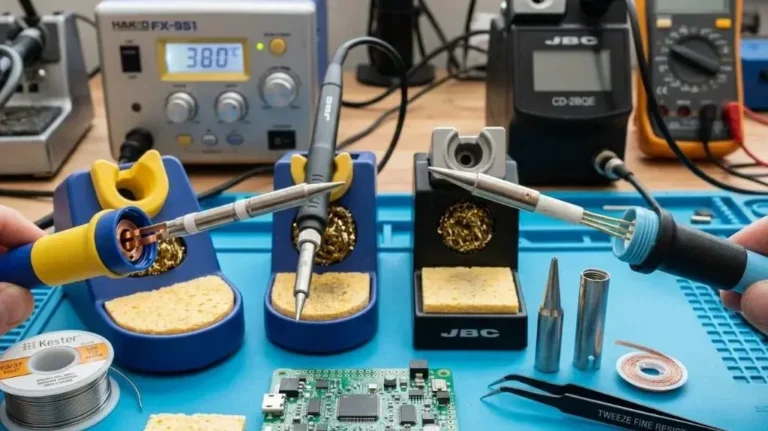
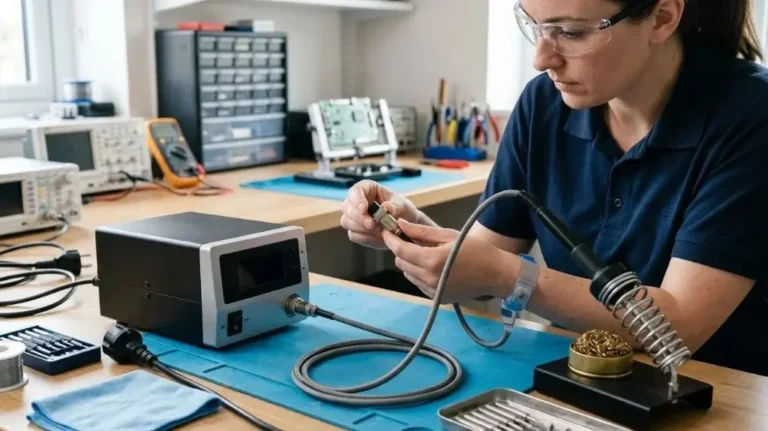
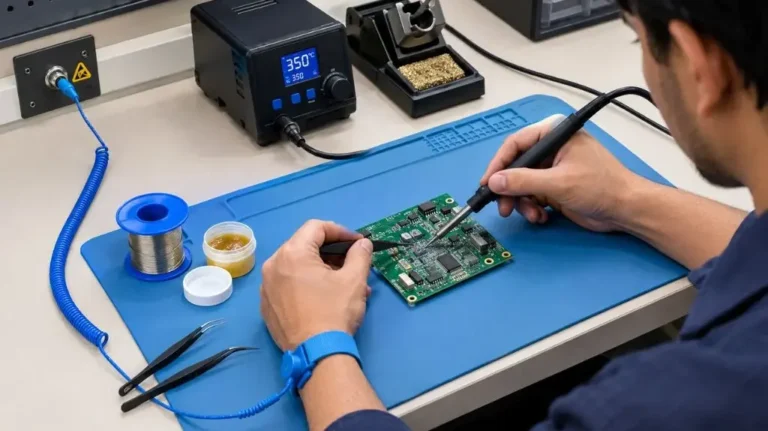
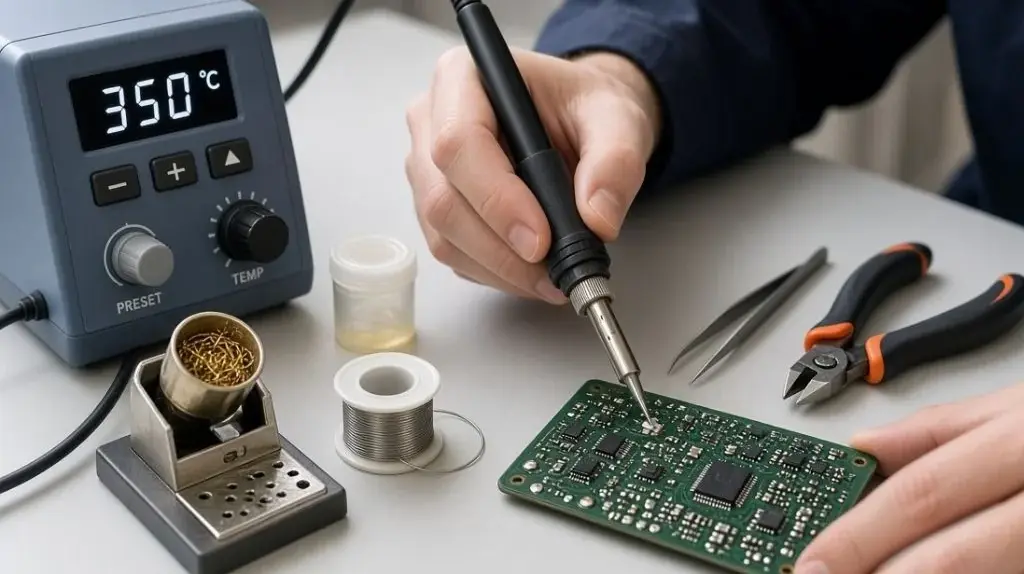
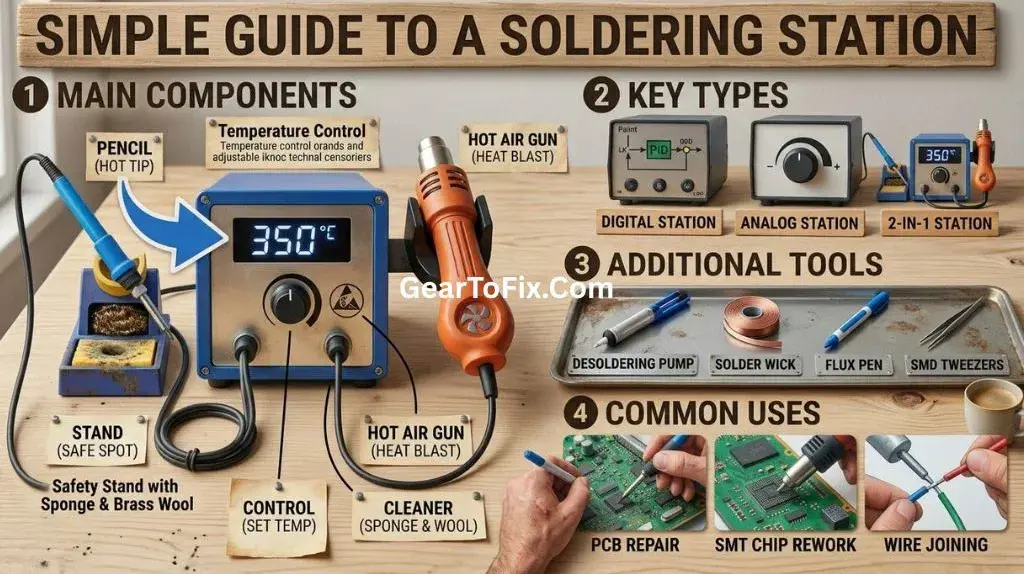
A typical station includes a control base, soldering handpiece, replaceable tip, holder, and cleaning equipment. Some advanced models may also include hot-air rework, desoldering, or other functions. Soldering stations are commonly used for circuit-board repair, electronics assembly, wiring, hobby projects, and maintenance work.
How a Soldering Station Works
A soldering station transfers controlled heat from an electrical heating element to a removable metal tip. The tip then melts solder at the joint, allowing the solder to flow between the surfaces being connected.
The control unit supplies power to the handpiece and regulates its temperature. Many stations use a sensor near the heating element to detect temperature changes. If the tip cools when it touches a large joint or connector, the station can increase power to recover the selected temperature.
This temperature regulation is the main difference between a controlled station and a basic plug-in soldering iron.
The general process works like this:
- The station sends electrical power to the heating element.
- The heating element warms the soldering tip.
- A sensor measures the temperature or detects changes in heat.
- The control unit adjusts power to maintain the selected setting.
- The hot tip transfers heat to the workpiece and melts the solder.
The exact heating method and control system vary by design. Some stations use a separate heating element inside the cartridge or tip, while others place the heater farther back in the handpiece.
Main Parts of a Soldering Station
Although designs differ, most soldering stations contain several basic components.
Control Base
The control base is the main unit that connects to the power supply and manages the soldering temperature. It may have a dial, buttons, or a digital display.
Depending on the model, the base may provide:
- Adjustable temperature control
- Temperature display
- Power switch
- Sleep or standby settings
- Temperature presets
- Calibration functions
- Tip temperature monitoring
- ESD protection for sensitive electronics
The control base may be compact for bench work or larger when it supports multiple handpieces and functions.
Soldering Handpiece
The handpiece is the part held during soldering. It contains the heating element, temperature sensor, electrical connections, and tip mounting system.
A comfortable handpiece should be easy to grip and light enough for precise work. The distance between the grip and the tip also matters. A shorter distance can make small joints easier to control, while a longer or heavier design may be more tiring during detailed work.
Soldering Tip
The tip is the replaceable metal part that contacts the joint. It transfers heat from the handpiece to the component and solder.
Tips are available in different shapes and sizes, including:
- Conical tips for narrow or precise joints
- Chisel tips for general-purpose work
- Beveled tips for drag soldering and larger contact areas
- Knife-style tips for specialized applications
Tip shape affects heat transfer and access. A very small tip may be useful for fine work but can struggle to transfer enough heat to a larger connector. A larger chisel tip may heat a joint more effectively but can be difficult to position around closely spaced components.
Tip Holder and Cleaning Equipment
Most stations include a holder that keeps the hot handpiece away from the work surface. The holder may also include a brass-wire cleaner or a damp sponge.
A brass-wire cleaner removes excess solder and residue while causing less rapid cooling than a wet sponge. A sponge can also be used, but it should be damp rather than saturated. The preferred cleaning method depends on the station and the user’s working habits.
Power Cord and Connections
The station connects to an electrical outlet, while the handpiece usually plugs into the control base. Some stations include separate ports for additional tools, such as hot-air handles or desoldering guns.
The cables should remain flexible and free from damage. A stiff or damaged cable can make precise work more difficult and may create an electrical or heat hazard.
What Is a Soldering Station Used For?
A soldering station is used wherever controlled heat is needed to create or repair a soldered connection.
Common applications include:
- Attaching wires to circuit boards
- Repairing broken solder joints
- Installing electronic components
- Building hobby circuits
- Soldering connectors and terminals
- Repairing cables
- Assembling kits and small devices
- Reworking components on printed circuit boards
- Joining small electrical contacts
A station is particularly useful when the work requires repeatable temperature control or when the parts are sensitive to excess heat.
For example, a small circuit-board component may need enough heat to form a reliable joint without exposing the surrounding board to unnecessary heat. A properly adjusted station can make that process more controlled than an inexpensive iron with a fixed or poorly regulated temperature.
Soldering Station vs. Soldering Iron
A soldering station and a soldering iron perform the same basic task, but they differ in control, design, and typical use.
| Feature | Soldering Station | Basic Soldering Iron |
|---|---|---|
| Temperature control | Usually adjustable and regulated | May be fixed or less precise |
| Control unit | Separate base unit | Usually built into the handle or cord |
| Heat recovery | Often better, depending on design | Varies widely |
| Tip replacement | Usually designed for interchangeable tips | May use replaceable tips, depending on model |
| Precision | Better suited to controlled electronic work | Suitable for simple or occasional tasks |
| Portability | Less compact because of the base | Often easier to transport |
| Cost | Usually higher | Often lower |
| Best use | Repeated, delicate, or varied soldering | Basic repairs and occasional work |
A basic iron may be sufficient for simple wire repairs or infrequent household projects. A station becomes more useful when temperature adjustment, comfortable handling, and consistent performance matter.
The distinction is not absolute. Some modern soldering irons include electronic temperature control, while some low-cost stations may offer limited regulation. The actual performance depends on the design, heating system, tip compatibility, and control accuracy.
Why Temperature Control Matters
Temperature control helps the user match the heat level to the solder, joint, component, and work surface. Too little heat may produce a weak or incomplete connection. Too much heat can damage components, lift circuit-board pads, melt insulation, or degrade the tip.
Temperature is not the only factor that determines soldering performance. Heat transfer also depends on:
- Tip size and shape
- Joint size
- Material being heated
- Surface condition
- Contact time
- Solder composition
- Presence of flux
- Station power and heat recovery
A station set to a certain temperature does not guarantee that every joint will reach that temperature immediately. A large metal connector can draw heat away from the tip, while a small component may heat quickly.
For this reason, the tip should be appropriate for the joint, and the workpiece should be clean enough for solder to flow properly.
Power, Heat Recovery, and Thermal Performance
Power rating describes how much electrical energy the station can deliver to its heating system. A higher power rating does not automatically mean that a station operates at a higher temperature. Instead, it may help the tool recover heat more quickly when the tip contacts a larger or cooler joint.
Heat recovery is the ability of the station to restore the tip to its working temperature after heat is drawn into the workpiece. Good recovery can make soldering more consistent, especially when working with:
- Ground planes on circuit boards
- Large connectors
- Thick wires
- Metal terminals
- Repeated joints
The practical performance depends on the entire heating system, not just the stated power. Tip construction, sensor placement, control electronics, and the thermal mass of the work all affect how the station behaves.
Common Types of Soldering Stations
Temperature-Controlled Stations
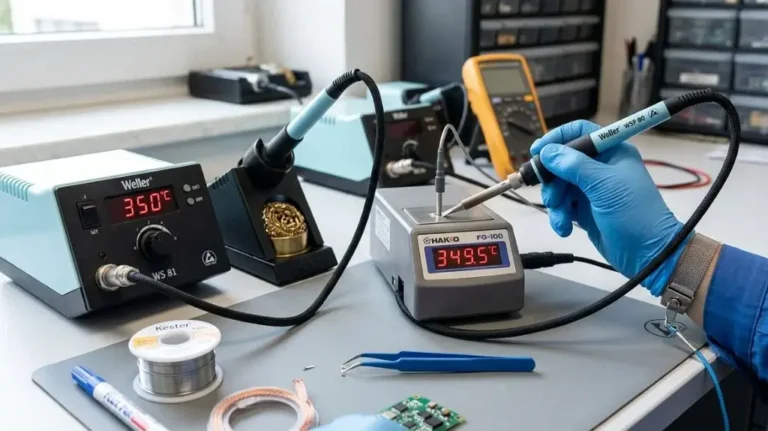
These are the standard type for electronics work. The user selects a temperature, and the control unit regulates power to keep the tip near that setting.
They are suitable for general circuit-board assembly, wire work, repairs, and hobby projects.
Digital Soldering Stations
Digital stations use buttons or controls with a numerical display. They may offer presets, password locks, standby settings, or temperature adjustments in defined increments.
A digital display can make settings easier to repeat, but a display alone does not prove that the station controls temperature accurately. The heating system and sensor design still matter.
Analog Soldering Stations
Analog stations commonly use a dial to adjust the temperature. They can provide effective control without a digital display and may be straightforward to operate.
The markings may be less precise than a numerical display, depending on the design. In practice, the quality of regulation and the suitability of the tip are often more important than whether the control is analog or digital.
Hot-Air Rework Stations
A hot-air rework station uses heated airflow rather than a contact tip. It can warm several points at once and is often used for removing or installing surface-mounted components.
Some combination stations include both a contact soldering handpiece and a hot-air tool. These stations are more specialized and may require additional care because hot air can move small components or heat nearby parts unintentionally.
Desoldering Stations
A desoldering station combines heat with a suction mechanism to remove molten solder. It is useful for clearing through-hole joints and removing components from circuit boards.
A standard soldering station can sometimes be used with separate desoldering tools, but a dedicated station may make repeated removal work easier.
Choosing a Soldering Station
The right soldering station depends on the type of work rather than on a single specification.
Consider the Type of Work
Fine-pitch circuit boards may require a small, precise handpiece and suitable fine or chisel tips. Wiring and larger connectors may benefit from a tip and heating system that can transfer more heat without excessive recovery time.
Think about the work you expect to perform:
- Small electronics and circuit boards
- Larger wires and terminals
- Occasional repairs
- Frequent production or repair work
- Surface-mount rework
- Component removal
- Portable field work
A station designed for delicate circuit work may not be the best choice for large metal connections, and a high-heat setup may be unnecessarily aggressive for small components.
Check Tip Compatibility
Tips are consumable parts, so replacement availability and shape options matter. A station with a broad selection of compatible tips is usually more flexible.
Check whether the tips are easy to replace and whether the available shapes match the work you plan to do. The mounting system should hold the tip securely while still allowing replacement when the tip becomes worn or damaged.
Look at Handpiece Comfort
A station can have good temperature control but still be uncomfortable if the handpiece is heavy, poorly balanced, or difficult to grip.
For detailed work, useful features may include:
- A lightweight handle
- Flexible cable
- Comfortable grip
- Short distance between grip and tip
- Easy tip replacement
- Stable handpiece connection
Comfort matters more during repeated soldering than during a single short repair.
Consider Maintenance Requirements
Soldering tips gradually wear out, especially when exposed to excessive heat, aggressive cleaning, or unsuitable materials. Choose a station for which replacement tips and other consumable parts are practical to obtain.
Maintenance may include cleaning the tip, keeping it properly tinned, inspecting the cord, and removing accumulated residue from the holder or work area.
Basic Soldering Station Safety
A soldering station contains a hot metal tip that can cause burns, ignite nearby materials, or damage surfaces. It should be placed on a stable, heat-resistant work area with the handpiece secured in its holder when not in use.
Follow these basic precautions:
- Keep the hot tip away from skin, cables, plastics, paper, and other flammable materials.
- Use suitable ventilation when soldering, especially when working with flux or solder that produces noticeable fumes.
- Do not touch the tip to check whether it is hot.
- Turn the station off when the work is complete.
- Allow the handpiece and tip to cool before storage or replacement.
- Keep the workspace organized so the cable cannot pull the station or handpiece.
- Use eye protection when trimming component leads or working with solder that may splatter.
- Avoid modifying the station or bypassing its electrical safety features.
Soldering should also be performed with awareness of the materials involved. Some solder and flux products require specific handling, and local rules may affect how certain materials are used or disposed of.
Common Soldering Station Mistakes
Using the Wrong Tip Size
A tip that is too small may not transfer enough heat to the joint. A tip that is too large may contact nearby components or make precise positioning difficult.
Use the smallest tip that can still transfer heat effectively to the joint.
Leaving the Tip Dry
A dry tip does not transfer heat as effectively and can oxidize more quickly. A thin coating of solder on the working surface helps protect the tip and improve heat transfer.
The tip should not be covered in a large blob of solder. It should have enough solder to make efficient thermal contact without creating unnecessary mess.
Setting the Temperature Too High
Higher heat is not always faster or better. Excessive temperature can damage components, lift pads from a circuit board, and shorten tip life.
Use the lowest practical temperature that allows the solder to flow and the joint to form properly. The appropriate setting depends on the solder, materials, joint size, and specific work instructions.
Holding the Tip on the Joint Too Long
If a joint does not heat properly, the solution may be a better tip, cleaner surfaces, or improved contact rather than simply holding the tip in place longer.
Long contact can transfer excessive heat to the component or board.
Using the Station Without Cleaning the Work
Oxidation, dirt, and residue can prevent solder from wetting the surfaces. Cleaning the surfaces and using suitable flux when appropriate can improve the connection.
Do not assume that additional heat will correct a contaminated or poorly prepared joint.
FAQs About What Is A Soldering Station
Is a soldering station better than a soldering iron?
A soldering station is generally more useful for repeated, precise, or temperature-sensitive work because it provides a separate control unit and regulated heating. A basic soldering iron may be adequate for occasional repairs and simple wire connections.
The better choice depends on the type and frequency of soldering rather than on the tool category alone.
Can beginners use a soldering station?
Yes. A soldering station can be suitable for beginners because adjustable temperature control and a stable holder make it easier to work consistently. Beginners still need to learn basic joint preparation, tip care, solder handling, and heat safety.
Starting with simple joints and practicing on scrap components can help build control before working on valuable equipment.
Does a soldering station need special solder?
Not necessarily. The suitable solder depends on the application, materials, joint requirements, and any applicable rules. Solder varies by composition, diameter, and flux type.
The station must be capable of providing enough controlled heat for the selected solder and the workpiece. Always follow the handling guidance provided with the solder and flux.
How often should a soldering tip be replaced?
There is no universal replacement schedule. A tip should be replaced when it no longer transfers heat effectively, becomes heavily pitted or damaged, fails to hold solder properly, or has worn plating.
Proper cleaning, suitable temperature settings, and keeping the tip lightly tinned can extend its usable life.
Can a soldering station damage a circuit board?
Yes, a soldering station can damage a circuit board if the temperature is excessive, the tip is held on the joint too long, or too much mechanical force is applied. Poorly prepared surfaces and repeated rework can also contribute to damage.
Use an appropriate tip, controlled heat, gentle handling, and sufficient but limited contact time.
What is the difference between a soldering station and a rework station?
A soldering station usually refers to a temperature-controlled contact soldering tool. A rework station may include hot-air equipment, desoldering tools, or other functions designed to remove and replace components.
Some products combine both types of equipment, so the exact features depend on the design.
Final Takeaway
A soldering station is a controlled heating system for creating and repairing soldered connections. Its separate control base, adjustable temperature, replaceable tips, and regulated handpiece make it more consistent and versatile than a basic soldering iron.
For occasional simple repairs, a basic iron may be enough. For circuit-board work, repeated soldering, delicate components, or varied joint sizes, a station provides better control and easier adjustment. The most useful features to consider are temperature regulation, suitable power and heat recovery, tip compatibility, handpiece comfort, and the type of work you plan to perform.

Scott Yarnell is a tool expert focused on practical guides, product research, and real-world tool performance to help readers make informed decisions.