How Thermal Recovery Works In Soldering Stations: Explained
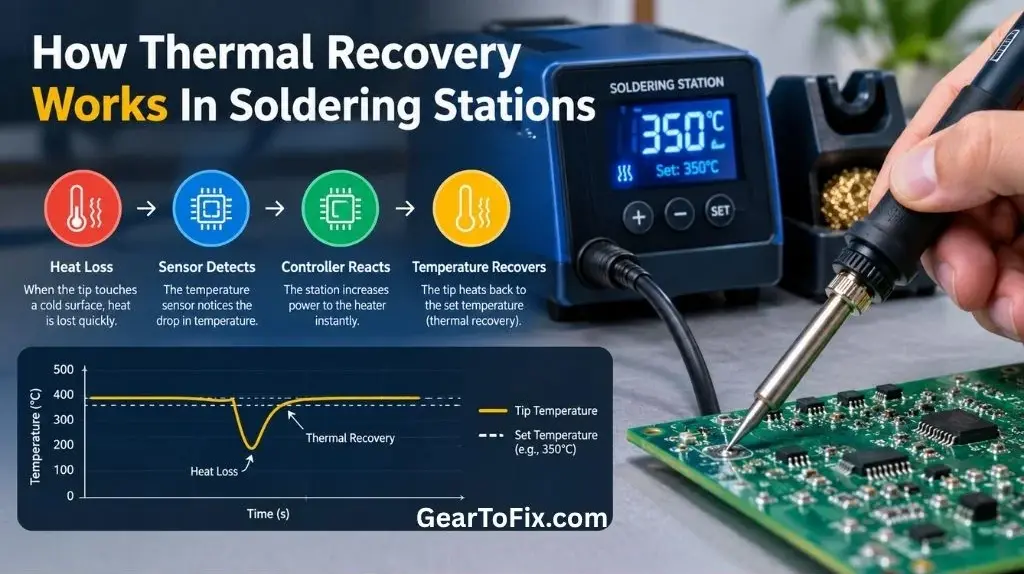
Thermal recovery is the ability of a soldering station to regain its selected tip temperature after heat is pulled away during soldering. When the tip touches a joint, pad, wire, or connector, some of its heat transfers into that workpiece. A station with strong thermal recovery detects the temperature drop and quickly restores the tip to its target range.
This process depends on more than heater wattage. The temperature sensor, control electronics, heater design, tip construction, heat transfer, and the workpiece itself all affect recovery. Understanding these factors makes it easier to choose the right soldering station, avoid overheating, and diagnose inconsistent soldering performance.
What Thermal Recovery Means During Soldering
A soldering iron does not maintain exactly the same temperature every second under all conditions. The tip loses heat whenever it contacts a cooler object, such as:
- A large copper ground plane
- A thick wire
- A connector terminal
- A metal chassis
- A heatsink
- A heavily plated circuit-board pad
Thermal recovery describes how quickly and effectively the station compensates for that heat loss.
For example, a tip set to a particular temperature may cool when it touches a large joint. The station’s sensor detects the change, the control system increases power to the heater, and the tip begins returning toward its selected temperature. Once the target is reached, the controller reduces heater output to prevent excessive heating.
A station with good thermal recovery does not necessarily make the tip feel dramatically hotter. Instead, it helps the tip stay closer to its intended operating temperature while heat is being transferred to the joint.
The Thermal Recovery Process, Step by Step
Thermal recovery is a closed-loop process. The station continually measures temperature and adjusts heater power based on the measurement.
1. The station is set to a target temperature
The user selects a temperature using the station’s control interface. The controller treats this value as the desired tip temperature or as a closely related heater-control target, depending on the station’s design.
The displayed value may not exactly match the temperature at every part of the tip. Temperature can vary along the tip, especially when the tip is small, worn, poorly fitted, or under heavy thermal load.
2. Heat transfers from the tip to the workpiece
When the tip touches a joint, the soldering tip transfers heat into the solder, component lead, pad, or wire. The amount of heat lost depends on the relative temperature, mass, material, and contact area of the objects.
A large copper area can absorb heat much faster than a small component lead. A poorly wetted or oxidized tip may also transfer heat less effectively, causing the user to keep contact longer and increasing the total heat load.
3. The sensor detects a temperature change
A temperature sensor is positioned near the heater or tip. Depending on the station design, it may be integrated into a cartridge, mounted close to the heating element, or located in another part of the handpiece.
The sensor provides feedback to the control electronics. When the measured temperature falls below the control target, the station responds by increasing heater output.
The sensor’s location matters. A sensor close to the working end can detect changes more quickly than one located farther from the tip, although the overall performance also depends on the heater and control system.
4. The controller increases heater power
The control circuit compares the measured temperature with the selected target. If the tip is losing heat, it supplies more power to the heating element.
This may happen through rapid switching or other power-control methods. The exact control method varies by station, but the purpose is the same: deliver enough energy to offset heat loss without allowing the temperature to rise excessively.
5. The tip returns toward its working temperature
As power increases, the heater adds energy to the tip. The tip temperature begins to recover while heat continues flowing into the workpiece.
A well-designed system can respond quickly enough that the tip remains usable during the joint. A weaker system may allow a more noticeable temperature drop, which can result in slower solder melting, longer contact time, or a dull-looking joint.
6. Heater output is reduced near the target
As the measured temperature approaches the selected value, the controller reduces heater output. This limits overshoot and helps stabilize the tip.
The station is not simply switching the heater fully on and fully off according to a timer. It is responding to temperature feedback. That feedback is what distinguishes a regulated soldering station from a basic uncontrolled soldering iron.
Why Thermal Recovery Matters
Good recovery helps maintain consistent heat transfer from one joint to the next. It is particularly useful when working with objects that absorb substantial heat.
A station with effective recovery can provide several practical benefits:
- More consistent solder melting
- Shorter contact time on heat-sensitive assemblies
- Better performance on large terminals and ground planes
- Less need to raise the temperature unnecessarily
- More predictable results during repeated soldering
- Reduced temptation to press harder or hold the tip on the joint too long
Thermal recovery does not eliminate the need for correct technique. A damaged tip, poor flux coverage, inadequate wetting, or an undersized tip can still cause problems even when the station has a strong heater and responsive control system.
The Main Parts That Affect Thermal Recovery
Heater power
The heater supplies the energy needed to replace heat lost at the tip. Higher available power can support faster recovery, but wattage alone does not determine performance.
A station with a powerful heater may still recover poorly if the heat path between the heater and tip is inefficient or if the control system responds slowly. Conversely, a well-designed lower-power station may perform effectively for small electronic work.
Power should be considered together with heater placement, sensor response, tip design, and the intended application.
Temperature sensor location
The sensor must provide useful feedback to the control system. If it is too far from the working end, the station may react slowly to changes at the tip. If it is positioned close to the heat source, it may detect heater temperature well but not reflect the exact temperature at the working surface.
Some modern handpieces place the heater and sensor close to the tip, reducing the distance heat must travel. This arrangement can improve response because the system detects and corrects temperature changes near the point where soldering takes place.
Control electronics
The controller determines how quickly the station responds when the tip cools and how carefully it limits overshoot.
A responsive control loop can increase heater output promptly when the tip contacts a large joint. It must also avoid excessive oscillation, where the temperature repeatedly rises above and falls below the target.
The quality of the control system matters because recovery is not just about producing heat. It is about producing the right amount of heat at the right time.
Tip construction and size
The tip stores and transfers heat. Its shape, mass, plating, and internal construction all affect recovery.
A larger tip may hold more thermal energy and transfer heat effectively to a large joint. A small precision tip may be better for access and control but can lose temperature more quickly when touching a large metal area.
The tip must also fit the handpiece properly. A loose, incompatible, or poorly seated tip can create a weak thermal connection between the heater and the working surface.
Heat transfer through the handpiece
Heat must move efficiently from the heater to the tip. Unnecessary gaps, contamination, corrosion, or poor fit can increase thermal resistance.
Thermal resistance is the opposition to heat flow. When it is high, the heater may be generating substantial power while less of that energy reaches the soldering surface quickly.
This is why a clean, correctly installed tip is part of the recovery system—not merely a consumable accessory.
Thermal Recovery Versus Temperature Stability
Thermal recovery and temperature stability are related but not identical.
Thermal recovery describes how the station responds after heat is removed from the tip.
Temperature stability describes how consistently the tip stays near its target during normal operation, including periods when it is sitting idle or lightly loaded.
A station can have good idle stability but weak recovery under a heavy load. It can also respond quickly but overshoot or fluctuate if its control system is poorly tuned.
For practical soldering, both characteristics matter:
- Recovery helps when the tip contacts a demanding joint.
- Stability helps maintain predictable behavior between joints and during continuous work.
What Determines How Much Heat a Joint Requires?
The required heat depends on the thermal characteristics of the joint, not simply its visible size. Important factors include:
- The mass of the parts being heated
- The material’s thermal conductivity
- The size of the copper area
- Whether the joint is connected to a ground plane
- The contact area between tip and joint
- The tip shape and condition
- The type and amount of solder
- The use of flux
- Air movement around the work area
- The length of time the tip remains in contact
Copper conducts heat away quickly, which is why large copper traces and ground planes can be demanding. A small pad connected to a large copper region may require more heat delivery than a visibly larger isolated pad.
The goal should not be to increase temperature indefinitely. It is usually better to improve the heat path, use an appropriate tip, and apply heat efficiently.
How Tip Choice Affects Recovery
Tip selection has a direct effect on how well heat reaches the joint.
Use enough contact area
A tip that is too fine may touch only a small portion of the joint. Limited contact area restricts heat transfer, even if the station itself has adequate recovery.
A tip with a broader face can transfer heat more effectively to a larger pad, terminal, or wire. The correct shape still needs to fit the work area without touching nearby components.
Match tip mass to the work
Small tips are useful for fine work, but they contain less thermal mass and may cool more quickly when used on large joints. Larger tips generally provide more stored heat and contact area, although they can be unsuitable for crowded or delicate areas.
Keep the tip clean and wetted
A clean, lightly tinned tip transfers heat more effectively than an oxidized or dry tip. Solder on the working surface helps create a thermal bridge between the tip and the joint.
Excessive oxidation can make the tip appear unable to recover because heat is not entering the joint efficiently. The station may be delivering power, but the interface between tip and workpiece remains poor.
Signs of Weak or Poor Thermal Recovery
A temperature display alone cannot fully diagnose recovery performance. Look for behavior during actual work, such as:
- Solder takes noticeably longer to melt after the tip contacts the joint.
- The tip loses its ability to melt solder during repeated work.
- Large pads or terminals require excessive contact time.
- The station appears to heat normally at idle but struggles under load.
- The user must select an unusually high temperature for ordinary joints.
- Solder joints become inconsistent during continuous work.
- The tip appears hot but does not transfer heat effectively.
These symptoms do not prove that the station’s heater or control circuit is defective. They can also result from an unsuitable tip, oxidation, incorrect tip installation, poor solder wetting, or a workpiece that is acting as a large heat sink.
Troubleshooting Slow Recovery
| What you notice | Possible reason | Practical check |
|---|---|---|
| The tip heats slowly from cold | Heater, sensor, power, or control issue | Confirm the handpiece and tip are correctly installed and inspect for obvious damage |
| The tip cools on large joints | Tip too small or joint absorbs substantial heat | Try a suitable larger tip and improve contact technique |
| Solder will not wet the tip | Oxidation, contamination, or insufficient flux | Clean and tin the tip according to the station and tip manufacturer’s guidance |
| Temperature fluctuates at idle | Control, sensor, connection, or calibration issue | Check connections and compare behavior with a known-good compatible tip if available |
| The display looks normal but soldering is poor | Heat is not transferring effectively | Inspect tip fit, tip condition, contact area, and joint preparation |
| Recovery worsens after changing tips | Tip type may be incompatible or poorly seated | Verify compatibility and install the tip correctly |
If the station struggles with every tip and every type of joint, the problem may involve the heater, sensor, handpiece connection, or control electronics. Avoid opening or modifying a mains-powered station unless you are qualified to work safely on that equipment.
How to Improve Heat Recovery During Use
You can often improve practical recovery without changing the soldering station.
- Choose a tip suited to the joint. Use enough tip mass and contact area for the work, while maintaining access and control.
- Clean and tin the tip. Remove oxidation and maintain a small amount of solder on the working surface.
- Make a broad, stable contact. Touch the tip to both the pad and the component lead when the joint permits.
- Use flux appropriately. Flux helps solder wet the surfaces and can improve the heat-transfer interface.
- Avoid excessive pressure. Pressing harder does not reliably increase heat transfer and may damage pads or components.
- Avoid unnecessarily high temperature settings. Excessive heat can damage components, lift pads, accelerate tip oxidation, and degrade solder joints.
- Prepare heat-sensitive assemblies. Sensitive components may require shorter contact time, heat shielding, or a different soldering method.
- Allow the station to reach its operating condition. A station that is still warming up cannot provide its normal control behavior.
The best result comes from balancing temperature, tip size, contact area, and contact time rather than relying on temperature alone.
Does Higher Wattage Always Mean Better Recovery?
No. Higher wattage can provide more available heating capacity, but it does not guarantee better thermal recovery.
Recovery also depends on:
- How quickly the sensor detects a temperature drop
- How close the heater is to the tip
- How efficiently heat travels through the handpiece
- How the controller manages power
- Whether the tip is properly matched to the work
- Whether the station can deliver its rated power under the actual operating conditions
A high-power station with poor thermal coupling may perform less effectively than a well-designed station with a more modest rating. Wattage is best viewed as one part of the station’s thermal system.
Cartridge Tips and Conventional Tip Designs
Some soldering stations use a cartridge in which the heater and temperature sensor are integrated into or positioned very close to the tip assembly. Other designs use a separate heater and replaceable tip.
A closely integrated cartridge can reduce the distance between the heat source, sensor, and working end. This may support fast response and precise control. The exact result still depends on the cartridge construction, controller, tip geometry, and application.
A conventional design can also provide strong recovery when the heater, sensor, tip, and handpiece are well matched. The presence of a cartridge alone does not establish that one station will outperform every other design.
When comparing stations, look at the complete heating system rather than one feature in isolation.
Common Misconceptions About Thermal Recovery
“A hotter setting fixes every recovery problem”
Increasing the set temperature may make solder melt faster, but it does not correct poor heat transfer, an oxidized tip, or an undersized tip. It may also increase the risk of component or board damage.
“The displayed temperature is always the exact tip temperature”
The display is based on the station’s sensing and control system. The working surface can experience local temperature differences, especially under load or when the tip is poorly fitted.
“A large tip is always better”
A larger tip can transfer more heat to demanding joints, but it may be too bulky for fine work. Tip size should match the joint and the available access.
“Recovery means the temperature never drops”
Heat loss is unavoidable when the tip contacts a cooler object. Recovery means the station responds to that loss and returns toward the target effectively; it does not mean the temperature remains perfectly unchanged.
What to Look For in a Soldering Station
If thermal recovery is important for your work, consider the complete system rather than focusing only on the temperature range or wattage rating.
Useful characteristics include:
- Responsive temperature control
- A heater and sensor positioned effectively near the tip
- Tip options appropriate for both fine and demanding joints
- A handpiece that accepts tips securely
- Sufficient power for the largest work you expect to perform
- Replacement tips that are available and suited to the application
- Clear temperature adjustment and status indication
- Stable performance during repeated soldering
For small electronic repairs, precision and tip compatibility may matter more than maximum power. For large connectors, heavy wires, ground planes, or chassis-mounted parts, heat delivery and recovery under load become more significant.
FAQs Of How Thermal Recovery Works In Soldering Stations
What is thermal recovery in a soldering station?
Thermal recovery is the station’s ability to restore tip temperature after heat is transferred into a joint or other workpiece. The sensor detects the temperature change, and the controller increases heater output until the tip returns toward its target.
Why does a soldering tip cool down on a large copper pad?
Copper conducts heat away from the tip quickly. A large pad or ground plane also has greater thermal mass, so it absorbs more energy than a small isolated joint. A larger, properly shaped tip may improve heat transfer.
Is thermal recovery the same as temperature accuracy?
No. Accuracy concerns how closely the station’s measured or controlled temperature corresponds to the intended temperature. Recovery concerns how the system responds when the tip loses heat during use. Both affect soldering performance, but they describe different behaviors.
Can a dirty tip reduce thermal recovery?
Yes. Oxidation and contamination can prevent solder from wetting the tip and reduce heat transfer to the joint. The heater may still be working normally while the joint receives less usable heat.
Does increasing soldering temperature improve recovery?
Not necessarily. A higher setting can provide a greater temperature difference between the tip and the joint, but it does not fix poor tip contact, an unsuitable tip, or a faulty heater. Excessive temperature can also damage components and circuit boards.
How can I tell whether the station or the tip is the problem?
Test the station with a clean, compatible, correctly installed tip on both a small joint and a larger heat-demanding joint. If the behavior improves with a suitable tip, the original tip or technique may be responsible. If every compatible tip performs
Final Takeaway
Thermal recovery in a soldering station is a feedback-controlled process that replaces heat lost from the tip during soldering. The sensor detects a temperature change, the controller increases heater power, and the tip moves back toward its target temperature.
Strong recovery depends on the entire thermal system: heater capacity, sensor position, control response, tip design, heat transfer, and workpiece size. For consistent results, use a clean and compatible tip, choose enough contact area for the joint, apply heat efficiently, and avoid treating higher temperature as a substitute for proper technique.

Scott Yarnell is a tool expert focused on practical guides, product research, and real-world tool performance to help readers make informed decisions.